Download Video Information Modified Date: 2026-06-06 21:11:04 Resolution: 1080 x 2338 File size: 55.28 MB Bitrate: 1223 kbps Duration: 00:06:16 Video codec: h.264/mpeg-4 H.264 Audio codec: ISO/IEC 14496-3 AAC
Reading Time: 61minutes, [10521 words]
The Atlanta Constitution,
Thursday, 7th August 1913,
PAGE 1, COLUMN 1.
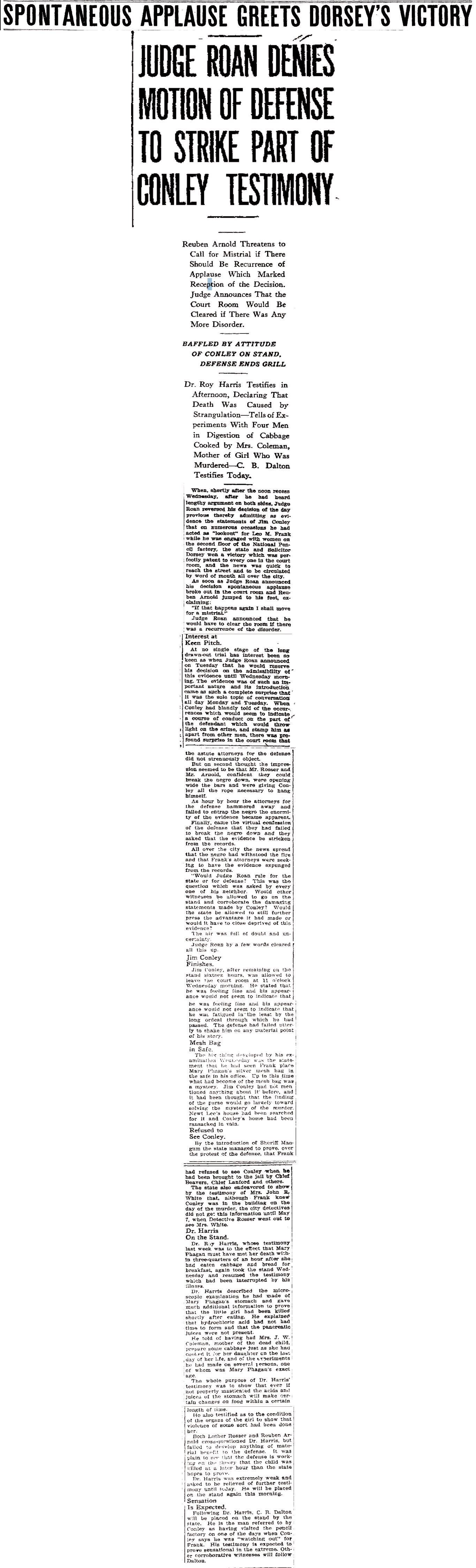
JUDGE ROAN DENIES MOTION OF DEFENSE TO STRIKE PART OF CONLEY TESTIMONY
Reuben Arnold Threatens to Call for Mistrial if There Should Be Recurrence of Applause Which Marked Reception of the Decision.
Judge Announces That the Court Room Would Be Cleared if There Was Any More Disorder.
BAFFLED BY ATTITUDE OF CONLEY ON STAND, DEFENSE ENDS GRILL
Dr. Roy Harris Testifies in Afternoon, Declaring That Death Was Caused by Strangulation Tells of Experiments With Four Men in Digestion of Cabbage
Cooked by Mrs. Coleman, Mother of Girl Who Was Murdered C. B. Dalton Testifies Today.
When, shortly after the noon recess Wednesday, after he had heard lengthy argument on both sides, Judge Roan reversed his decision of the day previous thereby admitting as evidence the statements of Jim Conley that on numerous occasions he had acted as "lookout" for Leo M. Frank while he was engaged with women on the second floor of the National Pencil factory, the state and Solicitor Dorsey won a victory which was perfectly patent to every one in the court room, and the news was quick to reach the street and to be circulated by word of mouth all over the city.
As soon as Judge Roan announced his decision spontaneous applause broke out in the court room and Reuben Arnold jumped to his feet, exclaiming: "If that happens again I shall move for a mistrial." Judge Roan announced that he would have to clear the room if there was a recurrence of the disorder.
Interest at Keen Pitch.
At no single stage of the long drawn-out trial has interest been so keen as when Judge Roan announced on Tuesday that he would reserve his decision on the admissibility of this evidence until Wednesday morning. The evidence was of such an important nature and its introduction came as such a complete surprise that it was the sole topic of conversation all day Monday and Tuesday. When Conley had blandly told of the occurrences which would seem to indicate a course of conduct on the part of the defendant which would throw light on the crime, and stamp him as apart from other men, there was profound surprise in the court room that
PAGE 2, COLUMN 1
the astute attorneys for the defense did not strenuously object.
But on second thought the impression seemed to be that Mr. Rosser and Mr. Arnold, confident they could break the negro down, were opening wide the bars and were giving Conley all the rope necessary to hang himself.
As hour by hour the attorneys for the defense hammered away and failed to entrap the negro the enormity of the evidence became apparent.
Finally, came the virtual confession of the defense that they had failed to break the negro down and they asked that the evidence be stricken from the records.
All over the city the news spread that the negro had withstood the fire and that Frank's attorneys were seeking to have the evidence expunged from the records.
"Would Judge Roan rule for the state or for defense? This was the question which was asked by every one of his neighbor. Would other witnesses be allowed to go on the stand and corroborate the damaging statements made by Conley? Would the state be allowed to still further press the advantage it had made or would it have to be closer deprived of this evidence?"
The air was full of doubt and uncertainty.
Judge Roan by a few words cleared all this up.
Jim Conley Finishes.
Jim Conley, after remaining on the stand sixteen hours, was allowed to leave the court room at 11 o'clock Wednesday morning. He stated that he was feeling fine and his appearance would not seem to indicate that he was fatigued in the least by the long ordeal through which he had passed. The defense had failed utterly to shake him on any material point of his story.
Mesh Bag in Safe.
The big thing developed by his examination Wednesday was the statement that he had seen Frank place Mary Phagan's silver mesh bag in the safe in his office. Up to this time what had become of the mesh bag was a mystery. Jim Conley had not mentioned anything about it before, and it had been thought that the finding of the purse would go largely toward solving the mystery of the murder. Newt Lee's house had been searched for it and Conley's home had been ransacked in vain.
Refused to See Conley.
By the introduction of Sheriff Mangum the state managed to prove, over the protest of the defense, that Frank had refused to see Conley when he had been brought to the jail by Chief Beavers, Chief Lanford and others. The state also endeavored to show by the testimony of Mrs. John R. White, although Frank knew that Conley was in the building on the day of the murder, the city detectives did not get this information until May 7, when Detective Rosser went out to see Mrs. White.
Dr. Harris On the Stand.
Dr. R. Y. Harris, whose testimony last week was to the effect that Mary Phagan must have met her death within three-quarters of an hour after she had eaten cabbage and bread for breakfast, again took the stand Wednesday and resumed the testimony which had been interrupted by his illness.
Dr. Harris described the microscopic examination he had made of Mary Phagan's stomach and gave much additional information to prove that the little girl had been killed shortly after eating. He explained that hydrochloric acid had not had time to form and that the pancreatic juices were not present.
He told of having had Mrs. J. W. Coleman, mother of the dead child, prepare some cabbage just as she had cooked it for her daughter on the last day of her life, and of the experiments he had made on several persons, one of whom was Mary Phagan's exact age.
The whole purpose of Dr. Harris' testimony was to show that even if not properly masticated the acids and juices of the stomach will make certain changes on food within a certain length of time.
He also testified as to the condition of the organs of the girl to show that violence of some sort had been done her.
Both Luther Rosser and Reuben Arnold cross-questioned Dr. Harris, but failed to develop anything of material benefit to the defense. It was plain to see that the defense is working on the theory that the child was killed at a later hour than the state hopes to prove.
Dr. Harris was extremely weak and asked to be relieved of further testimony until today. He will be placed on the stand again this morning.
Sensation Is Expected.
Following Dr. Harris, C. B. Dalton will be placed on the stand by the state. He is the man referred to by Conley as having visited the pencil factory on one of the days when Conley says he was "watching out" for Frank. His testimony is expected to prove sensational in the extreme. Other corroborative witnesses will follow Dalton.
PAGE 1, COLUMN 2
Their Testimony Will Have Direct Bearing on Leo Frank's Case
Photos by Francis E. Price, Staff Photographer.
Left to right: W. H. Mincey, called by the defense to testify that Jim Conley told him he had murdered a girl; Mrs. Emma Freeman, an employee in the pencil factory, who is a witness for the defense, and C. B. Dalton, who was mentioned in story told by Conley on stand. He will testify for state today, and is expected to give sensational testimony.
PAGE 2, COLUMN 1
Unable to Shake Conley's Story
Rosser Ends Cross-Examination
On the opening of court Wednesday morning when Judge L. S. Roan announced that he would postpone his final decision in regard to the admissibility of Jim Conley's evidence in regard to Leo Frank's alleged misconduct and also to the negro's acting as "lookout," on previous occasions Luther Rosser began his final effort to break the negro down.
Conley stayed on the stand until 10 o'clock and was then excused. He had been testifying for fifteen hours in all and of this thirteen hours had been under the merciless grilling of Attorney Rosser.
negro stuck to the last to the main points of his story, and, while admitting that he had lied on previous occasions, swore that he had only tried to save himself and that about the murder he was telling the whole truth. No amount of effort could break him from this declaration.
Reads Black Affidavit.
Mr. Rosser opened the morning cross-examination by reading to the negro the second affidavit he made to Detective John H. Black and Harry Scott. It was in this that the darkey swore he had left home at about 9 o'clock and after visiting several saloons and poolrooms, among which was one bearing the name of the "But In" saloon, he had won 90 cents at dice and then gone to the factory at about 1 o'clock. In it he had admitted to writing the murder notes, but made no mention of helping Frank dispose of the body.
Then the lawyer read the next affidavit in which the negro declared he had aided Frank in taking the dead girl's body to the cellar in which, despite the fact that he had put into it the claim that he was telling the whole truth, he had not told certain things which he waited until he got on the stand to tell.
Mr. Rosser made Conley acknowledge to having made these affidavits and with particular emphasis called his attention to the various discrepancies between them and also between them and the final sworn testimony.
Then the lawyer asked the witness about several conversations he is alleged by the defense to have had with various factory employees after the murder was discovered and before he was arrested.
"Jim," began Mr. Rosser, "soon after the murder weren't you working near where Miss Rebecca Carson was, and did she say to you, Jim, they ain't got you yet for this, and didn't you say, 'No, and they ain't goin' to, cause I ain't done nothin'...'"
"No, sir," replied Jim Conley, "dat lady ain't never said nothing like dat to me and I never said nothing like dat to her."
"Didn't she say, Well, they've got Mr. Frank and he ain't done nothing, and you didn't then say, Mr. Frank is innocent as you say, and de Lord knows you ain't guilty?"
"No, sir," replied Jim positively; "no. Mr. Rosser, wasn't nothing lak dat passed 'tween us."
Denies That He Hid.
"Jim," Mr. Rosser next asked, "weren't you talking to one of the ladies right after the murder and did you say, 'Jim, you did this,' and didn't you lay down your broom and go off to another part of the building?"
"Nothing lak dat ever happened," asserted the witness. "Well, Jim, one day just before you were arrested, weren't you hiding yourself on the second floor, afraid to go downstairs, and didn't you say that you'd give a million dollars to be a white man, in the presence of Mr. Herbert Schiff, and didn't you say that if you were a white man you'd go down the steps?"
"No, sir," replied Jim, "I did say dat I wished I was a white man and dat if I was I'd go on down."
"Didn't you ask Mrs. Dora Small to read an extra to you about that same..."
"...day, and then tell her Mr. Frank was innocent..."
"No, sir," replied Jim, "I never had no talk like dat wid her."
"Didn't you tell Miss Julia Fuss that Mr. Frank was as innocent as an angel in heaven?"
"No, sir, I never said nothing like dat to her lady, either."
Dorsey Takes Witness.
It was then 10 o'clock and Mr. Rosser suddenly announced that he was through with his cross-examination. Solicitor Dorsey declared that he wished to ask a few more questions before Conley was excused.
"Jim," he said, "when you told Mr. Rosser about being in jail where you were kept?"
"I meant at police station," replied Jim.
"What did they put you in jail for, Jim?"
Mr. Rosser objected strenuously, declaring that every negro asked when questioned that answers "for nothin'." After some argument on both sides Judge Roan held that the question might be asked and answered.
Conley then swore that the first time he was put in jail as a boy when he was arrested for throwing rocks, and that the other times he had been for fighting with other negroes and being drunk and disorderly. He declared he had never been in the county jail until after he was placed there following the murder, and that he had never been arrested for a serious offense.
"Did you ever see Frank down there in the jail?" asked Mr. Dorsey.
"No, sir." "Why didn't you?" "Mr. Rosser succeeded in having this ruled out. From the time you were arrested, did you see Frank until the day you came into this courtroom?" asked Dorsey.
"Yes, sir, I seed him at the coroner's court down there at headquarters, and he went by me and lowed his head and smiled." "Was that before you had told on him?" "Yes, sir."
Says Frank Dictated Notes.
"Tell the jury what, if anything, Frank did with your pencil while you were writing the murder notes."
"He stuck the pencil outer my hand and rubbed out the letter 's' I had... ...put at the end of 'negro,'" said Jim.
"Did you ever see the pocketbook or purse or meshbag of Miss Mary Phagan?"
"Yes, sir, I saw it on Mr. Frank's desk after we came back from putting the body in the basement, and he tuck it and put it in his safe," said Jim.
Mr. Dorsey then asked the negro to describe the scream he claims to have heard, but Mr. Rosser succeeded in having it ruled out, claiming that it had been gone into before. "Jim," Mr. Dorsey then asked, "who has asked you the most questions and talked to you the longest, Mr. Black, Mr. Scott, Mr. Sturnes, Mr. Campbell, or myself or Mr. Rosser?"
Rosser got this question declared illegal.
"Well, what was the longest time any of these detectives talked to you?"
"Well, Mr. Rosser dere, don't you means you," said Jim, and the courtroom got itself for the moment until vigorous rapping of deputies restored order.
Conley Causes Laughter.
Conley finally was made to understand that Mr. Rosser, although he had stood that for about two days, did not wear a star and rubber-heeled shoes, and he then stated that Scott and Black had talked to him more than any of the other detectives, and had kept him on one occasion from about 11 o'clock until dark, but he declared that they had given him several rests between talks, and that they actually talked to him about three and a half hours.
"Well, how long did Mr. Rosser talk to you?"
Mr. Rosser had this question ruled out, the solicitor making a vigorous plea that it should get on record how long the negro had been questioned by counsel for the defense.
"There was some moving the body a pretty hard job," said Attorney Rosser's objections to this were overruled. Upon the request of the solicitor Conley then lay down on the floor and illustrated how he had placed the negro's body in the basement, and he also took The Constitution's flashlight picture of the basement and showed exactly where he had placed the body.
"Tell the jury everything you did after you looked at the clock, and saw it was four minutes to one," said Mr. Dorsey.
"Where did Mr. Frank wash his hands?"
Conley indicated on the diagram a spot near the office.
"What was your going about to Brooklyn?"
"Mr. Frank never said nothing about going to Brooklyn; he said he was going to send me away," replied Jim.
Denies Seeing Mincey.
"Did you ever have a talk with W. H. Mincey?"
"Never except that day he came to the station house when he come there."
"Jim, on the night you were put in jail, what did the newspaper men ask you?" said Mr. Dorsey.
"They just talked to me, an' one of them offered me a paper," said Jim.
At this juncture Mr. Dorsey requested that Harlee Branch and Harold W. Ross, two reporters at the press table, leave the courtroom. When they left he continued:
"What did you say to Mr. Schiff?"
"How long have you known Mr. N. V. Darley?"
"Ever since he come to the factory."
"Did Mr. Schiff and Mr. Darley know that you could write?"
Mr. Rosser entered an objection to this, and in reply Mr. Dorsey said: "Your honor, while this negro was in jail and the National Pencil Factory had employed detectives to find the murderer, and while he was claiming that he could not write, these men knew that these detectives wanted Conley. It's not in evidence that these men knew the detectives."
"I can prove it by those two newspaper men," replied Mr. Dorsey, "and yet these two men connected with the pencil factory concealed the fact that this negro could write."
Evidence Ruled Out.
Judge Roan ruled that Mr. Dorsey could not introduce the evidence to show that Schiff and Darley knew that Jim could not write, and introduce his evidence to show that the two factory employees knew the detectives desired him to write. The two newspaper men were then allowed to to re-enter the room.
"Jim, can you write 'luxury?'"
"Yes, sir," replied Jim, "they had boxes with that on 'em at the factory and when they gave out I had to write it down and give it to Mr. Frank so he would know to order some more."
"Did he furnish the paper for you to write on?"
"Yes, sir."
It was now 10:50 o'clock and Mr. Rosser again took up the cross-examination for a few questions.
"Did Mr. Frank have the dead girl's meshbag on his desk when you came back from the basement Jim?"
"Yes, sir."
"He put it in his safe and locked the door, did he?"
"He put it in the safe," said Jim, "but I dunno whether he locked the door or no."
Mr. Rosser then went into much detail about the various times that detectives and the state's lawyers had talked to Conley about the crime. He had to explain to Jim what was meant by the state's lawyers.
"Jim," he next asked, "how long had you been caring for the boxes?"
"'Bout a year," said Jim.
"So Mr. Frank knew for over a year that you could write?"
"I reckon he did," said Conley; "I'd been writing down the things about the boxes and givin' 'em to him that long."
A New, Simplified Method.
It was at this juncture that Conley, prompted by Attorney Rosser, introduced to the world an absolutely new method of spelling, and one that would put A. Carnegie and T. Roosevelt to shame should they ever learn that a man with no education had introduced it.
The exemplification of the new method began with "Uncle Remus," a word known and loved by Carnegie himself. It happened that Jim said that the National Pencil company used this as a trade name for one of their brands of pencils.
"How do you spell 'Uncle Remus,' Jim?" Mr. Rosser asked.
"Well, I kin spell it," replied Jim.
"Go ahead," he was urged.
"O-n," said Jim.
"Well, does that spell 'Uncle?'" asked Mr. Rosser.
"Yes, sir."
"Well, spell 'Remus.'"
"R-i-m-e-s-s-," said Jim proudly.
"That's fine, Jim. Now, spell 'luxury.'"
It was here that the new system reached its climax.
"L-u-s-t-r-i-s," Jim replied.
"All right, Jim. Now, spell 'Thomas Jefferson,'" urged Mr. Rosser, that being also a trade name of the pencils.
"T-o-m-a-i-s, Thomas," said Jim.
"Go ahead."
"J-a-s-s-," finished Jim.
Leo Frank was laughing by this time and deputies were frowning and threatening to eject certain spectators from the courtroom.
Conley wound up the spelling bee by declaring that "Joe Wishton" was the orthodox way of spelling the name of the man who made the cherry tree famous.
"Jim," next asked Mr. Rosser, "wouldn't you sometimes write Mr. Frank a note in order to draw on your wages?"
"Yes, sir; I'd write out, 'Please let me have 50 cents,'" replied the negro.
"And you'd say, 'An' take it out of my wages,' wouldn't you?" the questioner added.
"No, sir; I couldn't write out all dat last part. Mr. Frank he'd know where to take hit fum."
Mr. Dorsey then put a few minor question and after these Mr. Rosser asked the negro if Schiff did not have charge of the boxes instead of Frank. Conley declared that Frank had charge of them.
It was 11:14 o'clock when the negro finally left the stand.
PAGE 2, COLUMN 4
Mary Phagan Was Strangled Declares Dr. H. F. Harris
Dr. Roy F. Harris, the pathologist, head of the state board of health, and the expert who exhumed and examined the body of Mary Phagan, went on the stand at the close of the argument over Judge Roan's reserved decision to continue the testimony from which he was interrupted Friday by a fainting spell in the courtroom.
He still suffered from weakness and was allowed to sit in a heavily-upholstered armchair.
He was questioned first by Solicitor Dorsey.
"Dr. Harris, what is your particular branch of medicine?"
"My usual line is pathology, chemistry and chemical work, as well as diagnosis."
"Can you indicate the signs of what you saw on Mary Phagan's body which showed strangulation?"
Died by Strangulation.
"It was out of the question that her death was caused by a blow on the head it was not sufficient to even produce noticeable pressure. The only thing evident from which death could have resulted was the deep indentation along the throat, obviously inflicted during life. There were other signs as well the protruding tongue, congested blood in the face and hands, all of which indicated that strangulation had caused death."
"Did you notice the larynx?"
"Yes; there seemed no damage done."
"Did you see the windpipe?"
"Yes."
"Did you take it out?"
"No; there seemed but little damage to it. I did not remove it because I did not want to mutilate the poor child any more than necessary."
"Did you see the lungs?"
"Yes, but the lungs were congested, due to the use of formaldehyde used in embalming."
The solicitor asked the defense for the bloody stick found by Pinkertons on May 10 in the pencil factory. It was produced and shown to the physician.
"Do you think the blow you found on the child's head could have been inflicted by a cudgel like this?"
"In my opinion, I would think not the gash evidently was inflicted with some sharp instrument."
"Did you make a scientific examination of the female organs?"
Violence Before Death.
"Yes; I made a microscopic examination."
Dr. Harris at this point testified as to the condition of the organs of the girl to show that violence of some sort had been done her.
Following these questions Dr. Harris was asked regarding certain experiments he had made on digestive organs relative to their action upon cabbage. He had started to detail a test he had made twelve years ago, when Rosser objected to his personal experience being put before the jury.
"This witness is testifying to a science which directly concerns this case," said the solicitor, "and I submit that it is absolutely relevant and admissible."
"There is no doubt that if Dr. Harris was the only man in the world who had made this experiment there would be an objection to his stating it by the defense."
"You can give the results of your experiment or authority in the subject," ruled Judge Roan.
Only One to Make Experiment.
"I know of none other who have made this experiment," said the doctor, "and therefore I decided to make it myself. The stomach frees itself quickly of cabbage and bread. It frees itself as quickly of cabbage as it does of a mixture of the two."
"As soon as I saw the peculiar relation of cabbage to this case I knew the girl had come to her death or to unconsciousness at the time digestion was stopped."
At this juncture the witness was stopped by Mr. Rosser, who declared that the expert must give, or detail, the science of his statement.
"If that cabbage had been on my stomach," said the attorney, "it would stay there until tomorrow."
The solicitor protested to the objection, saying that Dr. Harris had already stated he was the only man who had ever made such an experiment.
It was following this assertion that the first injection of the Grace case was made into the Frank trial. Attorney Hooper brought comparison by reminding Judge Roan of a decision he had made in the famous case following an experiment by two marksmen with revolvers at police headquarters during course of the trial.
"Two men, who were not experts," said Mr. Hooper, "went to police headquarters and, with pistols, determined the distance required to inflict powder marks upon a white cloth. There were no experts in the test, but there was an experiment, on which your honor ruled favorably."
"You can give the science of your experiment, Dr. Harris," ruled Judge Roan, "without disclosing the process by which your knowledge was gained."
Girl's Stomach Normal.
Following which came a declaration by Dr. Harris that the girl's stomach was normal.
The defense frequently asked Judge Roan for rulings to objections which they made. In each instance it was specifically requested that particular note be made of it in the records. It was obvious that foundation was being laid for appeal for new trial.
During the course of an argument which followed an objection to certain parts of the expert's testimony Attorney Rosser accused the witness of being intensely argumentative.
Dr. Harris continued:
"I recently experimented with four persons with cabbage cooked by Mrs. Coleman and in each case the effect upon them was the same, that is, pertaining to digestion. The results also were the same as found in Mary Phagan's body."
At this Dr. Harris attempted to display the vials of cabbage removed from the stomachs of the men on whom he had made the experiment. Attorney Rosser voiced objection.
"I want to show," argued the solicitor, "that the stomach of Mary Phagan was normal, and that the cabbage discovered in her body was undigested. It is possible that this expert cannot explain his experiment and to show comparisons revealing that this cabbage was cooked alike, swallowed alike and chewed alike by the men on whom Dr. Harris made the experiment."
He was sustained.
Dr. Harris continued:
"Mary Phagan's stomach was normal in size, development and position in fact, it was normal in every particular."
Believes Doctors Are Guessing.
At this, Mr. Rosser insisted that Dr. Harris tell his reasons for knowing these facts.
"I don't know what the doctor means about this and about that," he said, "for I think all these doctors are guessing most of the time."
Judge Roan cautioned the witness to tell purely all he found in his examination.
"I found in Mary Phagan's case," he said, "that even the particles finely chewed were not digested at all. Digestion had not gone on to any extent at the time of death or unconsciousness."
It was while he was attempting to explain one of his own theories relating to this condition Dr. Harris was interrupted by Mr. Rosser, who said:
"You should not give your opinion, doctor, nor make any stump speeches."
"It was clear that this cabbage had not entered the smaller intestines," continued the witness, "which showed that the contents of the stomach had not been pressed into the intestines at the time of death."
"Also the amount of gastric juice in this case was less than would have occurred in an hour in an ordinary case. Hydrochloric acid forms at certain periods of digestion, and had not formed in this case of Mary Phagan. There was no free hydrochloric acid, but there were 32 degrees of combined hydrochloric acid."
Girl Dead in Forty Minutes.
"In this case, the combined hydrochloric was about the amount one would suppose to exist within thirty or forty minutes. I have assumed that the girl, after she ate, was dead within that length of time thirty or forty minutes."
"Another question is the pancreatic juice would make its appearance in the stomach and intestines within that period. It was absent in this case."
"Was failure to digest cabbage due to its condition?" asked the solicitor.
"No, the digestive fluid was there."
"Was there any obstruction in the flow of the stomach's contents?"
"None."
"Would a blow or struggle check the process of digestion?"
"Yes."
"Had digestion up the time of death progressed favorably?"
"Yes. Her digestion was normal."
"Dr. Harris, will you please give the jury some idea of the power of magnification your microscope projected upon the stomach in your examination?"
"My microscope is the finest made. It could have enlarged objects thousands of times."
"How did the state of bread correspond to the state of the cabbage?"
"Just the same."
"Suppose it had been chewed up entirely, would that have had any effect?"
"No; the effect would have been the same."
At this point Attorney Arnold took up the cross-examination.
"Where did Mr. Dorsey first talk to you about this matter?" he asked.
"I don't recall."
Asked Him to Keep Silent.
"Did Mr. Dorsey request you not to make the result of this examination public?"
"Yes, sir. I told him I would take the case and go into it thoroughly. There was some suggestion of poison, and I made an examination for poison, but none was found."
"Couldn't a man be dying and all the appearance in this case be produced by putting a cord around his throat?"
"I think not."
"A man might be dying from strangulation for an hour, mightn't he?"
"Yes."
"Having explained, doctor, that death by strangulation was more the result of the body retaining poisons than from the failure to get oxygen, you still state that is correct, eh?"
"Yes."
"If breath was cut off completely, how long before a man would die?"
"No one has ever been able to ascertain definitely."
"You say your first intention was to examine Mary Phagan's body for poison?"
"Yes."
"What kind of poison?"
"Alcaloid."
"What else?"
"Strychnine or morphine."
"Was there any arsenic in Gheesling's embalming formula?"
"Yes."
Made the Opium Test.
"What test did you make for poison?"
"The opium test."
"Did you test for mercury?"
"Not directly."
"For what mineral poisons did you test?"
"I did not test for mineral poisons."
"Did you make the poison tests before you made the others?"
"I made them all at the same time."
"In how many parts did you divide the contents of the stomach?"
"I divided them into all parts necessary; I do not recollect the exact number."
"How many tests did you make?"
"Six or eight in all, all of which were necessary."
"What was the first test?"
"To determine various quantities."
"What was the second?"
"For hydrochloric acid."
"How do you measure hydrochloric acid?"
"By degrees."
"How many drops would 32 degrees form?"
Dr. Harris figured for several minutes on his notebook, multiplying, dividing, saying finally:
"About a drop and a half."
this part is immaterial."
"We've shown that Frank knew of this disclosure on April 28 and now we expect to show that although Detective Bass Rosser questioned this woman here on that same day that she refused to disclose this information to him or to any detective working for the state," said Mr. Dorsey, "and that the state never knew of it until May 27."
"Scott had been told by Frank," snapped Mr. Rosser, "and he had declared that he was working in conjunction with the police."
"I want to show that this woman, closely connected with employees of the National Pencil factory, concealed this important evidence from the detectives representing the state," answered the solicitor. By this time Mrs. White was swelling up and almost crying as she sat on the witness stand and listened to implications that she had tried to conceal evidence from the state and had not told the whole truth to the authorities.
"Did you ever try to conceal anything, Mrs. White?" Mr. Rosser inquired of her.
"No, sir. I never did," she replied. She was then allowed to leave the stand.
Sheriff Mangum on Stand.
Sheriff C. Wheeler Mangum was then sworn in and put upon the stand by the solicitor.
"Were you at the jail when Conley went there and asked to see Frank?" the solicitor asked.
"Yes, sir."
"Did you talk to Frank about his seeing Conley?"
"Yes, sir."
Mr. Rosser then objected, declaring that it was inadmissible to show whether or not Frank wanted to see anyone.
"Your honor," said Mr. Dorsey, "I want to show that for the first time in the history of the white race a white man, claiming innocence, refused to confront his accuser, and particularly that this accuser was only an ignorant negro."
Judge Roan sustained the state.
"I told Mr. Frank that Chief Beavers and Detectives Lanford, Scott and Black were out there with Conley and wanted to know if he would talk to the negro," said the sheriff.
"What did he say?"
"He said he did not; that none of his lawyers were there and no one to defend " Here the sheriff paused.
"Did you say he said he had no one there to defend him?" Mr. Dorsey asked quickly.
Sheriff Mangum paused and then said, "He said he had none of his lawyers there to listen to what might be said."
"Did he use the word 'defend'?" questioned the solicitor.
"No he said he didn't want anybody to see him unless his lawyers were there."
The name of Mrs. J. W. Coleman, mother of Mary Phagan, and of George Epps, the little newsie with whom she is said to have ridden to town that day, were then called, but neither answered.
Jury Sent Out of Courtroom.
"Your Honor," Mr. Dorsey then announced, "we want to put these witnesses up and they are practically all with the exception of Dr. Roy Harris, whom I can't reach until 2 o'clock. I want to ask that the jury be sent out, as I have something to say to the court which might better be said in their absence."
When the jury retired the solicitor announced that he wanted to make three points.
"First, we want to protest against ruling out that part of Conley's testimony which refers to Frank's previous misconduct at the times the negro acted as his 'lookout.'
"Second, we want to introduce witnesses to sustain what Conley said about this.
"And third, we want to put George Epps back on the stand to let him testify that Mary Phagan told him that morning on the car as she was on her way to the factory that Frank had pinched her and made eyes at her and that she was afraid of him."
"As to the boy's testimony," said Mr. Arnold, "we would have to hear him testify before we could talk about that; we don't know that he would say exactly what our friend, Dorsey, has just stated."
Mr. Arnold then entered into his reasons for holding that that part of Conley's testimony about Frank's alleged misconduct on previous occasions was not admissible.
The matter was argued by both sides, Mr. Arnold claiming that in no English-speaking countries was a man's past conduct ever put up against him, and Mr. Dorsey declaring that such evidence in this case was admissible to show his tendency to this particular crime.
It was now 12:45 o'clock and Mr. Arnold stated that he was so weak and hot that he could go no further. He was given a glass of water and allowed to remain seated while he addressed the judge, and went on.
A few minutes later court adjourned.
Mrs. Coleman Tells of Cooking Cabbage for Dr. H. F. Harris
Mrs. J. W. Coleman, mother of Mary Phagan, followed Dr. Harris to the stand. She told of cooking an amount of cabbage at the chemist's request for his experiments with the four men.
She stated that it had been ground finely, as she had prepared it on the day of Mary's last meal, and had
Only Chemical Acids.
"What are the properties of free acid?"
"Chemical acid only."
"Hydrochloric acid is a powerful property, isn' tit?"
"Very powerful."
"The average man has how many degrees?"
"Fifty-five or sixty degrees three or four drops."
"What is the next juices of importance to the digestive organs?"
"Pepsin."
"How much pepsin should there be to correspond with 32 degrees hydrochloric acid?"
"Unfortunately we have no accurate way of determining the measurements of pepsin."
"Do different stomachs and glands produce various quantities of pepsin and hydrochloric acid?"
"Yes, there has been much argument on the subject."
"Where does the pepsin come from that we get at soda founts?"
"From cows and animals."
It is purely an animal substance, then?"
"Yes."
"What becomes of the juices in the body after death?"
"They evaporate gradually."
"Embalming removes most of the fluids, doesn't it?"
"Yes."
Come From the Stomach.
"Gastric juices all come from the stomach, don't they?"
"Yes."
"How long, doctor, is the small intestine of which you speak?"
"About twenty-five feet."
"Did you find any of the cabbage in Mary Phagan's body to have been mulsified?"
"Yes, I've already explained that."
"What were the proportionate parts in her stomach?"
"Ninety per cent water, 10 per cent solid."
"The important constituents, then, are in the solid, as the fluid amounts to but little?"
"Yes."
"Is cabbage nourishing?"
"About as much as any other vegetable. No vegetable has any great amount of nourishment."
"What gastric juice is created by the mouth?"
"Saliva."
"Is that a digestive property?"
"Yes."
"What chemical properties are in saliva?"
"It helps digest the starch that goes into the stomach."
Here Dr. Harris became slightly ill, and, at his request, was removed from the stand.
PAGE 3, COLUMN 1
Applause Sweeps Courtroom When Dorsey Scores a Point
Following Conley's departure from the stand the jury was allowed a five-minute recess and on their return Solicitor Dorsey tendered in evidence a picture of the pencil factory basement which was taken by Francis E. Price, The Constitution staff photographer, on the morning that the body was found and a cut of which appeared in The Constitution. He also tendered a scratch pad, sample of one of those around the factory, the murder notes and the pad found near the body.
There were no objections from the defense.
"Bring in C. B. Dalton," called out the solicitor. Dalton is the man named by Conley as having gone into the factory with Frank when the latter chatted with women and had Conley act as "lookout." Dalton took his place on the stand, but was excused, because the judge had not made his final decision with reference to the protested Conley testimony, and Mrs. John Arthur White was called in.
Conley was brought back and Mrs. White was asked if he was the negro she claimed to have seen on April 26 concealed behind some boxes on the first floor of the factory.
She could not say that he was or was not, but declared that he looked more like the man than anyone else she had seen and that he was about the same stature. The defense entered frequent objections while this was being brought out.
"Mrs. White," the solicitor then asked, "on April 28 didn't you tell your brother, Wade Campbell, an employee of the pencil company, that you had seen a negro there on the previous Saturday?"
Mr. Rosser objected.
"Your honor," said Mr. Dorsey, "I'm going to show that this woman, wife of one employee of the National Pencil company and sister and daughter of two others, did tell that to her brother, but on the same day concealed it from detectives working for the state. We can show that although Frank knew this and told Scott, of the Pinkertons, employed by the National Pencil company, about it, that he concealed it from the detectives working for the state when he was telling what he knew about the people there that day, and at other times, too."
Record Proves Dorsey Correct.
"How can you prove that Frank knew it, or that he told Scott?" thundered Attorney Rosser.
"It's in the record, as part of Scott's testimony," said the solicitor.
"It is not," replied Rosser.
Mr. Dorsey's motion the court stenographer produced his official record of Scott's testimony. Mr. Rosser took it from him and began to search through it for the statement. It had already been transcribed to typewritten form, and while Mr. Dorsey entered objection after objection of Mr. Rosser's keeping it, the latter calmly searched for it while his colleague, Mr. Arnold, stated in answer to Mr. Dorsey that they would give it to the state in a few minutes.
"Well, Mr. Dorsey's right for once," Mr. Rosser then said quietly.
The record showed that Harry Scott, of the Pinkertons, had sworn to being told by Frank on April 28 of what Mrs. White had disclosed about the presence of a negro.
Applause Sweeps Courtroom.
It was at this moment that something occurred that had never occurred before during the progress of the trial. A burst of applause swept through the courtroom and several people clapped their hands loudly as though applauding at the theater something that met their approval. The deputies immediately began rapping for order and Judge Roan announced from the bench that such actions would not be tolerated. When order was restored Mr. Rosser objected to another phase of the subject.
"Now Mr. Dorsey wants to show that this didn't get to the police authorities until May 27, and I claim this part is immaterial."
"We've shown that Frank knew of this disclosure on April 28 and now we expect to show that although Detective Bass Rosser questioned this woman here on that same day that she refused to disclose this information to him or to any detective working for the state," said Mr. Dorsey, "and that the state never knew of it until May 27."
"Scott had been told by Frank," snapped Mr. Rosser, "and he had declared that he was working in conjunction with the police."
"I want to show that this woman, closely connected with employees of the National Pencil factory, concealed this important evidence from the detectives representing the state," answered the solicitor. By this time Mrs. White was swelling up and almost crying as she sat on the witness stand and listened to implications that she had tried to conceal evidence from the state and had not told the whole truth to the authorities.
"Did you ever try to conceal anything, Mrs. White?" Mr. Rosser inquired of her.
"No, sir. I never did," she replied. She was then allowed to leave the stand.
Sheriff Mangum on Stand.
Sheriff C. Wheeler Mangum was then sworn in and put upon the stand by the solicitor.
"Were you at the jail when Conley went there and asked to see Frank?" the solicitor asked.
"Yes, sir."
"Did you talk to Frank about his seeing Conley?"
"Yes, sir."
Mr. Rosser then objected, declaring that it was inadmissible to show whether or not Frank wanted to see anyone.
"Your honor," said Mr. Dorsey, "I want to show that for the first time in the history of the white race a white man, claiming innocence, refused to confront his accuser, and particularly that this accuser was only an ignorant negro."
Judge Roan sustained the state.
"I told Mr. Frank that Chief Beavers and Detectives Lanford, Scott and Black were out there with Conley and wanted to know if he would talk to the negro," said the sheriff.
"What did he say?"
"He said he did not; that none of his lawyers were there and no one to defend " Here the sheriff paused.
"Did you say he said he had no one there to defend him?" Mr. Dorsey asked quickly.
Sheriff Mangum paused and then said, "He said he had none of his lawyers there to listen to what might be said."
"Did he use the word 'defend'?" questioned the solicitor.
"No he said he didn't want anybody to see him unless his lawyers were there."
The name of Mrs. J. W. Coleman, mother of Mary Phagan, and of George Epps, the little newsie with whom she is said to have ridden to town that day, were then called, but neither answered.
Jury Sent Out of Courtroom.
"Your Honor," Mr. Dorsey then announced, "we want to put these witnesses up and they are practically all with the exception of Dr. Roy Harris, whom I can't reach until 2 o'clock. I want to ask that the jury be sent out, as I have something to say to the court which might better be said in their absence."
When the jury retired the solicitor announced that he wanted to make three points.
"First, we want to protest against ruling out that part of Conley's testimony which refers to Frank's previous misconduct at the times the negro acted as his 'lookout.'
"Second, we want to introduce witnesses to sustain what Conley said about this.
"And third, we want to put George Epps back on the stand to let him testify that Mary Phagan told him that morning on the car as she was on her way to the factory that Frank had pinched her and made eyes at her and that she was afraid of him."
"As to the boy's testimony," said Mr. Arnold, "we would have to hear him testify before we could talk about that; we don't know that he would say exactly what our friend, Dorsey, has just stated."
Mr. Arnold then entered into his reasons for holding that that part of Conley's testimony about Frank's alleged misconduct on previous occasions was not admissible.
The matter was argued by both sides, Mr. Arnold claiming that in no English-speaking countries was a man's past conduct ever put up against him, and Mr. Dorsey declaring that such evidence in this case was admissible to show his tendency to this particular crime.
It was now 12:45 o'clock and Mr. Arnold stated that he was so weak and hot that he could go no further. He was given a glass of water and allowed to remain seated while he addressed the judge, and went on.
A few minutes later court adjourned.
PAGE 3, COLUMN 3
Mrs. Coleman Tells of Cooking
Cabbage for Dr. H. F. Harris
Mrs. J. W. Coleman, mother of Mary Phagan, followed Dr. Harris to the stand. She told of cooking an amount of cabbage at the chemist's request for his experiments with the four men.
She stated that it had been ground finely, as she had prepared it on the day of Mary's last meal, and had boiled it for an hour. She remained on the stand but for a few minutes, and was asked but a few questions by either the state or defense.
She was asked to describe Mary's pocketbook, answering that she had already given a description when she first went upon the stand at the opening of the trial.
PAGE 3, COLUMN 3
Because He Is Patriotic Mincey Is Here for Trial
W. H. Mincey, witness for the defense in the Leo M. Frank trial, whose substantial affidavit that Jim Conley had told him of killing a white girl on the day Mary Phagan was murdered, was published some weeks ago, was a conspicuous figure in front of the courthouse Wednesday.
Mincey is a country school teacher and has been for twenty years. He is not used to city ways, he says, and the excitement of the crowd around the courthouse seemed to worry him.
"I have great patriotism," said Mr. Mincey, "and that is the sole reason I am here. I felt it was my duty to throw any light I could on the case. No, I will not talk at the present time. I'll do my talking when I get on the stand."
PAGE 3, COLUMN 3
Judge's Decision Admits
Conley Testimony in Full
At the continuation of the argument on the subject of Judge Roan's reserved decision, Solicitor Dorsey cited extracts from many legal volumes, many of which pertained to the untimeliness of objections in just such cases as the one which he argued.
"It makes no difference if the act in question was a separate or distinct crime," he said, "just so it shows a course of conduct, and has sufficient probity value to the case on trial. It is absolutely admissible.
"We contend that the defense has stopped at this late hour, after examining extensively and minutely along the point, and have attempted to do something which is deplorably irrelevant. We object to the ruling out of this testimony because we propose to substantiate the truth of Conley's statement by other witnesses, including C. B. Dalton, George Epps and others.
"We intend to introduce Epps to show that Mary Phagan, fifteen minutes before she went to her death, expressed fear of Leo Frank because he had been flirting with her and making continued advances."
At this, the solicitor cited the case of a trial in which the deceased, a woman, stated, upon leaving home, that there were two persons in a nearby alley, and that she thought one was her husband the other his sweetheart, and that she would go see. She went into the alley never to return alive. Her body was found there later.
Law Plain, Declares Hooper.
Upon the conclusion of Solicitor Dorsey's statement, Attorney Hooper had to say:
"The law of Georgia, I understand, controls this court, and not the supreme court of Minnesota, or California, as my friends Rosser and Arnold have striven to show.
"There is no necessity for argument. The law stands plainly for itself. It says that objections shall not be ruled out unless the objection is made at the time the question is propounded.
"If this evidence was not admissible at the time it was offered by the state and cross-examined upon by the defense, why the only motion to which they would be entitled was to rule out their own cross-examination and nothing else.
"Your honor has admitted that this testimony was admissible by ruling against the state while the cross-examination was in progress. Before they have any right to ask that it be ruled out they must dissect the volumes of evidence they have also introduced which has a bearing on this place, and point out exactly the evidence they want to extract."
The attorney then proceeded to recite cases from various law authorities, in the course of which he recited one of Judge Roan's own decisions.
"Now," he said, "is your honor going back on his own ruling? If the objection is to be made legally, it should have been made the instant the question was asked. There is no impartial lawyer in town who will dispute that fact."
Reuben Arnold arose to say:
"These authorities, from which my friends are reading, have no bearing on the case. The twenty-eighth Georgia says that illegal testimony is always subject to withdrawal. If the evidence is illegal, a move can always be made to withdraw it, whether it has been permitted as an experiment or otherwise. The time for withdrawal always exists."
Roan Makes Decision.
In making his decision, Judge Roan stated:
"I have serious doubts as to the admissibility of this testimony as an original proposition. As it has been cross examined you may expunge it from the records, but you can't disassociate the original from the cross examination. I am going to allow it to remain in the record. It may be extracted from the record, but it is an impossibility to withdraw it from the jury's minds."
As the judge announced his decision there arose a spontaneous riot of applause from the audience. Court attaches, lawyers and judge looked up astonished. Attorney Arnold said:
"I will ask for a mistrial if such a demonstration as this again arises. Also, I will ask that the court be cleared if it continues. Mistrials can easily be caused by just such actions."
In continuation, Judge Roan said:
"I am ruling just whatever I deem fit and proper, whether it pleases or displeases. On the question of the Epps boy's testimony, I rule that it is inadmissible."
"I want your honor to rule positively, now, on this first question," said Mr. Rosser.
"I am going to let it remain," calmly declared the judge.
"In regard to Dalton," spoke up Mr. Arnold, "we object to his testimony on anything relating to affairs and happenings previous to the day of the murder."
"I will rule that Dalton's testimony will be inadmissible in anything except in support of the negro Conley."
PAGE 3, COLUMN 5
While Murder Trial Goes On Witnesses While Away Time With Old Camp Meeting Songs
By Britt Craig.
There is one woman with no connection whatever with the Frank case, who sits undisturbed in an obscure corner of the courtroom. Throughout Jim Conley's testimony, she remained in her seat, while court deputies removed women from all parts of the place and sent them outside at order of the judge.
She is Mrs. Hattie Barnett, a detective, and a woman who has seen more of the world and knows more of its multi-varied phases than many of Atlanta's most successful business men. She has seen and heard enough not to be touched by the negro's sordid story. She has rubbed shoulders with all manner of mankind long enough not to be affected by anything which might develop in the trial.
Mrs. Barnett is attending the Frank case to study human nature and to study court procedure in a state's biggest trial. To her, it will be a liberal education. She will learn many things that will be of inestimable value in her work.
Spectators have watched her as she sits alone in the obscure corner and listens intently to all of the trial. They have wondered at who she is, and why she is able to remain there unmolested, in a courtroom where all women have been barred. If the truth were known, there is room for but little wonderment.
She is there for an education in a line of work she follows daily. A peculiar education it might be, but a valuable education it is.
Mrs. Barnett is a middle-aged woman, who has been an investigator for the larger part of her life. She has been connected in many of the state's biggest criminal cases, and, at first, did a deal of work on the Phagan investigation. Since the movement has been started in police headquarters to employ female detectives, it has been suggested that she be put at the head of the squad of women.
Witnesses Sing Time Away.
Sitting quietly for hours and hours in a large room is enough to try the patience of a modern Job. Thirty or more witnesses for both the state and defense in the Frank trial are cooped up in the second floor of the improvised court building, whiling away the long and tedious days by gossiping and talking and reading and dodging the newspaper cameras.
Wednesday, shortly before noon, sounds of songs filtered down the stairway. It reminded many of the song service of an old-fashioned campmeeting, and, to the court attaches out front who had been bred on rural soil, brought back memories of Indian summer and campmeeting time in the mountains and lowlands of their boyhood homesteads.
Somebody with a curiosity as well as an ear for harmony, investigated, and found a dozen or more witnesses, men, women and children, gathered in the center of the witness room, singing the songs of the old country church, and singing them with a zest that rocked the building with music.
"There is a fountain filled with blood, Drawn from Emanuel's veins, And sinners plunged beneath that flood, Lose all their guilty stains."
A little girl in white, with a big bow of pink ribbon fastened about the single strand of hair that fell down her back, arose at request and sang a solo. Others followed. Men with deep bass voices sang as fervently as though they were singing at the church of their childhood.
Many verses were sung in solo verses of quaint, old-time songs that are fragrant with the past. The gathering would join in the chorus, and there would be a leader, who would sing and mark time with a broken chair rung as he stood beside a table.
Most of these were the plain, simple folk who had worked at the pencil factory folk with the average home of the factory-worker, but folk with happy pasts of boy and girlhood, in which the country church and quaint song had been fragrant factors.
This was the way they passed the time Wednesday, and so pleasantly did it pass that they, no doubt, will pass it in the same manner today and henceforth. That is, until they are called downstairs, where their recitals are to play respective parts in the grim drama of tragedy that is being enacted therein.
It is easy to forget the ghastliness of the affair with which they are connected, when these simple folk can sing the songs of youth, and it is a happy way to while along the fretful hours of their stay in the courtroom.
Therefore, there was not a complaint when Wednesday the volume of song poured from the witness room on the second floor.
Instead, there was rejoicing.
Trial Marked by Intenseness.
There has never been more intenseness in a courtroom in the history of Georgia or, probably any other state than has been noted in the Frank trial.
The audience sits with bated breath and eager ear and eye as tragic tales are unfolded from the witness stand. There are grim flashes of humor, pathos and sordidness that spring frequently from the trial's procedure, and, never yet has one of these incidents failed to elicit its share of emotion's expression from the hushed gathering.
Wednesday, when Solicitor Dorsey argued fiercely with the state over a disputed portion of Harry Scott's testimony, revealed the statement in question, and heard from Attorney Rosser's lips an admission of a mistake, there was spontaneous applause that came from all parts of the room.
The deputies rapped for order, and Judge Roan gazed over the throng with astonishment. Several court attaches spotted men who had applauded, and they were forthwith ejected from the room.
There was pained surprise in the faces of the attorneys for both the state and defense. They wondered, as all others wondered, why should there be applause when the procedure there in effect would, surely, lead on of two men to the scaffold.
And, Tuesday, when Jim Conley strove to explain the heighth and width of the crocus bagging in which he had removed the body of Mary Phagan, and, upon being asked by the attorney if he knew what were two feet, answered with a point to his shoes:
"Them's two feet," there was a ripple of laughter that could not be restrained. Even the deputies and lawyers could not check smiles.
Friday, when Dr. Roy Harris held to view of the courtroom two tiny vials of cabbage that had been removed from the slain child's stomach, there was a faint exclamation of horror. Women turned their faces from the spectacle, and two girls left the courtroom, shielding their gaze with newspapers.
This is one thing that the court cannot control the expression of emotion. Sentiment is at a high pitch, and nerves are strung to their keenest point. And there was no cause for amazement Wednesday morning when Jim Conley lay himself prone upon the floor in a distorted position to explain to the jury the exact position in which he had deposited Mary Phagan's corpse in the basement blackness, someone in the audience uttered audibly:
"My God, that's awful!"
Also, there was still less cause when another audible voice agreed:
"It is it certainly is!"
PAGE 4, COLUMN 1
Hugh Dorsey Wins His Spurs;
Crowd Recognizes Gameness
When the spectators at the Frank trial Wednesday broke into a ripple of applause, after Judge Roan had announced his decision that the damaging evidence of Jim Conley that he had "watched out" for Frank on several occasions prior to the murder and had encountered him in an attitude which set him apart from normal men, would remain in the records when this applause came it was not that any man contributing to it necessarily thought Frank guilty. It was simply a spontaneous tribute to Solicitor Hugh Dorsey who has fought so doggedly against such enormous odds to get before the jury a mass of evidence which, woven together, forms the whole fabric of the state's case. The applause was a recognition of the ability of a young man who, say what you will of the guilt or the innocence of Leo M. Frank, has demonstrated that he is an antagonist of whom any man need feel fear.
The applause was simply an expression of the desire of the average person for fair play. Feeling for or against Frank seemed to be suspended. It was, more than anything else, an expression of approval for work well done by a young man who was passing through a strenuous ordeal. Interest in the actual evidence in question and its possible effect on the fate of the defendant seemed to be set aside for just the brief interval that it took for the clapping of hands.
The moment this applause was over, the fact that it was unseemly and might prove prejudicial to the continuance of the case was apparent to every man who had participated in it. Each felt abashed that he should have allowed an expression of his feelings which might be misconstrued.
Dorsey Wins His Spurs.
Whatever may be the outcome of the trial whether Frank be believed guilty or innocent or the jury fail to agree one thing stands out crystal clear Hugh Dorsey has won his spurs! He has proved himself capable of coping with the foremost criminal lawyers of this or any other state.
It is no small undertaking for a man of Hugh Dorsey's years to find himself pitted against such able counsel as Luther Rosser and Reuben Arnold, men the very mention of whose names causes witnesses to tremble and get stage fright.
Luther Rosser is an old hand at the game of badgering and buffeting the attorney who is pitted against him. He is a past master in the gentle art of goat-getting, and what he doesn't know about ruffling up a fellow's feelings wouldn't add materially to the repertoire of a nagging mother-in-law. When he goes out to "get" a lawyer he discards all rules laid down by polite society and the result is interesting as well as exciting.
Reuben Arnold's Sting.
The sting of Reuben Arnold is as sharp as an adder. He's mighty polite about it injects the poison skillfully without mussing up the patient's clothing or causing him any unnecessary loss of blood but the poison works just as surely. He is also some goat-getter a sort of polite purloiner of goats, is Reuben!
Hugh Dorsey found himself opposed to these two men whose reputation alone is enough to awe the average man. He was opposed to them in a case which, for many reasons, was a difficult one to handle. It was his to piece together scores of bits of evidence each in itself of no apparent consequence, but the whole forming a strong fabric. It was his to set the stage, to project not only the possible, but the probable. He had to gather together from a hundred different sources a large amount of material, to test it, to accept this and to discard that.
SOLICITOR HUGH DORSEY.
The central figure Conley was an unknown quantity. Many doubted his story. He had lied repeatedly. In order to pave the way for Conley's appearance on the scene Mr. Dorsey had to work like an artist in mosaic. Corners had to fit and angles had to be true. It would never do to dump the mass before the jury and say:
"Here it is now fit it together for yourself."
Getting the evidence was but the first stage. Getting it by Rosser and Arnold was the real fight. And fight it has been at every stage of the proceedings. Either Rosser or Arnold was on his feet at every turn.
Frequently Rosser would say in that goat-getting tone of his:
"Sit down sit down little Hugh, you don't know enough law to discuss it."
But Dorsey has taken it all in good spirit. He has been the personification of patience.
Master of Himself.
He has at all times been master of himself, certain of his rights and willing to fight for them.
Hugh Dorsey simply doesn't know when he is beaten. He refuses to give up. He refuses to lose his temper. He refuses to lose faith in himself.
That's why the crowd applauded Wednesday. They recognized a game fighter and they expressed recognition in the only way they could.
Thursday, 7th August 1913 Spontaneous Applause Greets Dorseys Victory PDF