Download Video Information Modified Date: 2026-06-06 21:07:05 Resolution: 1080 x 2338 File size: 38.11 MB Bitrate: 856 kbps Duration: 00:06:09 Video codec: h.264/mpeg-4 H.264 Audio codec: ISO/IEC 14496-3 AAC
Reading Time: 75minutes, [13045 words]
The Atlanta Constitution,
Tuesday, 5th August 1913,
PAGE 1, COLUMN 1.
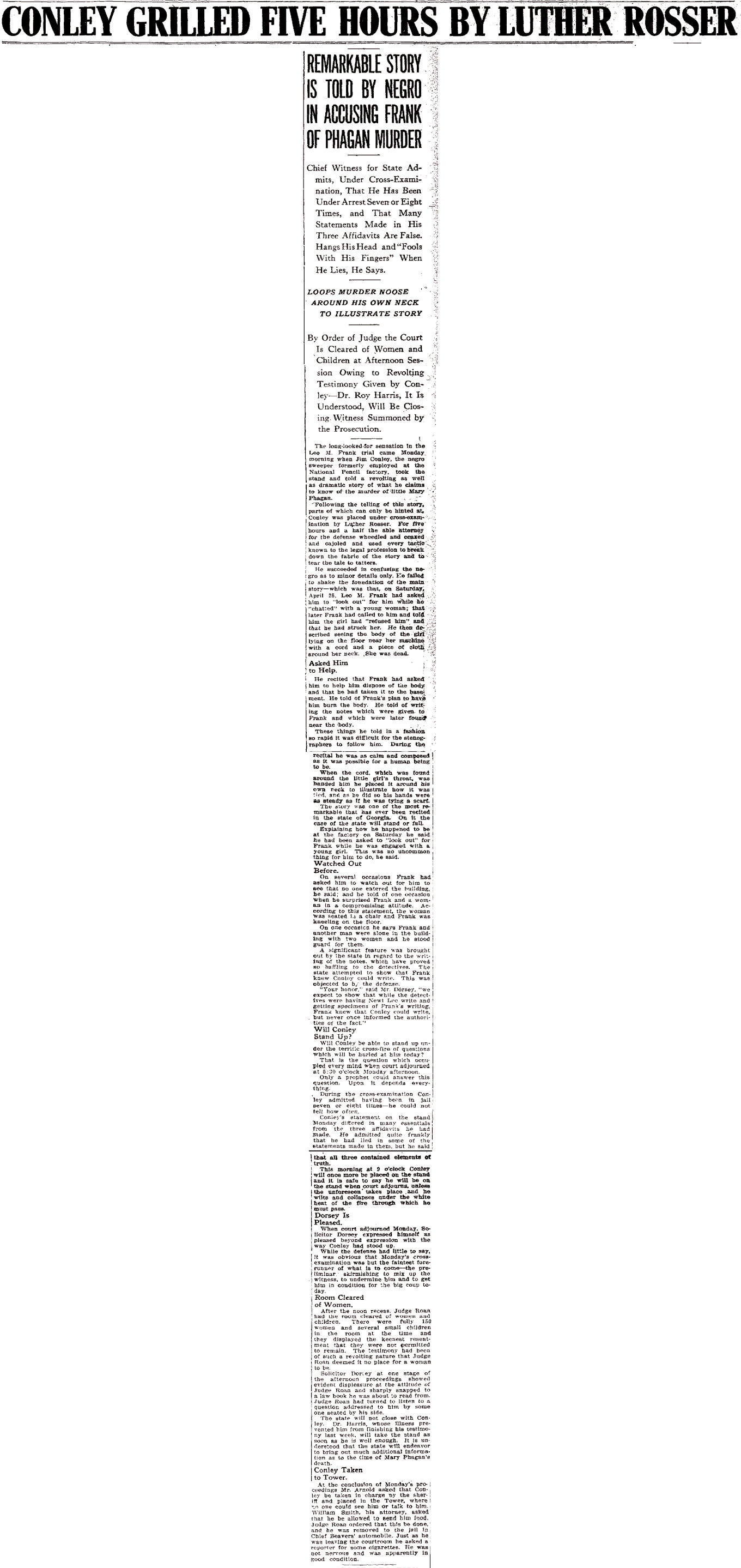
REMARKABLE STORY IS TOLD BY NEGRO IN ACCUSING FRANK OF PHAGAN MURDER
Chief Witness for State Admits, Under Cross-Examination, That He Has Been Under Arrest Seven or Eight Times, and That Many Statements Made in His Three Affidavits Are False.
Hangs His Head and "Fools With His Fingers" When He Lies, He Says.
LOOPS MURDER NOOSE AROUND HIS OWN NECK TO ILLUSTRATE STORY
By Order of Judge the Court Is Cleared of Women and Children at Afternoon Session Owing to Revolting Testimony Given by Conley Dr. Roy Harris, It Is Understood, Will Be Closing Witness Summoned by the Prosecution.
The long-looked-for sensation in the Leo M. Frank trial came Monday morning when Jim Conley, the negro sweeper formerly employed at the National Pencil factory, took the stand and told a revolting as well as dramatic story of what he claims to know of the murder of little Mary Phagan.
Following the telling of this story, parts of which can only be hinted at, Conley was placed under cross-examination by Luther Rosser. For five hours and a half the able attorney for the defense wheedled and coaxed and cajoled and used every tactic known to the legal profession to break down the fabric of the story and to tear the tale to tatters.
He succeeded in confusing the negro as to minor details only. He failed to shake the foundation of the main story which was that, on Saturday, April 25, Leo M. Frank had asked him to "look out" for him while he "chatted" with a young woman; that later Frank had called to him and told him the girl had "refused him" and that he had struck her. He then described seeing the body of the girl lying on the floor near her machine with a cord and a piece of cloth around her neck. She was dead.
Asked Him to Help.
He recited that Frank had asked him to help him dispose of the body and that he had taken it to the basement. He told of Frank's plan to have him burn the body. He told of writing the notes which were given to Frank and which were later found near the body.
These things he told in a fashion so rapid it was difficult for the stenographers to follow him. During the recital he was as calm and composed as it was possible for a human being to be.
When the cord, which was found around the little girl's throat, was handed him he placed it around his own neck to illustrate how it was tied, and as he did so his hands were as steady as if he was tying a scarf.
The story was one of the most remarkable that has ever been recited in the state of Georgia. On it the case of the state will stand or fall.
Explaining how he happened to be at the factory on Saturday he said he had been asked to "look out" for Frank while he was engaged with a young girl. This was no uncommon thing for him to do, he said.
Watched Out Before.
On several occasions Frank had asked him to watch out for him to see that no one entered the building, he said; and he told of one occasion when he surprised Frank and a woman in a compromising attitude. According to this statement, the woman was seated in a chair and Frank was kneeling on the floor.
On one occasion he says Frank and another man were alone in the building with two women and he stood guard for them.
A significant feature was brought out by the state in regard to the writing of the notes, which have proved so baffling to the detectives. The state attempted to show that Frank knew Conley could write. This was objected to by the defense.
"Your honor," said Mr. Dorsey, "we expect to show that while the detectives were having Newt Lee write and getting specimens of Frank's writing, Frank knew that Conley could write, but never once informed the authorities of the fact."
Will Conley Stand Up?
Will Conley be able to stand up under the terrific cross-fire of questions which will be hurled at him today?
That is the question which occupied every mind when court adjourned at 5:30 o'clock Monday afternoon.
Only a prophet could answer this question. Upon it depends everything.
During the cross-examination Conley admitted having been in jail seven or eight times he could not tell how often.
Conley's statement on the stand Monday differed in many essentials from the three affidavits he had made. He admitted quite frankly that he had lied in some of the statements made in them, but he said that all three contained elements of truth.
This morning at 9 o'clock Conley will once more be placed on the stand and it is safe to say he will be on the stand when court adjourns, unless the unforeseen takes place and he wilts and collapses under the white heat of the fire through which he must pass.
Dorsey Is Pleased.
When court adjourned Monday, Solicitor Dorsey expressed himself as pleased beyond expression with the way Conley had stood up.
While the defense had little to say, it was obvious that Monday's cross-examination was but the faintest forerunner of what is to come the preliminary skirmishing to mix up the witness, to undermine him and to get him in condition for the big coup today.
Room Cleared of Women.
After the noon recess, Judge Roan had the room cleared of women and children. There were fully 150 women and several small children in the room at the time and they displayed the keenest resentment that they were not permitted to remain. The testimony had been of such a revolting nature that Judge Roan deemed it no place for a woman to be.
Solicitor Dorsey at one stage of the afternoon proceedings showed evident displeasure at the attitude of Judge Roan and sharply snapped to a law book he was about to read from. Judge Roan had turned to listen to a question addressed to him by some one seated by his side.
The state will not close with Conley. Dr. Harris, whose illness prevented him from finishing his testimony last week, will take the stand as soon as he is well enough. It is understood that the state will endeavor to bring out much additional information as to the time of Mary Phagan's death.
Conley Taken to Tower.
At the conclusion of Monday's proceedings Mr. Arnold asked that Conley be taken in charge by the sheriff and placed in the Tower, where no one could see him or talk to him. William Smith, his attorney, asked that he be allowed to send him food. Judge Roan ordered that this be done, and he was removed to the jail in Chief Beavers' automobile. Just as he was leaving the courtroom he asked a reporter for some cigarettes. He was not nervous and was apparently in good condition.
PAGE 2, COLUMN 1
Scenes in Courtroom Monday While Conley Was on Stand
"JIM, CAN YOU PUT THIS CORD AROUND YOUR NECK LIKE YOU FOUND IT ON MARY PHAGAN'S BODY?" SOLICITOR DORSEY.
WOMEN SPECTATORS.
JIM CONLEY On the STAND.
PAGE 2, COLUMN 3
Amazing Testimony of Conley Marks Crucial Point of Trial; Says Frank Admitted Crime
The crucial point of the entire case of the state versus Leo M. Frank, charged with the murder of little Mary Phagan, an employee in the National Pencil factory, of which he was superintendent, came Monday morning when after putting one or two witnesses back on the stand to bring out minor points. Solicitor Hugh Dorsey called out, "Bring in Jim Conley."
The state had been gradually paving the way for the testimony of the negro sweeper who declares that Frank called on him to hide the body of the dead girl and told him that "he had struck her too hard," and as the darkey's name was called out a murmur ran through the crowded courtroom and several women spectators even clapped their hands together before the sheriff's deputies could restore order.
Jim Conley came in after a short wait. Police Chief James L. Beavers had brought the negro from the station house in his automobile and the negro came slowly into the courtroom walking directly in front of the chief and with no handcuffs or other evidences of being a prisoner.
Conley on the Stand.
After the usual questions to establish his identity the solicitor asked: "Do you know Leo M. Frank?"
"Yes, sir."
"Point him out."
The negro did so, indicating with his right hand the defendant who was sitting within a few feet of him.
"Did you talk to him on Friday, April 25, of this year?"
"Yes, sir."
"Tell about it and what was said?"
"Well, about 3 o'clock that day Mr. Frank came up to where I was at work and told me to come back Saturday morning that he had work for me to do."
"How long had you been working at the factory?"
"About two years."
"Had you ever gone back before for Mr. Frank?"
"Yes, sir," replied the negro.
"Did he give you any instructions about coming back Saturday?"
"I dunno what you mean by 'instructions'," said the witness.
"Well, did he tell you what he wanted you to do on Saturday when you came back?"
"He told me to come back there Saturday about 8 o'clock."
"Did you go?"
"Yes, sir."
"What time did you get there?"
"'Bout half pas' eight."
"Who got there first, you or Frank?"
"We both got there 'bout the same time."
"What was said?"
"Well, I said, 'Good mornin', Mr. Frank,' an' he said, 'Good mornin', Jim.' an' I followed him into the building right away. He then told me I was there rather earlier than he thought I'd be there and that he wanted me to watch the door for him, as I'd done lots o' times before."
"Had you ever watched the door before?"
"Yes, sir."
"Why did you watch the door, what for?"
Frank Trusted Negro.
"Well, when Mr. Frank would have young ladies up dere to chat with them I'd always watch the door for him while dey wuz chattin'."
"Well, I dunno 'bout dat, but dey wuz up dere whilse I watched de door; dat's what I had to watch it fur, so's nobody could disturb 'em while he and de ladies wuz chattin'."
"How many times had you watched the door for Frank before that day?"
"I can't remember 'zactly how many times, but it was lots o' times I'd done it."
"Well, tell us some particular time that you'd watched the door before."
"Well, I 'members watchin' de door on last Thanksgiving day for him; dere was a big, handsome lady up dere then and another man and another lady, too. They all stayed up in the factory whilze I watched de door."
"Well, go back to that day."
"Well, when Mr. Frank said I was dere too early I tole him I'd go down to the Capital City laundry and see er pusson an' come back, and he said for me to be shore and be back in 40 minutes."
"Did you come back, and when did you next see Frank?"
"Well, sir, he told me to meet him on Forsyth street near Nelson street, long where Montag's is, an' I met him there."
"What time did you meet him there?"
"I dunno 'zactly."
"About what time was it?"
"Well, it was about half past ten."
Meet By Appointment.
"You met Frank there, which way did he come from?"
"He came on his way to Montag's."
"Did he say anything?"
"Yes, sir."
"What was it?"
"He said, 'Ha, ha, youse here's is you.' an' I said, 'Yes, sir, Mr. Frank I's here all right.'"
"Well, what did he say then?"
"He told me to wait there for him whilse he went on to Montag's and he said he'd be righ back."
"Did he come back?"
"Yes, sir; he come back in a few minutes and told me to come on with him and I followed him down the street, going towards the factory."
"Did you go to the factory and no where else?"
"Well sir, we stopped in at Curtis' drug store, least Mr. Frank went in there a moment and I waited for him, an' then we went on down the street, me er followin' Mr. Frank and once he looked back to say something to me an' he run into a little baby on the sidewalk and I 'members that cause the man what was with the baby looked at me like he thought I done it, but the white man didn't say nothing and Mr. Frank and I went on to the factory and he told me to go sit on a box near a trash pile on the first floor and I did that.
Arranges Signals.
"Then he said, 'Jim, there'll be a young lady up here to chat with me in a while an' I want you to watch the door whilse we are up there. I wants you to do jes like you allus do,' he says, 'an' when a lady goes up if I stomp my feets on the flo', you go an' lock de front door an' then when you hear me whistle, you go an' unlock the door and get back some '
"Well, did you start to watching then?"
"Yes, sir; Mr. Frank, he went on upstairs and I started to watch an' bimeby Mr. Darley, he came up and went on up the steps and then Miss Mattie Smith, she come up and then came on back down and in er little while Mr. Darley, he come back and went on out right after Miss Mattie an' he patted her on the back an' I heard him say, 'Dat's all right Miss Smith, you jes wait; you'll get dat on next Saturday an' you needn't worry no more.' Dat was all I heard 'em say and de lady went on out, wiping her eyes with a handkerchief, an' Mr. Darley went back up stairs."
"Was this talking between the two people before or after you and Mr. Frank came back to the factory from where you met him at Forsyth and Nelson streets?" asked the solicitor.
"It was after we come back," replied Conley.
"Well, what happened then?"
"Well, after de lady done lef', then Mr. Darley lef' too."
"Well, go on, what happened next?"
"Well, a lady, she come in and went up the stairs and then a nigger come on in. He was a nigger drayman er peg-leg nigger, and he went up the stairs and I waited around er while and Mr. Darley and Mr. Holloway bof came down and lef', and then Mr. Quinn come in and he went up stairs."
"How long did he stay?"
"He stayed just er little while and he came down and left."
"Who came next?"
Mary Phagan Came.
"Den de lady, she came up and went up de steps."
"What lady?" asked the solicitor.
"De lady what's dead."
"What is her name?"
"Miss Mary Miss Mary Perkins, I allus called her," said the negro witness.
"Well, go on."
"Well, den I hears footsteps an' thought that two people was coming from the office and going to come down de steps, but I hear the footsteps all pass the head of the steps and go back towards the back of the building, back towards the metal room, an' after a little while I heard a lady scream back there an' then everything got quiet again."
"Well, what took place next?"
"Well, dis Miss Montee Stover, she come on in an went up the steps."
"How was she dressed?"
"She had on er rain coat an' tennis shoes."
"Had you ever seen her before! Did you know her?" asked Dorsey.
"Yes, sir; I'd seen her onct or twice befo' an' I knowed who she was."
"Go on, Jim," urged the solicitor.
"Well, dis Miss Monteen Stover, she come on down and everything was quiet and den I heard somebody tiptoin' from de back of the building towards the head of the stairs on the second floor, sounded lak dey wuz kinder runnin' on dey toes," he added.
"Then I heard somebody go back towards the metal room on dey tiptoes again, an' 'bout dat time I des dozed off an' I waked sometime later, I dunno how long 'twas, but it wuz Mr. Frank er stompin' on de floor above what waked me. I locked de door lak he done tole me to do when I heard him er stompin' an' finally he began to whistle and I unlocked de door and went back to my box and den in a few minutes I walked up dey steps."
"Did you see Frank then?"
Frank Was Scared.
"Yes, sir. I seed him. He was standin' dere in his office jes er shiverin' an' er rubbin' his hands together an' he had er cord in one han'."
"Did you look at his eyes?"
"Yes, sir."
"How did they look?"
"Dey was large and he looked funny out of them."
"How did his face look?"
"His face was all red like."
"Is this the cord you saw?" asked the solicitor, displaying a small piece of wrapping twine similar to that found tied around the dead girl's neck.
"Well, it was cord jes like dat," replied the witness.
"What was said?"
"Well, sir; Mr. Frank asked me ef I'd seed er girl come up and I told him I'd seed two of 'em come up and seed one of 'em go back down, but I hadn't seed the other go down yet. Then he said I never would see on of them go back down."
"He said that the little girl went to the metal department with him and he tried to be with her and when she tried to stop him he guessed he hit her too hard.
"'Jim,' he says to me, 'You know I ain't made like other men.'" added the negro witness.
"Had you ever seen that he was not made like other men?" asked the solicitor.
"Yes, sir."
"When?"
"Well, on las' Thanksgiving day, for instance, I seed him with a lady up there.
The negro sweeper then went on to describe in detail what he claims to have seen in regard to Frank and his conduct with women and with girls in the factory and declared that what he was telling he had seen with his own eyes.
"Had you seen this often?" asked Mr. Dorsey.
"Yes, sir; several times."
"In this factory?"
"Yes, sir."
Finds Girl Dead.
"Well, what did Frank tell you to do when you came upstairs?"
"He told me to go on back and get the girl and bring her up there and I went back and found her lying there on her back with her hands kinder stretched out above her head and a cord tied round her neck."
With a cord furnished by the solicitor the negro showed the jury how he meant the cord was tied around the dead girl's neck.
"She was dead and when I saw that I went back to where Mr. Frank was in his office and told him that the girl was dead an' he then told me to get a piece of cloth and tie her up in it and take her downstairs to the basement. He said I could get a piece of dat baggin' like dey wrap cotton in and that it was in er box on the same floor and I got it and went back to wrap her up.
"I took the young girl," the negro said, "an pulled her hands down to her sides and closed her feet together and wrapped the sack around her, and then I got kinder scared and went back to see Mr. Frank and I looked at er clock and it was four minutes to one."
At the solicitor's order Conley then pointed out to the jury on the cross-section diagram of the building the spot where he had found the body.
"I went on and I walked up to Mr. Frank and told him that girl was dead and he done just like this and said, 'Shh'" the negro held up one hand as persons do when they warn another to stop talking.
The negro then pointed out where he got the bagging to wrap the dead girl in.
"I then rolled the dead lady over and went on and tied her up in the sack."
"Why did you do this?" the solicitor interrupted the grewsome story.
"Well, Mr. Frank, he was my boss and he tole me to," said the negro simply.
"Go ahead," replied the solicitor.
"Well, I saw her hat and a piece of ribbon lying on the floor and I layed that across her and tied her up jes like er washerwoman does clothes on dem from the white folks' house to wash 'em. I picked her up and she was so heavy I drapped her on the floor and when she fell that scared me and I called to Mr. Frank to come help me.
"He said he would and he come running back there on his tiptoes and he was trembling awful like, but he grabbed her by the feet and helped me carry her to the elevator. We started on down and at the first floor the elevator hung up and finally we got it started again and went on down to the basement and Mr. Frank told me to take the body on back to the far back end of the basement and put it on the sawdust pile and I did, half draggin' it, it was so heavy," he added.
Threw Body In Corner.
"I throwed her down and took off the cloth she was wrapped in and her umbrella and hat fell to one side and I picked them up and started back towards the elevator and called out to Mr. Frank to ask him what I was to do with the umbrella and hat and he said drop them right there and I flung 'em to one side.
"Coming up the elevator Mr. Frank went to get off and he was so excited he could not wait for the car to stop, but jumped off and fell an' the car door hit me er awful whack on the shoulder." Here the darkey rubbed his right shoulder and winched, as though the remembrance of the pain made it hurt again.
"And Mr. Frank, he went on back to the sink to wash his hands where he'd got them dirty when he fell and as he went he says, 'Gee! that was a tiresome job.'"
"Was his face red then?"
"Yes, sir; and his eyes was looking like diamonds."
"What happened next?"
"Well, he heard someone er coming and he made me hide in the wardrobe for fear they'd see me and he shut me up in there and I heard someone come in the office and talk to him and then they went out together and after a while, when I thought I would jes die in that close place he came back and let me out and he said, 'I here a long time,'" and he said, 'I reckon I did Jim, you are all sweating,' and he gave me some cigarettes out of a box and told me I could smoke. It was against the rules to smoke ever in the factory, but he told me to go ahead and smoke."
"What did he do then?" asked Mr. Dorsey.
"Well, he sat dere in the chair an' squirmed about and finally he said, 'you can write, can't you Jim,' and I told him that I could that I'd written before him."
"He then said there was only one way for us both to get out of it and asked if I'd help him and I told him I would. He was a white man and my superintendent," explained the witness, "and I thought I ought to help him out of his trouble.
Jim Writes the Notes.
"An he made me write some notes for him, he telling me what to write and when I had written four notes he slapped me on the back and said that was right, that was fine, and he took out a nice roll of greenbacks and handed them to me and I said, 'Mr. Frank, I'm going to take some er this money to pay for my watch,' and he said I needn't worry about that watch, that we'd both have plenty of money, and wouldn't have to worry about nothing.
"'Jim,' he went on, 'I've got lots of money aht I've saved up; that fat wife o' mine wanted to buy an automobile, but I wouldn't do it, I've saved my money.'
"Then he told me he wanted me to go to the basement after a while for him and then he asked me to hand that money he'd give me back to him for a minute and I thought he wanted to count it and I handed it to him and jes kept the little money what he had given me with the cigarette box."
"Well, then he put the money in his pocket an said that it would be all right about that and finally he jumped up and clapped his feet together and he says, 'Why should I hang? I've got wealthy folks and they'll care for me.'"
"Then he tole me to take the notes and put them near the dead lady's body and said, 'What ever you do, Jim, you keep your mouth shut,' and I promised him I would and went and put the notes by the body and then I came back and he said he wanted me to come back there in about 40 minutes, but I could go out for a while."
"Well, what did you do then?" asked Mr. Dorsey.
"I went to a near-beer saloon and bought a 'double-header' and some sandwiches and fooled around in the place for a while and then I looked at a clock and it was twenty minutes to two and I came out with a nigger and he made me lend him a dime.
Jim Goes Home.
"After a while I decided I would go on out home and give the old lady some money to pay the rent with before I went back to the factory and I got there and found no dinner ready for me and I give a nigger chile a quarter and says, 'here, you kid, you run up to dat store and buy me some sandwiches,' and when I got dem I ate 'em and went to sleep and when I woke up it was about 6 o'clock."
"Did you see Frank again that day?" asked Mr. Dorsey.
"No."
"No sir, next time I seed him was on er Tuesday following when I saw him at the factory and he came up and told me to keep my mouth shut, and then he said for me to come back to the office after a while that he wanted to see me, and I thought he was intending to give me back that money.
"Then I worked around during the day and finally one of the ladies told me that Mr. Frank had been 'rested."
Mr. Dorsey then had the negro identify the dead girl's parasol.
"Did Mr. Frank know you could write?" the solicitor then asked.
"Yes sir, he knowed I could write."
"How did he know?"
"Well, when I'd be cleaning up I'd have to count the boxes lying around and write down the number of them on a piece of paper, and Mr. Frank told me to do that and furnished the paper for me."
"When were you first arrested, Jim?"
"I was arrested on May 1."
"Look at these tablets and notes and see if the notes are the ones you wrote at Mr. Frank's dictation," said the solicitor.
"Dem's the ones," said Conley.
"Where did you get them?"
"That young man right over there, he give them to me, he knows all about it," said Conley, pointing to where Frank sat watching him closely.
"What did he tell you to write?" asked Mr. Dorsey.
"Jes what's on those notes there. I wrote jes lak he said."
Indicates Movements on Diagram.
Solicitor Dorsey then had Conley point out on the diagram his movements in the factory that day. The negro used the cross section drawing of the building and seemed to have much less trouble understanding it than Newt Lee had experienced.
He pointed out first the furnace where he said Frank had intended to burn the girl's body, and thus destroy every evidence of the crime.
"I was to help do that when I came back in the forty minutes Mr. Frank had allowed me," he said, "but I didn't come back no more."
"Could you have put the body in the furnace?" asked Mr. Dorsey.
"I don't know; I didn't try it," replied Conley.
"Do you know anything about the back door?"
"No sir, not a thing."
"Do you know what became of the notes you wrote?"
"No sir, I didn't hear anything more about them till I was in prison down at the police station."
"What time did you leave home that morning, Jim?" Mr. Dorsey then asked.
"About 7 or half past," said the negro.
"Who left the factory first after you had put the body in the basement, you or Frank?"
"I left first, and Mr. Frank, he was standing there watching me like he was afraid I wouldn't go straight out."
Doesn't Remember Woman's Name.
"Do you know the name of the woman who was there on Thanksgiving day?"
"Do you know the name of the woman who was there on Thanksgiving day?"
"No sir, I don't. There was two ladies and another man."
"What was the man's name?"
"His name was Mr. Dawson."
"Who was it who came into the office that Saturday when Frank had you locked up in the wardrobe?"
"I don't know, sir."
Conley was then made to point on the cross section the place where he had sat on a box and watched the door.
"What sort of work had you done around the factory, Jim?"
"I worked on the elevator until last Christmas and then they took me off and put me to cleaning up the building."
"Do you know Mrs. Arthur White?"
"No sir."
Mr. Dorsey then requested a deputy to bring Mrs. White in.
"How did you find out that the girl was dead?" he continued while waiting for the woman to appear.
"When Mr. Frank sent me back there I touched her and found out she was dead and I went and told him so."
Mrs. White entered the courtroom at this moment and was led to a spot facing the negro on the stand.
"Did you see this lady that day?" asked the solicitor.
"No, sir, I never seed her."
The solicitor then requested that the defense allow him to put Mrs. White on the stand for a few moments, but Attorney Rosser flatly refused. Mrs. White was then asked to leave the courtroom and the examination went on.
"What did the lady look like that you saw in Frank's office last Thanksgiving day?" Solicitor Dorsey asked.
Describes Woman With Frank.
"She was a big, handsome woman, wearing a big hat and she had on white shoes and stockings," said Conley.
"Tell about other times you watched
Image 3
for Frank," said Dorsey.
"Well, I watched for him lots of times and sometimes he'd let another man and woman come in and that man and woman would usually go down to the basement."
"Tell us about that contract you made for a watch," said the solicitor.
Attorney Rosser immediately entered an objection, declaring that the negro's contract, if there was one, about a watch had nothing to do with the case.
He gave Mr. Dorsey the chance to bring before the jury one of the strongest pieces of circumstantial evidence he had yet sprung, and in explaining to the judge before the jury his reasons for holding this part of the testimony the solicitor played one of his strong cards.
"I want to show by this contract and by the testimony that Frank advised the negro about it and saw him sign it," said the solicitor, "that Frank knew that Conley could write,
Image 4
and yet that when Frank and Lee and Conley were locked up as suspects and detectives were making Frank and Lee write so as to compare their penmanship with that of the murder notes, that Frank kept silent about knowing Conley could write."
Judge Roan allowed the testimony to be used and Conley was made to tell of some trouble he had got into over the purchase of a watch on the installment plan and of how Frank had advised him in regard to it and been present when he signed a final contract in regard to the watch.
Rosser and Arnold Confer.
At this juncture Attorneys Rosser and Reuben Arnold, for Frank, halted proceedings while they went into an ante-room for a conference. In the interim the solicitor had a bailiff bring the negro witness a glass of water, which he drank with every evidence of being thirsty.
The attorneys for the defense then returned and Mr. Dorsey again took up
Image 5
his examination.
"How old are you, Jim?" asked the solicitor.
"I'm 27, sir."
"Where did you work before you went to the pencil factory?"
"I worked for Dr. Palmer."
"What made you quit there?"
"Well, I was driving for Dr. Palmer and he bought an automobile and he was a colored doctor and didn't know how to run it and I didn't know, and so I had to quit so's he could get somebody what could run that thing for him."
Cross-Examination Begun.
Then at the solicitor's request he told of several other people and firms for which he had worked previous to getting a job at the pencil factory.
"That's all," the solicitor said finally, and turned his witness over to the tender mercies of the defense.
The negro was apparently as composed as anybody in the courtroom when he finished telling his story and
Image 6
he sat in the chair for a few minutes seemingly at ease while the defense made ready to go after him.
When Attorney Rosser finally rose to his feet and took a few steps forward Conley was still entirely at ease, but the spectators could see that the man who felt nervous was the solicitor. So much depended on Conley's actions during what the solicitor knew was coming that he could not help show what he felt.
Mr. Rosser got up naturally and faced the darkey. He wore a pleasant and agreeable expression.
"Jim," he said, "how old are you?"
"Twenty-seven, boss," said Jim, and he seemed from the first question to warm up to the man who had started to talk to him.
"Where were you born, Jim?"
"In Atlanta, Ga."
"When did you get your first job, Jim?"
"'Bout 'leven years ago, sir."
"How old were you then?"
"'Bout 'leven, I said, sir."
"I thought you said about eleven years ago you got a job; you must have misunderstood me," said Mr. Rosser, and in the kindest of tones he straightened things out until the witness established the fact that it was about sixteen years ago when he was eleven years old that he first got a job.
Conley Beams on Rosser.
Jim seemed to appreciate the efforts of the white man to get him straightened out after he had misunderstood him and the negro, who has rather a kindly face and the soft voice of the southern darkey, fairly beamed upon his questioner.
Wise lawyers in the courtroom saw what was coming. They realized that Mr. Rosser was reaching out for Jim like a small boy does for a dog he wants to get his hands on when the dog is rather shy and refuses to let himself be approached.
Like the boy who stoops down and chirps at the dog and shows friendship on his face, the shrewd lawyer conspired to get his hands on the witness. For the next half hour or more he carried out the metaphor of the boy and the shy dog.
Mr. Rosser and Jim Conley then went through a more or less connected story of Jim's early life, his school days and what he had learned in that rather short period of his life. Jim even told of how, like most boys, he did not care for his studies and never got so he could read much, but learned to count pretty well in later life when he worked as a drayman.
Here and there the lawyer corrected in a kindly tone certain discrepancies in the darkey's tale and helped him get it straightened out. To the casual observer Attorney Rosser had only the kindest intentions toward Jim, but was possessed with a desire that amounted to an obsession in regard to Jim's store of learning and the men for whom he had worked.
Rosser Toys With Words.
They took up again the subject of Jim's ability to read.
"Can you read the papers, Jim?" Mr. Rosser finally asked.
"Yes, sir," replied Jim proudly; "I kin read 'em, only not much. I jes reads dis and dat in 'em."
"Oh, you jes read dis an dat," Mr. Rosser had dropped into the negro talk that all southerners know and that many of them use as children and never seem to forget.
"You jus' look through the papers, Jim, till you nd 'dis an' dat,' and you read 'dis' and 'dat' and then you don't read anything else," he said, as though a great understanding of the importance of "dis an' dat" had just dawned upon him.
The lawyer went on making a play upon the words "dis" and "dat," which passed entirely over the negro's head, but which almost convulsed the courtroom with laughter.
"You said you used to work for Mr. Coates, Jim," said Mr. Rosser. "Can you spell 'Coates'?"
"No, sir; I can't spell that word."
"Can you spell 'search'?"
"No, sir, can't spell dat."
Then the lawyer named over a score or more of easy words, some of the simplest of which Jim proudly announced he could spell, and some of
Continued on Page Three.
PAGE 3, COLUMN 1
AMAZING TESTIMONY OF CONLEY MARKS TRIAL
Continued from Page Two.
which Jim proved that he could spell.
Spells "Cat" With a "K."
"Can you spell 'cat,' Jim?"
"Yes, sir, I can spell dat word, sho'," Jim replied.
"You spell it with a 'K,' don't you," said the lawyer encouragingly.
"Yes, sir, with a 'K.'" Jim replied, and forthwith spelled it with a "K."
"Why sure you do," said Mr. Rosser. "Jim, you and I understand each other thoroughly, don't we?"
Jim faces showed that he could not see what in the world a great big white man with the knowledge of Luther Rosser could want to take up the time in court to go into a spelling bee with him for, but he replied with his face beaming, "Yes, sir, we sho' does, sir."
Then followed more words for Jim to spell. The white man and the darkey had reached a perfect understanding, such as a white man and a negro have when they are raised together on the same big plantation.
What he could spell, Jim spelled, and what he could not he simply acknowledged he could not. Jim spelled "papa," but he could not spell "mother," and Mr. Rosser took his word for a number of other words he asked him about, and only when Jim desired to prove beyond doubt did he even have to spell the word out.
Then Jim's education in mathematics was taken up and gone over in the same detailed and kindly way. Jim did not know what was meant by the word "figuring," but he did know what counting meant, and showed proudly that he could count just as far as Mr. Rosser would let him go, and he could add, too. Jim proudly added small sums, and all the time his face beamed and pride showed. The man who was exhibiting his knowledge for him took pains, as Jim knew, not to give him much that was hard, and Jim was making a splendid impression with his knowledge.
Then the lawyer started out on his real work, but so deftly that no one realized it at the time.
"Jim," he began, "who did you work for first, and how long did you work there?"
"I worked for Mr. Truitt, of Ward & Truitt, for about a year," said Jim.
"How long did you work for the next man?"
"About five years," replied Jim.
The general interrogation had just led up naturally from Jim's school days to his life as a working man, and the same tones were used and the same perfect understanding prevailed.
"You say you went to school only about a year in all?"
"Yes, sir."
Given Job by Schiff.
"Well, Jim, who gave you the job at the pencil factory?"
"Mr. Schiff," replied Jim.
"Did Mr. Frank ever pay you off?"
"Yes, sir, sometimes."
"Tell me about how many times he paid you off."
"Well, I don't know 'zactly; sometimes I let the other fellows draw my money."
"Oh," said the lawyer, "you'd sometimes get into debt and let other fellows draw your money so you could escape the men you owed?"
"No, sir, I didn't want to get out of paying; I'd let the men I owed draw my money because I wanted them to have it."
"What was your pay a week?"
"$6.05," replied Jim.
Jim then said he did not want to tell at first what he got, as it was so small he was ashamed of it, and was afraid that other niggers would hear about it.
Mr. Dorsey protested at this juncture that all this was entirely immaterial, but Mr. Rosser declared to the court that it was, that he wanted to show certain facts about the negro and that he would show it later. Judge Roan sustained him.
Attorney Rosser then drew out of Jim the statement that when he owed a negro boy something like 15 cents he would take the boy into a near beer saloon and buy him three glasses of beer and settle the debt that way.
Never Saw Nightwatchman.
"Jim," said Mr. Rosser then, "what time did the nightwatchman come to work on Saturdays?"
"I don't know, sir."
"Have you ever seen the nightwatchman?"
"No, sir."
"Did you ever see the white watchman in the day?"
"Yes, sir."
"Ever see the colored watchman at all?"
"Yes, I've seen the negro they said was the watchman."
"Did you know old man Newt Lee?"
"No sir."
"What time did they pay off on Saturday?"
"About 12 o'clock."
Admits Watching Frank.
"You say you have watched for Mr. Frank?"
"Yes sir."
Mr. Rosser was getting into his real line of questions now, but still there was no apparent change in his attitude toward the witness.
"When was the first time you ever did that?"
"Sometime last July."
"What did Mr. Frank say at that time?"
"He just come out and called me into his office and said what he wanted me to do."
"How did they pay you?"
"Eleven cents an hour."
"Was it your duty to punch the clock?"
"Yes, but sometimes I didn't.
"If it wasn't punched every time how could they know how to pay you?"
"If it wasn't punched every time Mr. Holloway would see me and set things straight so I could get my money."
"The first time Frank talked with you was a lady with him?"
"Yes, Miss Daisy Hopkins."
"What did he say?"
"He said, 'Jim, see that lady there?' and when I said I did, he said, 'Go on down and watch the door.'"
"Was Miss Hopkins present?"
"Yes sir, she was there."
"Who else was there?"
"A man named Mr. Dawson."
"How long did this lady and man stay in Mr. Frank's office?"
"'Bout fifteen minutes," replied Jim.
"How long before Mr. Frank came down?"
Couple in Basement.
"It was about an hour before he came down, but the girl and man had come on down, and on his instructions I had opened the trap door and let the girl and man into the basement."
"What time was it when they came up?"
Image 11
"It was after a while."
"What did they do when they came up?"
"The lady went on upstairs and a little while later Mr. Frank and her come down."
"What happened next Saturday, two weeks later, Jim?"
"Well, I was in the rear of the fourth floor and Mr. Frank came to me and said, 'remember what you did last Saturday, Jim,' and I said I did and he said he wanted to put me wise to this Saturday. Miss Daisy Hopkins went into his office and Mr. Frank signalled with his fingers and I went down and locked the front door and watched for them."
"What next?"
"I stood on the steps and heard them go into Mr. Frank's office."
"How long did you stay?"
Given Money by Frank.
"I stayed about half an hour, then the lady come on down and went out, and Mr. Frank gave me a half dollar."
Image 12
"About the next time?" urged the lawyer. He was apparently helping Jim Conley to tell all the damaging evidence he knew on the man whom he accuses of the horrible crime.
"Well, I can't remember the exact time; it must have been about the middle of August."
"What time of day?"
"Well, it was about the time Mr. Frank came back from dinner. I was standing near the door and he came up and said he wanted to put me wise again for that day."
"What did he mean when he said, 'Put you wise?'"
"Well, he had said that on the other times he wanted me to watch for him," replied the negro.
Women Waited for Frank.
Conley then told of a woman waiting on the fourth floor who had gone up to Frank's office. Asked what sort of hair she had, he said it looked like Mr. Harper's. Mr. Harper referred to has gray hair and this state
Image 13
ment caused a great deal of amusement.
He also told of a woman dressed in green who had visited Frank.
"Did you inquire who she was?" he was asked.
"No sir, I did not."
"Did she speak to you?"
"No, she didn't know me."
"Did you run the elevator?"
"Yes, sir, sometimes."
"Didn't you then come in contact with everybody in the factory?"
"No, sir. I didn't have to go all over the floors."
"What did Mr. Frank tell you?"
"He said for me not to let Mr. Darley and Mr. Schiff know about it."
What Occurred Thanksgiving.
"The next time was Thanksgiving, wasn't it?"
"Yes, sir."
"What were his words then?"
"He said, 'How're you feeling,' and sent me to the first floor."
Image 14
"What time was that?"
"About half-past eight."
"What time did the woman come?"
"About half an hour later."
"Did you know her?"
"No, she didn't work at the factory."
"Ever seen her before?"
"Yes, I think so. I think I saw her one night in Mr. Frank's office."
"Why were you there?"
"I had some boxes to pack."
"Where were you when she arrived on Thanksgiving day?"
"On the first floor."
"What did you do?"
Had Code of Signals.
"I closed the door when Mr. Frank stomped on the floor."
"How long did you stand by the door?"
"I didn't stand by the door; I went and sat on a box for an hour or more."
"When Frank stamped what did you do?"
Image 15
"I kicked the elevator, so he would know I heard him and everything was all right."
"Did Frank come down then?"
"Yes, he came down and unlocked the door and went out and looked around, and then came back and went to the stairway and called for her to come down. She came on down and saw me and asked if I was the nigger he'd talked of and he said yes, and he says, 'That's the best nigger in the world,' and she asked if I talked much, and Mr. Frank said I didn't talk at all."
"When was the next time?"
"Way after Christmas, some time in
Image 16
January."
"How do you know?"
"Well, it was after New Year's."
"What did he say?"
Two Girls and a Man.
"I can't remember, but one thing he said, and that was that a young man and two ladies was coming, and that I could make a piece of money off them."
"What time was that?"
"About half past seven."
"Did anybody hear you?"
"Gordon Bailey did."
"What did you do?"
"I went and stood by the door; it was open."
"Did they come right in?"
"No, sir, the gentleman, he came on in and the ladies stood back, and then when he had talked to me he went back to them and they came on in with him."
"How long did you stay that time?"
"It seemed like two hours," replied the witness.
"Did you know either of the women?"
Image 17
"No, sir."
"Describe how they looked."
"I disremembers how they looked," said Conley.
"How about the man?"
"He was tall and slender."
"Ever see him again?"
"I saw him talking to Mr. Holloway several times."
"You say you don't know him?"
"No, sir, I don't know him."
"Had you ever seen the girls before?"
"No, sir."
At this point Judge Roan ordered an adjournment for lunch.
PAGE 3, COLUMN 3
Conley Is Mercilessly Grilled
ARRESTED 7 TIMES, HE ADMITS,
At Afternoon Session of Court
Jim Conley remained on the stand throughout the afternoon session,
Attorney Rosser continuing his cross-examination after the noon recess.
"Who saw you, Jim, at police headquarters?"
"Chief Beavers."
"Who else?"
"Mr. Smith, my lawyer."
"Was anybody else present?"
"Yes, Tawney."
"Did he hear what was said?"
"I guess so. He could have heard."
"You talked to no one else?"
"No, sir."
Conley Doesn't Remember.
"Did you watch for Mr. Frank since the time in January?"
"I think not."
"What did you do the Saturday after you watched for him?"
"I don't remember."
"What did you do the next Saturday?"
"I don't remember, except that I watched for him, I missed one Saturday."
"What did you do the Saturday before Thanksgiving and that afternoon?"
"I don't remember."
"How much money did you draw the first Saturday you watched for him?"
"I don't remember."
"What time did you leave home the first time you watched for him?"
"I don't remember."
"Did you draw your money the Saturday after Thanksgiving?"
"I don't remember."
"On the day before Thanksgiving, what time did you come to the factory?"
"I don't recollect exactly, Mr. Rosser."
"On the day after did you see Frank?"
"Yes, sir."
Remembers Seeing Frank.
"You remember that, alright?"
"Yes, sir."
"Did you see Mr. Darley?"
"I don't think so."
"How many hours did you put in that day?"
"I don't recollect."
"Then, you don't know how much pay you drew, do you?"
"Yes, sir, I know how much Mr. Frank gave me for watching for him a dollar and a quarter."
"You've already told about that."
"Yes, sir, I know it."
"Where did you live?"
"37 Bynum street."
"You've been in prison, haven't you, Jim?"
"Yes, sir."
"Do you remember the day you went to prison the first time and the day you got out?"
"No, sir; I don't."
"Did you ever live elsewhere than on Bynum street?"
"Yes, sir, 172 Rhodes street, near Electric avenue."
"You were in prison twice, weren't you, Jim?"
"Yes, sir, but I don't remember the exact dates of the second time."
"You stayed how long?"
"Between 21 and 31 days."
Rosser Asks Numerous Questions.
Rosser's attack upon the negro, at first, was a slow, gradual attempt to wear away the witness in the manner of water dropping incessantly upon stone. He put innumerable questions to the witness, pertaining to Conley's past, his various homes, his sweetheart, his working career. Many seemed utterly irrelevant, but obviously were decidedly significant to the plans of the defense.
"How many times, now, Jim, have you been in prison in all?"
"Somewhere between seven and eight."
"Now, let's see: The day you found the child in the pencil factory, as you say, was on April 26. The factory was closed that day, wasn't it?"
"Yes, sir. The day before, they had tacked up signs all over the building."
"Did you read them?"
"No, sir; I couldn't. They were read to me."
Mr. Rosser remained in his seat, playing with his witness like a cat plays with a ball of twine, or a child with a toy, plying question upon question. In each answer, he would find new material for countless additional questions, with which he sought to tangle Conley in his own narrative.
Many questions were asked of the negro regarding his associates of the street and fellow-workers in the pencil factory, most of which dealt with Gheron, "Snowball" Bailey, a negro youth who was once also under arrest in connection with the Mary Phagan murder during the early part of the investigation.
"When you were in prison, who took your place in the pencil factory, Jim?"
"I don't know, sir."
Sent Him to Stockade.
"What was the fine they imposed on you the last time you were sentenced?"
"They didn't give me no fine."
"You were one of the new darkeys in the factory, weren't you?"
"Yes, sir."
"When did you see Mr. Frank?"
"I don't remember."
"When was the first time he ever talked with you except on business?"
"I don't remember. He talked and jollied with me. He and Mr. Darley, both, jollied with me."
"Did he ever jolly with you before you watched for him?"
"Yes, sir, sometimes."
"Do you remember what he said?"
"No, sir."
"Who saw him ever jolly with you?"
"Mr. Darley and Mr. Schiff."
Questioned About Daisy Hopkins.
"When did Daisy Hopkins work at the pencil factory?"
"Some time in 1912."
"What floor did she work on?"
"The fourth floor."
"What part of 1912?"
"June on up."
"Has she ever worked there in 1913?"
"I don't know."
"Do you know where she lives?"
"No, sir."
"Is she married?"
"I don't know."
"What's the color of her hair?"
"Don't remember."
"What's the color of her complexion?"
"What's complexion?"
"You're dark complected I'm white complected."
"Oh, she was white complected."
Just Ears Like Folks.
"What kind of ears did she have?"
"Ears like folks."
"I didn't expect her to have ears like a rabbit small ears, big ears, or what?"
"Kinder small ears."
"How old was she?"
"About 22."
"How do you know she worked there in June, 1912?"
"I knew it was 1912, and one day she sent me down to the office with a note. It had 'June' on it."
"I thought you couldn't read?"
"I could read 'June' alright."
"How many times have you ever seen this man Dalton around the pencil factory?"
"Several times."
"On the third trip, of which you've stated, how did he come to be at the factory?"
"Miss Daisy Hopkins brought him."
"How long has it been since you've seen Dalton?"
Saw Him at Police Station.
"About a month. I saw him down at police headquarters when they brought him in for me to identify him."
"Did you identify him?"
"Yes, sir."
"The first day you watched for Frank, did you see Mr. Holloway?"
"Yes, sir."
"Was he around the factory?"
"Yes, sir."
"What time did he leave?"
"About 2:30 o'clock."
"Did you see Mr. Darley?"
"Yes, sir."
"What time did he leave?"
"I don't know, exactly he was always leaving."
"The next time you watched for Mr. Frank, who did you see of the working force?"
"Mr. Holloway."
"What time did he leave?"
"About 2 o'clock."
Watched in September.
"Thanksgiving was the next time you watched for Mr. Frank, wasn't it?"
"No, it was some time in September."
"Was Mr. Darley around the factory?"
"I didn't see him."
"Mr. Schiff?"
"I think so."
"What time did Schiff leave?"
"I didn't know."
"Isn't it true that a lot of people are at work in the factory on Saturdays?"
"Yes, sir, sometimes."
"On Thanksgiving, did anybody work there all afternoon?"
"I don't remember."
"Isn't it true that Schiff was in the office?"
"I didn't see him."
Knows Part of Plant.
"You know the whole plant well, don't you?"
"Some parts of it I do some parts I don't."
"How big a room, then, is Mr. Frank's office?"
"I don't know."
"It has two desks in it, hasn't it?"
"I think so."
"Who has the other desk?"
"Mr. Schiff."
"How long is the outside office?"
"I don't know."
"Is there a safe in the inside office?"
"Yes, sir."
"You can't see from the stairway into the inside office?"
"Yes, sir."
"Can a man sitting in the office see anyone coming up the stairs?"
"I don't know."
"But, Frank can't see folks coming along the floor unless they go past the clock?"
"If he is sitting at his desk, he can."
Conley Shown Diagram.
At this point, Conley was given a diagram to show the jury where he was sitting on the occasion of a certain talk with Frank near Frank's office.
"How much did you say you drank on Friday, April 25?"
"Not so very much."
"Do you know Detective Harry Scott?"
"Yes, sir."
"When you were at police headquarters, you told them that you got up at 9:30 a. m. on the morning of the 25th, didn't you?"
"Yes, sir."
"That wasn't so, was it?"
"No."
"Yet you looked them in the face and lied, didn't you?"
"Yes, sir."
"You also told them you went to Peters street?"
"Yes, sir."
"And didn't go?"
"Yes, sir. I went to Peters street, alright."
"How long did you stay on Peters street?"
"Not long."
"You stayed until 11 o'clock, didn't you?"
"No."
"You told Scott so, didn't you?"
"Don't remember about that."
Told Some Stories, He Admits.
"Do you remember what you told Harry Scott and John Black?"
"Not all."
"The truth is you lied all the way 'round?"
"I told some stories, I'll admit."
"Didn't you make three affidavits, neither of which is true?"
"Some of them are true."
"But aren't they all lies?"
"No, there's a lot of truth in all of them."
Attorney Hooper objected to this question, saying the affidavits were in existence and that they should be shown the witness as prescribed by the law.
Negro Drilled, Says Arnold.
Attorney Arnold, in discussion, said:
"It is easy to see that the negro has been canned and grilled and prepared for this business, and would easily recognize the affidavits. That is not what we want to do at present."
Hooper's retort was:
"Mr. Arnold, I do not think, was called upon to explain the history of the affidavits. They are here in the court, as requested, and the law demands that they be shown the witness. This is a new way of legislating. Should the law be changed just because these men get up and demand that their rights, and their right alone, prevail. This case should be tried entirely as any other case should be tried."
Solicitor Dorsey said:
"We submit that the remarks of Mr. Arnold be considered prejudicious his remarks that the witness had been canned and prepared in a state satisfactory to the defense. I beg that the judge make a statement to that effect to the jury."
Arnold Attacks Dorsey.
Mr. Arnold arose again.
"My friend Dorsey, in his usual fussy, snarlish way, has accused me of being prejudicious. If we sought to impeach Jim Conley finally, we will put the affidavits into evidence. Each affidavit represents a world of pumping and labor on the part of detectives. We expect to show that the affidavits followed many contradictory statements, and that Conley never admitted anything until confronted with the fact that he could write."
Judge Roan sustained the defense.
"How long did the detectives talk to you?" Mr. Rosser continued with the witness.
"I don't remember."
"The first time you made a statement of your movements, Black and Scott were together, weren't they?"
"Yes, I think I sent for Mr. Black."
"Where were you when this statement was made?"
"In the detectives' office in the police station."
"How long did they talk to you?"
"For quite a while."
"Didn't you buy a pint of liquor on Peters street at 10 o'clock, Friday, the 25th?"
"No."
"What did you tell Black?"
"That I bought it about 10 o'clock, as you say."
"Didn't you tell him you left Rhodes street about 10 o'clock."
"No, sir."
"After you bought this liquor "
Mr. Hooper interceded, saying:
An Attempt to Impeach.
"We have no objection to any of this going before the jury, but this procedure of Rosser's is only an attempt to impeach the witness, and it is in a manner against what is prescribed by the law. There is a rule against this method of his, and it is as plain as the nose on your face, your honor."
Mr. Rosser said:
"Now, is it to be said that I cannot ask this man what he said on a certain time? I've got a right to do it to test or refresh his memory."
Judge Roan, in answer, stated:
"This rule is universal. This man, Mr. Hooper, is your witness. The defense has ample grounds to test his memory."
Mr. Hooper replied:
"Does your honor hold that this examination is not solely for the purpose of impeachment?"
"I do not know what will be the ultimate result," said the judge.
Mr. Rosser's examination was resumed.
"That statement you made to Black, didn't you say in it that you bought the liquor after 11 o'clock? You went to a saloon which one did you go to?"
"Early's."
"Didn't you tell Black that you went to the Butt-in saloon?"
"I said I went there before I bought the liquor."
"Didn't you tell Black and Scott that some things you told them were true and some were not?"
"No; they never asked me."
"Didn't you look them straight in the face and lie?"
He Hung His Head.
"No, sir. I hung my head whenever I told them a lie, and looked them straight in the face when I told them the truth. I thought I'd tell just a little bit of the truth, so Mr. Frank would get scared and would send somebody to come and get me out of trouble."
"Oh, well we'll get to that later on."
"How many saloons did you tell them you went to?"
"Three."
"Did you tell them that you went straight home from Peters street?"
"No, sir, I told them I hung around a while."
"What did you tell them about the money you had?"
"I told them something about $3.50 I had."
"Which one of the detectives told you to look him squarely in the face?"
"Nary a-one."
When Jim is Lying.
"What good does it do you to hang your head when you're not telling the truth?"
"None that I know of."
"What else do you do when you are lying?"
"Fool with my fingers."
"How long did the detectives talk to you hours at a time?"
"Sometimes they'd talk to me for hours."
"Didn't John Black say you were a good nigger, and didn't Scott curse you?"
"No, sir simetimes they'd sit and whisper together, but that's all."
"Didn't they put a negro in there with you?"
"Yes, sir."
"Didn't he ask you what you were in there for?"
"No, sir."
"Didn't you tell that darkey that you weren't worried that you didn't know anything about the crime?"
"No, sir, I didn't tell him anything like that."
"On May 24, didn't you send for Black?"
"I don't remember, I don't know what date it was; it was when the papers put it in that I was down there suffering."
Mr. Dorsey objected, but was not sustained.
"I sent for Mr. Black," the negro continued, "and told him I would tell him. I told him I had held back part of it."
"You told Black you were going to tell part of the truth and hold back part of it?"
"Yes sir."
"Was Mr. Scott there?"
"I don't remember, I didn't see him, I know."
"Did you tell them in the police station that you were telling only part of the truth?"
"No sir."
The Mysterious Notes.
"Do you remember what were on the notes you say you wrote for Mr. Frank on the day of the murder?"
"Yes, sir; something about a long, tall black negro doing it."
"In your verbal statement to Black the first one did you say anything about a girl being dead and toting her down into the basement?"
"I don't remember."
"In your second statement, did you say anything about this?"
"Yes, sir I think I did. I think I remember saying something about it."
Mr. Dorsey objected to this statement in question being in writing, and in hands of the defense.
"Haven't we a right," he said, "to show a thing in writing as dictated by the law. Please take cognizance of the fact that we have produced these papers at their request. Then, does your honor tell me he does not know the statements are in writing, and give us no opportunity to refresh the memory of the witness. If there is any doubt in your honor's mind, then let us ask a question."
Rules for Defense.
"Suppose the affidavits contradict the statement of the witness?" replied Judge Roan. "In which case the defense would have grounds for testing the witness' memory. The man says he can't write, and did not write it himself. Does the law, in such a case, say that his memory may not be tested to oral statement he has made for transcription?"
His ruling was to the effect that the defense could ask the question which had formerly been put.
In the midst of this heated clash
Continued on Page Four.
PAGE 4, COLUMN 1
CONLEY IS GRILLED AT AFTERNOON SESSION
Continued From Page Three.
between counsel for the defense and counsel for the state, Solicitor Dorsey attempted to read a portion of a state statute for the judge's benefit. Judge Roan, as the solicitor spoke, turned to talk with a spectator who had climbed to the bench. The solicitor recited only three words from the book, caught sight of the judge's apparent disinterest, and threw down the volume with a deprecatory gesture of resignation.
"Now, Jim," continued Mr. Rosser, "whenever you are lying or telling the truth, please be so kind as to give me some signal. Did you say anything about going into the basement in that second statement?"
"I don't remember."
"You said you were going to keep back some of it what was it?"
"The best part."
At this juncture, when it was seen that the court was preparing to adjourn for the afternoon, Mr. Arnold arose, saying:
"We make a motion that the court take charge of this negro, Jim Conley, and let the sheriff put him in custody. The law requires such a move, and I ask your honor to do this fair and square thing. Not to let a soul talk with him, not even the sheriff."
No Objection by State.
In reply to this, Mr. Hooper stated:
"So far as the state is concerned, no objection can be voiced on our part, that is, if he is put where no one at all can get to him."
Judge Roan said:
"Mr. Sheriff, no one is to get to this witness, not even you."
Attorney William M. Smith, counsel for Conley, who had mounted a seat in the jury box, vacated several moments previously, broke in:
"My connection with Jim Conley is solely for the safeguard of truth. I have full confidence in Sheriff Mangum, but there is no way in the county jail to keep persons from Conley in case he is placed therein, or, unless a special man is appointed to keep guard over him. I ask for an additional guard for his benefit. Also, he needs special food after the ordeal of this afternoon. Frank is enjoying special meals, is allowed better fare than any of the other prisoners, and I ask the same for Conley."
Sheriff Mangum assured the court that special pains would be taken for the negro, and that he would be sufficiently guarded. He left the courthouse in the sheriff's charge.
PAGE 4, COLUMN 1
Women of Every Class and Age Listen With Morbid Curiosity To Testimony of Negro Conley
By Britt Craig.
There was a chorus girl who sat next to an aged and withered woman who is undoubtedly a grandmother a great-grandmother, maybe; there was a painted-cheeked girl with hollow eyes who bore the unmistakable stain of crimson, who sat between a mother who held in her lap an eager 13-year-old.
There was a wrinkled and worn old woman with the lines of care stamped indelibly, who hobbled into the room on a crutch and sat beside a man who chewed tobacco and whispered profanity. Over in a corner there was a graceful young woman with a wide hat and flowing plume and pretty features crowned with a wealth of auburn hair.
They all were at the Frank trial yesterday, listening intently to Jim Conley's ugly story, many parts of which brought shame to the cheeks of the hardened court attaches. They sat throughout his tale, eager, expectant, apparently thrilled through and through and intent upon missing nothing.
Not a single one left the courtroom until adjournment time. On Friday afternoon, when Dr. Harris gave intimate testimony of details of his examination of Mary Phagan's body a number of women arose from their seats, shielded their blushing cheeks with newspapers, and strode from the courtroom.
But Monday it was different. Jim Conley's tale reeked at times and yet not a woman left the courtroom. Instead they leaned forward, bent upon escaping nothing of the odious details that came from the negro's mouth. A mother held a child in knee dresses on a knee in a position in which the child could see and hear perfectly.
The mother held a fan, with which she fanned briskly at times. That is, at times when there was a lull in the story. But it stopped, the fan did, and was held, poised in expectation, when Conley would resume relating his story.
Every Type Represented.
There was every type of woman in the courtroom Monday. There seemed to have been something in the air that foretold of sensation and scandal. There were fully as many women and girls as men. Girls in their teens, women in the eighties. There was not the hubbub of voices and talk that generally spreads over a gathering of women. There was a hush that could almost be felt.
Nobody wanted to talk. They wanted to hear. Tomorrow they would talk tomorrow when they were in their own homes and porches. There would be plenty of topic then for talk. Now it was a case of gaining the topic listening to Jim Conley and his scandal-reeked narrative. A staid and experienced deputy looked over the courtroom at noon and said:
"It's shameful. I'm going to see if these little girls can't be kept out hereafter."
There were plenty of little girls, sprinkled all over the place. But there were more older women women who had mothered little girls and had seen their little girls mother little ones.
Fight for Seats.
The most prevalent type of woman at the trial Monday, however, seemed to be the ordinary housewife the wife and mother of an uncertain middle age. They came early to the building, and stood about in groups on the street, waiting for the doors to be thrown open. They rushed forward, and, some of them, even so far forgot themselves as to fight for seats.
In a number of cases some women patronized the doorkeepers for admittance. Some of those who came late did this. These same women, no doubt, would be shocked upon listening to the gossip of a neighbor who had committed the same indiscretion. They resorted to many subterfuges. Some said they were reporters. Others declared they were friends of the defendant.
Some even went so far as to say their husbands were connected with the trial, when, no doubt, if the truth were known, their husbands were employed blocks and blocks away maybe, miles. It was no sin to fib when the reward for fibbing was such a precious thing as a seat in which to hear Jim Conley's tale.
One thing is noticeable about the type of women at the Frank trial. There are but few women of experience, or, what might be called worldly knowledge and wisdom, seen among the gathering. The girl on whose face is stamped the wisdom of things she has seen by rubbing against the world is missing from the Frank audiences.
It might be peculiar, but it's true.
Why Do They Do It?
There are women whose features look out of place anywhere but in a neat and tidy home, or at the rocking-side of a cradle. They have come and mingled with the various characters that are found in every sensational trial. They come and sit beside the aged woman and withered, and the girl of the crimson stain and the man who chews tobacco and whispers profanity and winks significantly at suggestive testimony.
Is it that the housewife, cooped within the limited boundaries of her home-making, husband-keeping and child-mothering, pines to know the scandalous, the sensational, the underside of life which she has not seen?
Is it that she takes advantage when the opportunity affords purely because other women are doing the same?
Is it the same principle that makes the life of worldly things so attractive to the girl and woman who knows nothing but her home and neighborhood?
One little girl who said she was a newspaper reporter, but who, very likely, had never written anything more than a school essay and who had never seen any further in a newspaper shop than the business office, sat within the railing that separates the lawyers and persons interested from the audience, and scribbled enthusiastically in a notebook while Jim Conley told of an alleged scene he had witnessed between Leo Frank and a girl in Frank's office.
All Listen Eagerly.
The mother that held the 13-year-old strained eyes and ears while Conley told the same story. The woman on the crutch, whose years are but few among the living, cupped her hand behind an ear so as not to miss a word and leaned as far forward as her aching bones would permit.
The woman with the big, wide hat, flowing plume and auburn tresses, who wasn't as worldly as she tried to paint her features, while the negro prattled on, retained her standing position, unabashed, apparently unmindful of the eyes from all parts of the courtroom.
Two chorus girls, with all the appearance of the cheap vaudeville type, while Conley told his story, attempted to whisper something to each other, probably of similar incidents they themselves had seen, when the mother with the child leaned near with a cautioning whisper.
Women were all over the courtroom, sprinkled here, there and everywhere. They sat between criminals, crooks and jailbirds. They didn't care where they sat or between whom, just so they found a seat. They fought for them, they demanded them. Pride nor anything else counted. Just so they got a seat just so they could hear Jim Conley's story. Let the consequences take care of themselves.
And the question again is asked:
Why was the woman of worldly wisdom absent?
Why was the little girl and the housewife, who, no doubt, maintains a happy home, and the woman of withered countenance and few remaining years, present in scores?
It's a question even a woman could not answer.
PAGE 4, COLUMN 4
Flashlight in The Constitution Introduced in Trial of Frank
Police Sergeant L. S. Dobbs was the witness who followed Grice. The officer had already testified on the first day of the trial and was brought back for only a few minutes.
"Did you find a handkerchief that Sunday morning in the factory?"
"Yes sir, in the basement near a trash pile."
"That's all," said the solicitor.
Mr. Rosser then asked the officer several questions in regard to the detail of the basement and said he was through.
Mr. Dorsey then showed the officer a flashlight photograph of the spot in the basement where the girl's body was found. It was the flashlight taken by Francis E. Price, Constitution staff photographer, on the morning the body was found and used the next day in The Constitution. The solicitor had borrowed it from a member of the staff.
The picture showed Detective John R. Black standing near the spot, and Mr. Rosser interrupted with some very pleasant remarks about "My handsome friend, Black."
Mr. Dorsey then tendered the bloody handkerchief in evidence and had the officer identify it as the one he had found.
Sergeant Dobbs was then excused. He had been on the stand less than fifteen minutes.
PAGE 4, COLUMN 4
Witnesses in Frank's Trial In Role of Marriage Witnesses
While T. Y. Brent, notary public and ex-officio justice of the peace, was waiting in the witness room of the Frank murder trial yesterday, the "big and little of it" came to him to pronounce the magic words which would make them forever man and wife, one and inseparable.
Cleve Ware, weighing at the most 120 pounds, and Mattie Turner, who could easily muster 250 pounds, if required, were the parties, being from the swell section of Darktown.
The judge performed the ceremony in the most approved style, and Frank murder trial witnesses acting as the marriage witnesses.
PAGE 4, COLUMN 4
Handsome Woman Seeks in Vain For Witness at Frank's Trial
Shortly after the courtroom had been cleared of women during the trial of Leo M. Frank Monday, Detective Harper entered the room with a handsome woman and the two took a leisurely survey of those in the courtroom.
It was learned that the woman is a waitress at a well-known restaurant. and that shortly after the murder she is supposed to have overheard a conversation with two men who were discussing the killing. It is said they were friends of Frank and that they made admissions which would prove important to the state.
The two men were not in the courtroom.
PAGE 4, COLUMN 4
FRANK VERY NERVOUS, TESTIFIES L. O. GRICE
Witness Had Gone to the Pencil Factory After Reading The Constitution Extra.
L. O. Grice was the first witness put on the stand when court convened Monday morning. He was kept there but a few minutes. He stated that he is employed by W. H. Smith, auditor of the Atlanta and West Point railroad, and that he lives at 270 Houston street.
"Where were you on Sunday, April 27, about 3 o'clock?" Mr. Dorsey started out.
"I was in front of The Constitution building and I saw one of their extras and went on down to the National Pencil factory. I was going in that direction towards the office where I work, anyway," he replied.
"Did you go in the building?"
"Yes, sir."
Hadn't Been in Courtroom.
"Have you been in the courtroom during this trial?" interrupted Attorney Rosser. (Mr. Grice had not been among those witnesses first named by the solicitor.)
"No; I haven't been in here before this morning," said Grice.
"Did anything attract your attention down in the factory?" continued the solicitor when his opponent had subsided.
"Yes, sir; I saw Mr. Black, the detective, and a number of men."
"Did anybody attract your attention by showing nervousness?"
"Yes, sir."
"Who was it?"
"I didn't know him then."
"Is he the defendant, there?" said Mr. Dorsey, pointing to where Frank sat.
"Yes; he was the man," said Grice.
"Tell the jury what happened then."
"Well, Mr. Black and the others went on outside the factory, and Mr. Black said something about looking for a pin, and Mr. Frank began to walk around and look for it and he trembled so I couldn't help notice him. He did just this way," added the witness, and arose and showed the jury the sight of a man trembling as though his nerves were strained to the last point.
Mr. Rosser then took up the cross-examination. He went into a detailed questioning about the reasons for Grice's appearance on the stand and was told that the young man had told some friends about what he had noticed about Frank and they had advised him to go to the solicitor and tell about it.
Hadn't Seen Girl's Body.
"Didn't you know Mr. Frank had just seen the murdered girl in the basement?" asked Mr. Rosser next.
"No, sir; he hadn't seen her there they moved her before he came."
"Well, he had just seen the blood where her body had been found, hadn't he?"
"Well, I didn't see any blood there myself."
"You didn't attach any importance to his actions then?"
"Well, I thought about it, but I didn't want to get mixed up in this case, and only when I told some friends about it and they urged me to do it, did I go to Mr. Dorsey."
Mr. Grice was then excused, having been on the stand for about 15 minutes.
PAGE 4, COLUMN 5
STANFORD RECALLED BY SOLICITOR DORSEY
Declares There Were Bars Across Door on Second Floor on Day Before Murder.
Following Sergeant Dobbs, Mell Stanford, a factory employee, who had previously testified, was recalled for a few minutes.
"Was the door on the second floor back locked or unlocked on Friday, April 25?" asked Mr. Dorsey.
"There were bars across it," said Stanford.
"Was there any way to get down back there?"
"Only by the fire escape."
"Was the area of the metal room cleaned up after the murder?"
"Yes, sir, during the following week."
"Did you clean it up?" asked Mr. Rosser, who here took up the cross-examination.
"No, sir, I saw it being cleaned up, though."
"Could a man have removed that bar to the door back there and then gone up the stairs?"
"Yes, sir."
Stanford was then excused.
Tuesday, 5th August 1913 Conley Grilled Five Hours By Luther Rosser PDF