Download Video Information Modified Date: 2025-10-27 20:18:36 Resolution: 1440 x 1920 File size: 414.53 MB Bitrate: 4869 kbps Duration: 00:11:54 Video codec: h.264/mpeg-4 H.264 Audio codec: ISO/IEC 14496-3 AAC
Reading Time: 129minutes, [22465 words]
The Atlanta Constitution,
Saturday, 2nd August 1913,
PAGE 1, COLUMN 1.
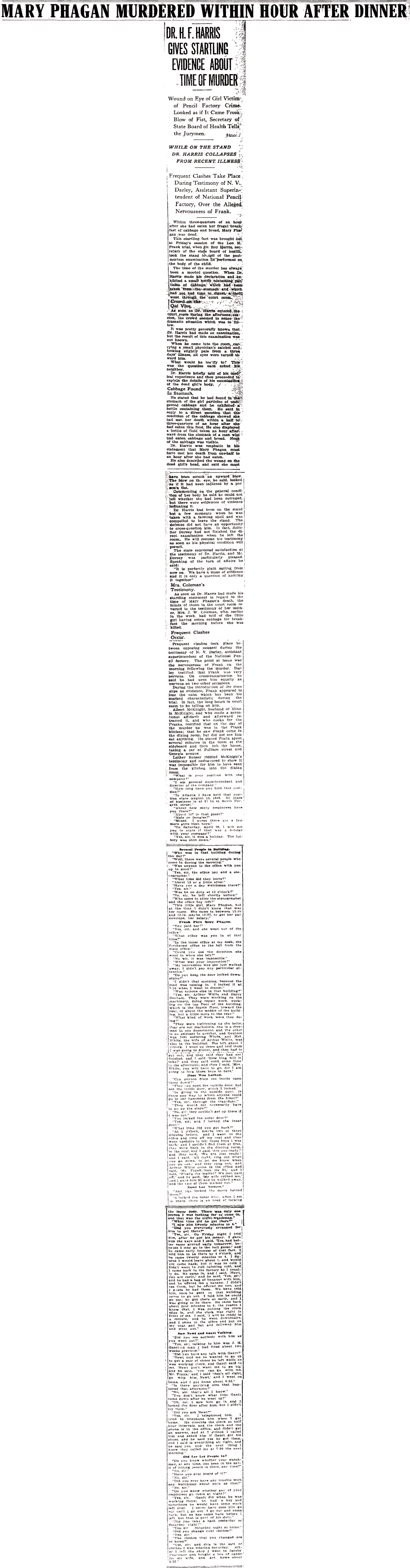
DR. H. F. HARRIS GIVES STARTLING EVIDENCE ABOUT TIME OF MURDER
Wound on Eye of Girl Victim of Pencil Factory Crime Looked as if It Came From Blow of Fist, Secretary of State Board of Health Tells the Jurymen.
WHILE ON THE STAND DR. HARRIS COLLAPSES FROM RECENT ILLNESS
Frequent Clashes Take Place During Testimony of N. V. Darley, Assistant Superintendent of National Pencil Factory, Over the Alleged Nervousness of Frank.
Within three-quarters of an hour after she had eaten her frugal breakfast of cabbage and bread, Mary Phagan was dead.
This startling fact was brought out at Friday's session of the Leo M. Frank trial, when Dr. Roy Harris, secretary of the state board of health, took the stand to tell of the post-mortem examination he performed on the body of the child.
The time of the murder has always been a mooted question. When Dr. Harris made his declaration and exhibited a small bottle containing particles of cabbage, which had been taken from the stomach and which had not had time to digest, a thrill went through the court room.
Crowd on the Qui Vive.
As soon as Dr. Harris entered the court room during the afternoon session, the crowd seemed to sense the dramatic situation which was to follow.
It was pretty generally known that Dr. Harris had made an examination, but the result of this examination was not known.
When he came into the room, carrying a small physician's satchel and looking slightly pale from a three days' illness, all eyes were turned toward him.
What would he testify to? This was the question each asked his neighbor.
Dr. Harris briefly told of his medical experience and then proceeded to explain the details of his examination of the dead girl's body.
Cabbage Found In Stomach.
He stated that he had found in the stomach of the girl particles of undigested cabbage and he exhibited a bottle containing them. He said in reply to a direct question that the condition of the cabbage showed she had met her death within a half to three-quarters of an hour after she had eaten this food. He also displayed a bottle of fluid taken an hour afterward from the stomach of a man who had eaten cabbage and bread. None of the cabbage was visible.
Dr. Harris was emphatic in his statement that Mary Phagan must have met her death from one-half to an hour after she had eaten.
He also described the wound on the dead girl's head, and said she must have been struck an upward blow. The blow on the eye, he said, looked as if it had been inflicted by a person's fist.
Commenting on the general condition of her body he said he could not tell whether she had been outraged, but there were evidences of violence indicating it.
Dr. Harris had been on the stand but a few moments when he was taken with a fainting spell and was compelled to leave the stand. The defense did not have an opportunity to cross-question him. In fact, Solicitor Dorsey had not finished the direct examination when he left the room. He will resume his testimony as soon as his physical condition will permit.
The state expressed satisfaction at the testimony of Dr. Harris, and Mr. Dorsey was particularly pleased. Speaking of the turn of affairs he said:
"It is perfectly plain sailing from now on. We have a mass of evidence and it is only a question of knitting it together"
Mrs. Coleman's Testimony.
As soon as Dr. Harris had made his startling statement in regard to the time of Mary Phagan's death, the minds of those in the court room reverted to the testimony of her mother, Mrs. J. W. Coleman, who, earlier in the week, had told of the little girl having eaten cabbage for breakfast the morning before she was killed.
Frequent Clashes Occur.
Frequent clashes took place between opposing counsel during the testimony of N. V. Darley, assistant superintendent of the National Pencil factory. The point at issue was the nervousness of Frank on the morning following the murder. Darley testified that Frank was very nervous. On cross-examination he said he had seen him equally as nervous on two other occasions.
During the introduction of the time slips as evidence, Frank appeared to lose the calm which has been his marked characteristic during the trial. In fact, the long hours in court seem to be telling on him.
Albert Mc Knight, husband of Minola Mc Knight, and who made a sensational affidavit and afterward retracted it, and who cooks for the Franks, testified that on the day of the murder he was in the Frank kitchen; that he saw Frank come in the dining room, but did not see him eat anything. He stated Frank spent several minutes in the room at the sideboard and then left the house, taking a car at Pulliam street and Georgia avenue.
Luther Rosser riddled Mc Knight's testimony and endeavored to show it was impossible for him to have seen from the kitchen into the dining room.
"What is your position with the company?"
"I am general superintendent and director of the company."
"How long have you held that position?"
"In Atlanta I have held that position since August 10, 1908. My place of business is at 37 to 41 South Forsyth street."
"About how many employees have you there?"
"About 107 in that plant?"
"Male or females?"
"Mixed. I guess there are a few more girls than boys."
"On Saturday, April 26, I will get you to state if that was a holiday with your company?"
"Yes, sir, it was a holiday. The factory was shut down."
Several People in Building.
"Who was in that building during the day?"
"Well, there were several people who come in during the morning."
"Was anyone in the office with you up to noon?"
"Yes, sir, the office boy and a stenographer."
"What time did they leave?"
"About 12 or a little after."
"Have you a day watchman there?"
"Yes, sir."
"Was he on duty at 12 o'clock?"
"No, sir, he left shortly before."
"Who came in after the stenographer and the office boy left?"
"This little girl, Mary Phagan, but at the time I didn't know that was her name. She came in between 12:05 and 12.10, maybe 12:07, to get her pay envelope, her salary."
Frank Pays Mary Phagan.
"You paid her?"
"Yes, sir, and she went out of the office."
"What office was you in at that time?"
"In the inner office at my desk, the furtherest office to the left from the main office."
"Could you see the direction she went in when she left?"
"No, sir, it was impossible."
"What was your impression?"
"My impression was she just walked away; I didn't pay any particular attention."
"Do you keep the door locked downstairs?"
"I didn't that morning, because the mail was coming in. I locked it at 1:10 when I went to dinner."
"Was anyone else in that building?"
"Yes, sir, Arthur White and Harry Denham. They were working on the machinery, doing repair work, working on the top floor of the building, which is the fourth floor, about the middle of the building, but a little more to the rear."
"What kind of work were they doing?"
"They were tightening up the belts; they are not machinists, one is a foreman in one department and the other is an assistant in another, and Denham was just assisting White, and Mrs. White, the wife of Arthur White, was also in the building. She left about 1 o'clock. I went up there and told them I was going to dinner, and they had to get out; and they said they had not finished, and I said 'How long will it take?' and they said until some time in the afternoon; and then I said, 'Mrs. White, you will have to go, for I am going to lock these boys in here.'
Door Was Locked.
"Can anyone from the inside open those doors?"
"They can open the outside door, but not the inside door, which I locked."
"In going in the outside door, is there any way by which anyone could go in the basement from the front?"
"Yes, sir; through the trap-door."
"They would not necessarily have to go up the steps?"
"No, sir; they couldn't get up there if I was out."
"You locked the outer door?"
"What time did you get back?"
"At 3 o'clock, maybe two or three minutes before, and I went to the office and took off my coat and then went upstairs to tell those boys I was back; and I couldn't find them at first, they were back in the dipping room, in the rear, and I said, 'Are you ready?' and they said, 'We are just ready;' and I said, 'All right, ring out when you go down, to let me know when you go out;' and they rang out, and Arthur White come in the office and said, 'Mr. Frank, loan me $2.' and I said, 'What's the matter? We just paid off,' and he said, 'My wife robbed me,' and I gave him $2 and he walked away, and the two of them walked out."
Newt Lee Arrives.
"And you locked the doors behind them?"
"I locked the outer door, when I am in there, there is no need of locking the inner door. There was only one person I was looking for to come in, and that was the night-watchman."
"What time did he get there?"
"I saw him twenty minutes to 4."
"Had you previously arranged for him to get there?"
"Yes, sir. On Friday night I told him, after he got his money. I gave him the keys and I said, 'You had better come around early tomorrow, because I may go to the ball game;' and he came early because of that fact. I told him to be there by 4 o'clock, and he came twenty minutes to 4. I figured I would leave about 1, and would not come back; but it was so cold I didn't want to risk catching cold, and I came back to the factory as I usually do. He came in, and I said, 'Newt, you are early,' and he said, 'Yes, sir;' and he had a bag of bananas with him, and he offered me a banana; I didn't see them, but he offered me one, and I guess he had them. We have told him, once he gets in that building never to go out. I told him he could go out; he got there so early, and I was going to be there. He came back about four minutes to 6; the reason I know that, I was putting the clock slips in, and the clock was right in front of me. I said, 'I will be ready in a minute,' and he went downstairs, and I came to the office and put on my coat and hat and followed him and went out."
Saw Newt and Gantt Talking.
"Did you see anybody with him as you went out?"
"Yes, sir; talking to him was J. M. Gantt a man I had fired about two weeks previous."
"Did you have any talk with Gantt?"
"Newt told me he wanted to go up to get a pair of shoes he left while he was working there, and Gantt said to me, 'Newt don't want me to go up,' and he said, 'you can go with me, Mr. Frank,' and I said 'that's all right, go with him, Newt,' and I went on home, and I got home about 6:25."
"Is there anything else that happened that afternoon?"
"No, sir; that's all I know."
"You don't know what time Gantt come down after he went up?"
"Oh, no; I saw him go in and I locked the door after him, but I didn't try them."
"Did you ask Newt?"
"Yes, sir. I telephoned him. I tried to telephone him when I got home. He punches the clock at half hour intervals, and the clock and the phone is in the office, and didn't get an answer, and at 7 o'clock I called him and asked him if Gantt got his shoes, and he said yes he got them, and I said is everything all right, and he said yes, and the next thing I knew they called me at 7:30 the next morning."
Did Lee Let People In?
"Do you know whether your watchman, at any time, has been in the habit of letting people in there, any time?"
"No, sir."
"Have you ever heard of it?"
"No, sir."
"Did you ever have any trouble with any watchman about such as that?"
"No, sir."
"Do you know whether any of your employees go there at night?"
"Yes, sir. Gantt did when he was working there; he had a key and sometimes he would have some work left over. I never have seen him go out until I go out; I go out and come back, but he has come back before I left, but that is part of his duty."
"Did you take a bath yesterday or Saturday night?"
"Yes, sir Saturday night at home."
"Did you change your clothes?"
"Yes, sir."
"The clothes that you changed are at home?"
"Yes, sir; and this is the suit of clothes I was wearing Saturday. After I left the shop I went to Jacobs' Pharmacy and bought a box of candy for my wife, and got home about 6:25."
PAGE 1, COLUMN 3
Witnesses Called to Stand to Testify Against Frank
Photos by Francis E. Price. Staff Photographer.
From left to right: Mrs. George W. Jefferson, who was a witness on Thursday morning; R. P. Barrett, who testified to finding Mary Phagan's pay envelope and strands of her hair, and Mrs. Maggie White, who told of seeing strange negro in pencil factory on afternoon of crime.
PAGE 2, COLUMN 2
Frequent and Angry Clashes Between Attorneys Mark the Hearing of Darley's Testimony
N. V. Darley, mechanical head of the National Pencil factory and directly in charge of the Georgia Cedar company, an adjunct concern, was put on the stand by the state, after Mrs. White had finished.
"How long have you been with the company, and are you still employed there?" asked Solicitor Dorsey.
"I've been there about five years, and am still employed there."
"Who is your immediate superior?"
"I consider Sig Montag my immediate superior," he replied.
"What is your relation to Frank?"
"We are co-laborers, on an equal basis."
"With whom do you more often come into contact?"
"With Frank."
"Did you see Frank on Saturday, April 26?"
"Yes."
"What time did you leave the factory that morning?"
"About 9:40."
"When did you next see Frank?"
"About 8:20 Sunday morning, at the factory."
"Was Frank there when you got there?"
"No; he came up just as I got there."
"What were you doing there?"
"Mrs. Frank had called me up and told me all. Mr. Frank had asked her to tell me to go to the factory."
Rosser objected to the witness telling anything Mrs. Frank had told him, and, despite the solicitor's statement that it had already been proved that Frank had asked his wife to call up Darley, Judge Roan ruled out his statements about what the wife had said.
Noticed Frank's Nervousness.
"Did you notice Frank as you got there?"
"Yes."
"What did you observe about him?"
"Nothing at first."
"Well, what, if anything, later?"
"When we started to go to the basement I noticed his nervousness."
"Describe it."
"Well, he started to lower the elevator, and as he reached for the rope his hands trembled, and then when he started to nail up the back door of the basement later his hands trimbled again, and I took the hammer and nailed up the door myself."
"What, if anything, did Frank say to you?"
"When we started to nail up the back door he made some remark about his clothes, and pulled off his coat."
"Did he say anything about coffee?"
"Not then."
Why Frank Wanted Coffee.
"Well, what did he say at any time that morning about coffee?"
"At the station house he told me he had been rushed away from home without any breakfast and carried into a dark room, where they turned the light on and showed him the dead girl, and that he was nervous and wanted some coffee."
"What did he say breakfast would do for him?"
"He said breakfast would keep him from being nervous."
"Did he get any breakfast?"
"I don't know; I left him at 10 o'clock."
"Did you see Newt Lee at the time you saw Frank in the factory?"
"Yes."
"Was Lee nervous or composed?"
The solicitor fired the above question at the witness as though seeking to show the jury that the man he charged with being guilty was nervous when at the scene of the crime, and the innocent man was not.
"Lee seemed thoroughly composed," answered the witness.
"What was said in the basement?"
"Something was said about the staple and Frank said that it would have been easy for anyone to have pulled out the staple. The staple looked to me like it had been pulled out before," the witness said.
"Did Frank suggest that the murder had occurred in the basement?"
"Yes."
"Repeat his words."
"I can't repeat the exact words, but I know he suggested that."
"Did he say anything later about being nervous or not?"
"Monday afternoon he said that if he had had some breakfast that morning he would not have been so nervous."
"What brought up the talk?"
"I don't remember what or who brought it up."
"How often did Frank try to explain his nervousness?"
"Twice."
"On what subject did Frank seem to dwell the most, the murder or his nervousness?"
Rosser Offers Objection.
Rosser entered a strong objection to this question, claiming that the witness was not qualified to testify about it. Judge Roan ruled that it could not be asked in that form.
"Well how often did he talk about the murder?"
"On numerous occasions."
"How much of Frank's body was shaking?"
"His hands."
The solicitor then produced a former affidavit made by Darley, in which the man had said Frank was shaking all over.
After he had looked at it, Darley reiterated his statement that only Frank's hands were trembling.
"It's too much to say that a man's whole body is trembling; you can't well tell," he continued.
"When were his hands trembling?"
"As we started to go down the elevator to the basement he reached for the rope and both hands trembled," and here the witness held up both his own hands and shook them violently.
Two Members of Jury
Photo by Francis E. Price. Staff Photographer.
On the left F. V. L. Smith, and on the right Beder Townsend.
"Could Frank have nailed up the back door?"
"I think so."
"What did you swear about this in your affidavit?" asked the solicitor, but the witness held out that he thought Frank could have nailed the door.
"How did Frank look that Sunday morning?"
"Pale."
"Can you say or not if Frank was upset and why in either case?"
Rosser Takes Dig at Dorsey.
"The witness can't testify in regard to 'upset,'" roared Attorney Rosser; "if he'd been in the courtroom all the week, though, and had watched the solicitor he would know what the word means."
"I don't see why we can't use the good old Anglo-Saxon word, 'upset,' instead of having to use 'nervous,'" the solicitor objected, and after an argument the court ruled that "upset" was just as much allowable as the Latin derivative.
"Well, was Frank upset?" continued the solicitor.
"I can't say that he was."
"Look here at what you said in your affidavit!" yelled the solicitor, apparently thoroughly exasperated.
Attorney Rosser declared that the solicitor had no right to talk in such a manner as to indicate to the jury what the witness had said in a former affidavit which had not been placed in evidence and went on to say that Frank's actions on that morning had shown that he was not thoroughly upset. Before he and the solicitor finished arguing the affair had almost developed into regular argument as to whether or not Frank was upset, rather than in contesting about the witness using the word.
"Well, on that Sunday morning was Frank thoroughly done-up?" asked the solicitor, seemingly determined to get down to plain, old Anglo-Saxon in preference to the Latin derivative, "nervous."
"What in the world does 'done-up' mean?" objected Reuben Arnold, Mr. Rosser's partner in the case. "It may mean in bed, for all I know," he added.
The court, however, held that "done-up" might come into the case and take its stand by the side of "upset" and that it was for the jury to determine what was meant when a witness used either of the words.
Frank "Partially Done-up."
Darley then declared that Frank was "partially done-up" on that Sunday morning that the body was discovered.
"Give your reasons for saying he was partially done-up," said Mr. Dorsey.
"Well, he did some things that a man entirely unstrung could not have done," said Darley.
"Unstrung" was a new word and when it came into the trial spectators expected Attorney Rosser to ask for its credentials, but he let it in without a murmur.
"Did Frank sit steadily on your knees in the auto ride to the station?" asked the solicitor.
"No, he was trembling and shaking."
"Did you see Lee?"
"Yes."
"What was his demeanor?"
"He was composed."
Mr. Rosser objected to the question about Lee, and Dorsey withdrew it.
"Did you attend to any business Monday?" the solicitor then asked.
"Yes"
"Did you see the financial sheet Sunday?"
"Yes."
"Who called your attention to sheet No. 28?"
"Frank."
"What did he say?"
"He said something about it."
"What time was it?"
"Between 8:20 and 9:45."
"Did J. M. Gantt ever come to the factory after he was discharged?"
"Yes."
"Did you see Frank examine the financial sheet?"
"Yes, he handed it to me."
"When did Haas, the insurance agent, come to the plant?"
"On Monday or Tuesday in May."
"What was done after his visit?"
"The plant was cleaned up in a general way."
"Did you clean up the first floor?"
"Yes, it was cleaned on May 3."
Bludgeon Produced in Court.
Mr. Dorsey then asked the defense to produce the bludgeon which it is claimed was found later in May near the elevator. They produced it.
"Did you see this club found?" Mr. Dorsey asked, sending it clattering down on the floor between the witness and the jury box.
"No."
"Was the finding of the club subsequent to the cleaning up?"
"Yes."
"Did you see anything on the rear of the office floor near the ladies' dressing room Monday after the murder?"
"Yes, blood," replied the witness.
"Who called your attention to the blood?" asked Attorney Arnold.
"Barnett and Quinn."
Arnold Cross-Questions.
"How many strands of hair did Barrett show you?" asked Mr. Arnold, who here took up the cross-examination which before this Attorney Rosser had always conducted.
"When I first saw them they were wound around a lever, and there seemed to be six or eight in all," said the witness.
"Wasn't it difficult to tell their color?"
"Yes."
"Barrett did most of the discovering, didn't he?"
"Yes."
"Isn't he mono-maniac on the subject of the crime; buys all the papers and keeps constant watch on the case?"
"Barrett claims to have discovered the blood spots, doesn't he?"
Mr. Dorsey also got this question ruled out.
"When you first saw the blood spots, who pointed them out to you?"
"Quinn, Barrett and others."
"Were they hidden by white spots?"
"Partially; not completely."
"In other words, the man who attempted to hide the spots left the spots and the attempt to hide them revealed," said Mr. Arnold.
"It looked that way," replied the witness.
"Did Barrett tell you he was working for the rewards?"
Mr. Dorsey objected to this question, and was sustained by Judge Roan.
"Did you ever see any blood around Mary Phagan's machine?"
"No."
"Did you see Barrett find the pay envelope?"
"No. I was at the other plant."
"What did most of the employees do with their pay envelopes?"
"Tear them and take out the money."
"By looking at this envelope can you tell whether it ever had any money in it?"
"No, there are no indications by which one can tell."
"Don't you find such envelopes all over the factory?"
"Yes, even in the metal room."
"Liable to find them anywhere, aren't you?"
"Yes."
"Nothing more common than pay envelopes?"
"No."
"Were you present when Frank ran his finger down the time slip?"
"Yes."
Fails to Identify Time Slip.
Mr. Arnold then showed the witness the time slip which the defense claims is the one taken out of the clock that Sunday morning by Frank.
"Is this the one?" the attorney asked.
"I can't say that it is, they are all alike."
"Did you notice the absence of punches on it?"
"No."
At this juncture M. Johenning, one of the jurors, stated that he desired some information about these time slips, and he and the witness exam
FREQUENT CLASHES BETWEEN ATTORNEYS
Continued From Page Two.
only about Frank's excitement that there was any material evidence.
Judge Roan held that the witness might be used to show that the occasion was an exciting one, but that he could not be used to show that others were excited.
Messrs. Arnold and Rosser repeatedly stated then that they wished their protest against this to go on record.
"Were there any spots on the metal room floor?" asked Mr. Arnold, again taking up his questioning.
"Yes; varnish spots," replied the witness.
"Any red spots?"
"Yes; red and dark ones."
"How long have you worked in a factory?"
"Twenty-four years."
Blood Spot Frequent.
"Have you ever seen blood spots where the employees work?"
"Yes, they are quite frequent."
"Why was the back door nailed up that Sunday morning?"
"Well, the factory could not be left unprotected."
"What colored suit did Frank have on that Saturday?"
"A brown one."
"Did he wear the same one Monday?"
"Yes; it looked like it."
"Well, the suit he wore Sunday was just his regular Sunday suit, wasn't it?"
"I don't know; it was a different suit."
"Did you see any scratches or bruises on Frank Sunday?"
"Never noticed any."
"Does the elevator make a noise when it runs?"
"Yes."
"Makes a bumping noise when it stops, too, doesn't it?"
"Yes, some."
"Is not the factory saw attached to the same motor as is the elevator?"
"Yes."
"Couldn't run the elevator without running the saw, could you?"
"Not unless you took the belt off that connects with the saw from the motor."
"Is the factory floor dirty?"
"Yes, it was when we went there. It was dirty, and it has always been so. In some places the dirt and grease is an inch thick and boxes are cluttered around on the floor."
Dark Around Elevator Shaft.
"Was it dark around the elevator shaft?"
"Yes, especially on cloudy days."
"Was April 26 cloudy? Didn't it rain on that day?"
"Yes, part of the time."
"Wasn't it very dark on the second floor around the elevator shaft and near the clock?"
"Yes."
"Can the metal room door be lock
"No, there is no lock on it."
"Aren't there large vats in the metal room?"
"Yes."
"Big enough to get a horse in?"
"Well, no, I won't say you could."
"Get a pony in there, then, couldn't you?" urged Mr. Arnold.
"Well, I don't know. They were rather shallow."
"Well, how deep are they, about 2 feet, or a foot and a half?"
"About a foot and a half, I think."
"Is anybody supposed to be in the factory on Sunday?"
"No."
"Isn't there slack in the elevator rope?"
"Yes, some little slack."
"When Frank was engaged in his work at the factory wasn't he very intent on it?"
"Yes."
Frank Easily Excited.
"Have you ever seen him get excited when things went wrong?"
"Yes, never a day went by without his getting excited. I've seen him get excited frequently and I've seen him rub his hands together a thousand times, and one day when Sig Montag raised cane he became terribly excited."
"Are you as nervous as Frank?"
"No."
"When he got excited and worried he would call on you, wouldn't he?"
"Yes, frequently."
"Did Frank know many of the help? Did he know Mary Phagan?"
Mr. Dorsey objected to the witness stating what was really something that was a state of Frank's own mind, and Judge Roan finally ruled that the witness might give his opinion.
"I don't know whether or not he knew Mary Phagan," the witness then declared.
"Did you know her?"
"I did not know the name, but if I had seen the girl on the street I would have known that she was one of the factory girls."
Darley then stated that pieces of paper similar to the part of a scratch pad found near the girl's body were commonly scattered around the building.
"Was the clock door unlocked that day?"
"Yes, the door was usually kept locked, but about that time the key was lost and the door was kept unlocked."
"Both you and Frank were mistaken that Sunday morning in thinking that the punches on the time slip were all right, were you not?"
"Yes," the witness replied.
Judge Roan then adjourned court for lunch.
Roan Reverses Decision.
At the beginning of the afternoon session Judge Roan reversed his decision in which he had sustained the state in their objection to testimony relative to the nervousness of others beside Frank being admitted.
He said:
"The defense can show the mental demeanor of any other person in the building. Relative to Darley's testimony of the handwriting, inasmuch as he is no expert, his statement will not be admitted without the compari
son of other handwriting specimens of the defendant."
The witness was then questioned by Attorney Arnold. After pointing out a number of stated discrepancies in the diagram presented by the state, he was asked:
"Anybody on the third floor can see anyone coming from the metal room, can they not?"
"Yes."
"Have you seen Mr. Frank in a nervous condition on any previous occasion?"
"Once, when he saw a child run over by a trolley car on which he was riding. He was nervous throughout the day and couldn't work. On an occasion prior to that he and Sig Montag had had an argument on the office floor of the pencil factory, and following, Mr. Frank was nervous the rest of the day."
"Did he use any remedy on day of the car accident."
"Yes, spirits of ammonia."
Everybody Was Excited.
"Everybody at the pencil factory was excited on the morning the body was discovered, were they not?"
"Yes."
"Some manifested nervousness in some ways while others manifested in different ways?"
"Yes."
"Who were there?"
"Detectives Black and Starnes and 'Boots' Rogers and others."
"Is there anything right about this diagram of the state's except a general view of things at the factory?"
"Yes."
"Isn't Frank's office a lot smaller than shown in the picture?"
"Yes."
"Does the picture show a bookcase in Frank's office?"
"No."
"Isn't there a case that hides part of the view from the office?"
"Yes."
"Doesn't the picture misrepresent the office view?"
"Yes."
"Isn't it drawn adroitly with that view?"
"It seems so."
Objection Is Sustained.
Attorney Hooper's objection to rule out the word "adroitly," on the grounds that it was purely a conclusion, was sustained.
"The safe looks small in the diagram, when, in fact, it is larger than the door?"
"Yes."
"The diagram doesn't show a rolltop desk, two cabinets nor a wardrobe, does it?"
"No."
"That's not a very accurate picture, is it?"
"No."
Solicitor Dorsey took the witness.
"Did you observe the persons who were there at the factory the same time you observed Frank's deportment?"
"Not at those very special moments."
"Did you tremble when you nailed the door in the basement?"
"No."
"Is there generally any difference in a person's attitude?"
"No."
"Who were nervous?"
"Starnes looked and spoke as though he was worried and excited."
"How do you know?"
"By his manner and words."
"Well, let's take up the next man."
"They all were officers."
Describe All Actions.
"Well, whether they were officers or not, you said they all were nervous. Now describe the actions of them all."
"I have explained all I know."
"Why did you notice Frank so much and fall on the others?"
"Because Frank was so much more nervous than all the others."
"Who else was nervous?"
"Mr. Holloway was shaky on Monday."
At this juncture the witness showed signs of anger. The solicitor asked him:
"Are you mad do you mind my questions?"
"No."
Another question was asked:
"Who else was nervous?"
"Mr. Schiff was shaky and apparently nervous."
"Was anybody nervous on Tuesday?"
"Yes, Mr. Frank was when the extras came out that he was to be arrested."
"Who gets up the data for the financial sheet?"
"Mr. Schiff and others."
"Then all Frank has to do is to compile this data?"
"I do not know."
"Was Newt Lee nervous?"
"I never noticed."
"What did Frank state to you in reference to the clock slips?"
Correct Up to 2:30 A. M.
"He said the slip of Newt Lee's was correct until 2:30 o'clock a. m."
"What was the date of this slip?"
"I didn't notice."
"Where are the time slips kept?"
"In a desk, and later in a safe."
"Could there have been two slips punched by Newt Lee were his slips ever in duplicate form?"
"Not to my knowledge."
"Where is the nearest place to Frank's office that these yellow pads are kept?"
In asking the question the solicitor held to view a yellow scratch pad containing sheets of paper similar to the sheet on which had been written one of the mysterious murder missives found beside the girl's body.
"On second floor near the office. We gave you twenty or more of them almost all we had."
"Is there a place to keep them in the basement?"
"No. They go down sometimes in the garbage."
"Is there any use for them on the first floor?"
"No use except on the office floor. They are often scattered around, however."
"Where is the trash put when carried downstairs?"
"Near the boiler in the basement."
Looked Like She Was Crying.
"What was Miss Smith doing that Saturday morning when you walked downstairs with her?"
"She looked as though she was crying."
"How long have you and Frank worked together?"
"For two years."
"On the Tuesday following the Phagan tragedy did any woman become subject to tears in the pencil factory?"
"Yes, a Miss Ella Mae Flowers had a crying spell Tuesday."
"The whole factory was wrought up, wasn't it?"
"Yes. I had to let them go on Monday, and I often wished I had not let them go back to working during the whole week."
PAGE 3, COLUMN 2
Startling Statements Made During Testimony of Dr. Harris
Making the startling declaration that Mary Phagan had been killed within thirty or forty-five minutes after she had eaten dinner, Dr. Roy F. Harris, state chemist, took the stand during the afternoon session yesterday.
It was Dr. Harris who made the autopsy upon the body when it was disinterred in Marietta on May 5. He brought with him into court specimens of predigested cabbage which had been removed from the slain girl's stomach.
He also testified to the effect that the girl had suffered violence before death and recited the condition in which he had found blood vessels and tissues of the girl's organs.
He was questioned first by Solicitor Dorsey.
"What is your occupation?"
"I am a physician."
"How long have you been a physician?"
"Since 1889."
"Give the jury a brief history of your career."
"I was graduated in Atlanta in 1889 and in Philadelphia in 1890. I was professor of chemistry in the medical college at Philadelphia, and later became assistant professor of bacteriology in the Jefferson Medical college. I was professor in the Atlanta College of Medicine, and have been director of laboratory in the state board of health since the inauguration of the board."
"Did you examine the body of Mary Phagan?"
"Yes. On May 5."
"What did you discover, if anything?"
"Several discolorations. One was on the forehead, one on an arm and one on each of the left and right legs. A huge discoloration was on the right eye."
"What did the discoloration of the right eye seem to have been inflicted by?"
"By a fist."
"Was there another wound?"
"Yes. One on the head about an inch and a half in length. On removing the he had discovered evidences of violence.
"How long does it take a corpse to begin rigor-mortis?"
"It varies so much in different cases that it is impossible to determine."
"Are you able to say how long it was before Mary Phagan died?"
"No. I can't say."
"How long did she live after eating her last meal?"
"Thirty or forty-five minutes."
"How much blood did she lose?"
"That, I cannot say."
It was upon this last answer that Dr. Harris suffered the collapse. He was assisted from the stand by Deputy Sheriff Plennie Miner before the defense was able to begin its cross-examination.
PAGE 3, COLUMN 4
Negro Lurking in Factory Seen by Wife of Employee
Mrs. Maggie White, wife of John Arthur White, who was at work on the fourth floor of the National Pencil factory part of the day upon which Mary Phagan was killed, was the first witness the state called to the stand Thursday morning in the Frank trial.
The witness told of going to the factory twice on that day to see her husband, and of seeing Frank on both occasions, and also of seeing a negro lurking behind some boxes on the first floor.
"How long has your husband been working for the National Pencil factory?" Solicitor Hugh Dorsey asked after the usual questions as to her identity.
"About two years," she replied.
"Does he still work there?"
"Yes."
"Was he at the factory on April 26, and at what time?"
"Yes, he was there; I left home to go there about 7:30 in the morning. I saw him there when I first went there about 11:30, and when I came back at 12:30 he was still there."
"Who else did you see there?"
"Miss Corinthia Hall, Mr. Frank, Miss Emma Freeman and two men whose names I do not know: all were in Mr. Frank's office when I first saw them."
"How long did you stay the first time?"
"About twenty minutes."
"Did you talk to Frank?"
"Yes; I asked to see my husband."
"What did he say?"
"He asked me if I were Mr. White's wife."
"What else did he say, if anything?"
"He said he thought as much, as I looked like the Campbells. My father, E. S. Campbell, and my brother, Wade Campbell, both worked there," she explained.
"How long had they worked there?"
"About two years."
"What did Frank say after that?"
Saw Her Husband.
"He told Miss Freeman to go after Mr. White, and my husband came down to see me."
"Where did you see your husband?"
"On the second floor, near the foot of the stairs."
"How long did you talk to him?"
"About fifteen minutes."
"What did you do then?"
"I went out."
"What time did you come back?"
"About 12:30."
"Why do you use the word 'about'?"
"Well, I looked at the clock and read the time as 12:30, but there might have been a minute's difference."
"Did you see Frank when you came back the second time?"
"Yes."
"What then?"
"He jumped when I went into his office and spoke to him."
"What did you do then?"
"I went upstairs to see my husband."
"Who was with him?"
"Harry Denham."
"Where were they?"
"On the fourth floor of the building, about middle way down."
"What were they doing?"
"Hammering on one of the machines."
"How many were using hammer?"
"One of them."
"Did you hear the hammering?"
"Yes."
"When?"
"As I got to the fourth floor."
"How loud was the noise?"
"Just like the sound of a hammer hitting a piece of iron."
"What did you ask Frank after he jumped?"
"I just asked if my husband and Mr. Denham had gone back to work, and he said they had."
Had to Repeat Question.
"How often did you ask him?"
"I asked him twice."
HE IS PRESIDING IN FRANK TRIAL
JUDGE L. S. ROAN
"Why did you repeat the question?"
"Because he asked me to."
"Did you see Frank again that day?"
"Yes, he came up to the fourth floor."
"What did he come up there for?"
"He came up about 1 o'clock and told my husband that if I wanted to leave the building before 3 o'clock that I had better go then, as he was going out to lunch."
"What time did you leave?"
"It was about 1 o'clock"
"Do you think it was just before or just after one?"
"Just before one."
"How do you know?"
"I stayed there about a half hour, and then I was somewhere else at 1 o'clock."
"Where did you go?"
"I went to Mc Donald's furniture store on West Mitchell street, four or five blocks away."
"I got there a few minutes after 1."
"How much before 1 was it when you left the factory?"
"It was about 10 minutes to 1."
"Why did you leave?"
"Well, Mr. Frank said I'd better leave if I wanted to get out of the building before 3 o'clock."
"Did you see him again?"
Saw Frank in Office.
"Yes, when I came down I saw him sitting at the table in his office."
"Which office was he in?"
"The outer office."
"Hadn't he said he was going as soon as he got his hat and coat?"
"Yes."
"Did you see anyone else?"
"Yes, I saw a negro behind some boxes as I came down the steps."
"Where and at what time was that?"
"It was on the first floor, close to the stairway that goes up to the second floor, and at about 10 minutes to 1."
Mrs. White then outlined, at the solicitor's request, upon the cross-section drawing, her movements on that day in the factory, and in doing so declared that her husband and Denham were nearer the front of the building than she had first thought.
Rosser Cross-Examines.
Mr. Rosser then took up the cross-examination for the defense. By a series of questions he made the witness declare that she was rather indefinite about the time on the various occasions of which she testified.
"Did anyone come upstairs where you were talking to your husband besides Mr. Frank?"
"Yes, Mrs. May Barrett and her daughter and Miss Hall and Miss Freeman."
"Who left first?"
"Mrs. Barrett and her daughter left and then the other two ladies."
"You went to the factory about 12:30 the second time?"
"Yes."
"Was Frank standing in front of the safe?"
HIS TESTIMONY CAUSES CLASH
Photo by Francis E. Price, Staff Photographer.
N. V. DARLEY.
Assistant Superintendent of National
Pencil Factory.
"Yes."
"Was the safe door open?"
"Yes."
"How close were you when you spoke to him?"
"I came right into the office and spoke to him."
"Didn't you surprise him by speaking suddenly?"
"I don't think so."
"What happened then?"
"He told me to go up and see my husband."
"Did Frank say when he came up there that if you wanted to get out before 3 that you had better go pretty soon, as he was going in a few minutes?"
"Yes, that's about it."
The attorney for the defense was evidently trying to convince the jury that Frank had not been especially anxious to get the woman out of the building right away.
"As you got down the steps you saw a darkey there?"
"Yes."
"Between the foot of the stairway and the door?"
"Yes."
On his own blue print of the factory the defending attorney then had the witness point out her various movements that day in the factory building, and she was allowed to come off the stand after having been testifying for about half an hour.
PAGE 3, COLUMN 5
Policeman W. F. Anderson Tells Of Newt Lee's Telephone Call
W. F. Anderson, the policeman who answered the telephone when Newt Lee called police headquarters on the morning of the discovery and who went with the police squad to the scene, was next called to the stand.
"About 3 o'clock on the morning of April 26 where were you?" he was asked by the solicitor.
"At police headquarters."
"Did you have a telephone call about that time?"
"A man called from the National Pencil factory and said a woman had been killed. I asked was it a white woman or negro, and he answered that she was white."
"Upon arriving at the factory who did you try to telephone?"
Called for Frank.
"I called for Leo M. Frank."
"Did you get him?"
"No."
"Did you get central?"
"Yes."
"How long did you continue to call?"
"Five minutes or more."
"Who else did you call?"
"Mr. Selig and Mr. Montag."
"Did you get them?"
"Yes."
"Within what time?"
"Within a very short time."
"Did you make any other effort to get in communication with Frank?"
"Yes, about 4 o'clock, with still no success."
"Who was the first to get into the basement when your party first arrived?"
"We were all together I think I was last."
"Describe the body's underclothing."
"It was dirty and soiled."
Attorney Rosser took the witness.
"Did you explain to Montag that a girl had been killed when you called him over the telephone?"
"Yes, and they said we would have to get Mr. Frank or Mr. Darley."
"What kind of lantern did Newt Lee have?"
"It was sooty and soiled."
Conduct Experiments.
"You stood in place from which Lee said he first saw the body, did you not?"
"Yes, we put a box with a sack over it and experimented. You could see the bulk of something in the spot in which the body lay."
"When the coroner's jury went down, didn't you take the lantern and say you didn't think you could see the body didn't you say it?"
"I said I didn't think you could distinguish it as a body."
"Did you find any tracks in the basement?"
"Yes."
"Did you say that there were tracks all over the cellar?"
"Yes."
"Isn't that all you said?"
"I said, also, that there were tracks on the left hand side of the shaving room."
"Do you remember Frank's telephone number?"
"No."
PAGE 5, COLUMN 1
Husband of Minola Mc Knight Describes Movements of Frank
Albert Mc Knight, colored, the husband of Minola Mc Knight, who made a startling affidavit for the police in regard to circumstances at the Frank home on the night of the murder, followed Febuary to the stand.
"What is your wife's name?" the solicitor asked. "Minola Mc Knight." "What does she do?" "Cooks at Mrs. Selig's home." "How long has she held that place?" "For two years." "Where were you about 1 o'clock on the afternoon of April 26?"
Saw Frank April 26.
"I was at Mr. Frank's home." (The Franks have been living with the Seligs, Mrs. Frank's parents.) "Did you see Frank?" "Yes." "What did he do?" "He went to the sideboard and then went out. The sideboard is in the dining room." "How long did he stay at home?" "Five or ten minutes."
Rosser began questioning the negro. "Who were at home when Frank arrived?" "Mrs. Frank and Mrs. Selig." "Where were you?" "In the kitchen." "How could you see into the dining room?" "The door was open." "Do you know positively that he ate nothing?" "Yes." "Doesn't the door stay closed?" "Sometimes." "How could you see into the entire dining room?" "I could look into a mirror in the " "How long is the dining room?" "I couldn't tell."
Sketch Drawn by Prisoner.
Frank, at this point of the negro's testimony, drew a sketch to illustrate the position of the dining room and kitchen. Mc Knight explained, by aid of the drawing, how he could see into the dining room.
"You haven't got a curve in your eye, have you? You can't look a curve, can you?" Rosser asked. Witness did not answer. "You say Frank went to the sideboard then back to town?" "Yes." "You couldn't tell what he did at the sideboard?" "No." "Who talked to you at the station?" "Mr. Lanford, Mr. Starnes, Mr. Campbell and Mr. Dorsey." "That's the day Dorsey sent Minola to jail, isn't it?" "Yes." "Did you go to see Minola in jail?" "No." "Never?" "No, sir." "When you got to Frank's home, Mrs. Frank and Mrs. Selig were there, weren't they?" "I heard them talking." "You followed Frank from the house, didn't you?" "Yes." "Where did he go?"
Took Street Car to Town.
"He got on a Georgia avenue car at Pulliam street." "Are you sure?" "Yes, sir."
Dorsey began questioning here. "What street is the Frank home on?" "Georgia avenue." "Upon leaving his home, what did Frank do?" "Came out of the front door and walked up Georgia avenue to Pulliam street, where he caught a car." "Which was nearer for him to have caught a car, at Pulliam street or Washington street?" "Both are about the same." He was then called from the stand.
PAGE 5, COLUMN 1
Stenographer Parry Identifies Notes Taken at Phagan Inquest
Stenographer Parry, the official court stenographer, was next called to the stand to identify a number of notes he took at the coroner's inquest held in police headquarters shortly after Frank's arrest.
He was asked by Solicitor Dorsey: "Did you report the coroner's inquest over the body of Mary Phagan?" "Yes." "Did you take a statement from Leo Frank?" "Yes." The solicitor showed the stenographer's notes. "Is that your report?" "Yes." "Is it correct?" "It is correct to the best of my ability." "You are an expert?" "I am a man of twenty-five years' experience."
Attorney Rosser took the examination: "Look at Lee's testimony. Did you take it down correctly?" "To the best of my ability." "I don't want to know your ability. I want to know if it was correct. Are you prepared to say whatever you took down is correct or not?" "In the proper acceptation of the term it is correct." He then identified an amount of Lee's testimony.
PAGE 5, COLUMN 1
Women and Girls Thronging Court for Trial of Leo Frank
Fully one-fourth of the big audience at yesterday afternoon's session of the Frank trial was composed of women and girls. It was the largest crowd of the entire case, and, to the credit of Deputy Sheriff Miner and his force, was handled more effectively than at any preceding session.
There were many strange faces. The women sat in conspicuous seats, fighting many times to obtain a location in view of the witness stand and the tables at which sat the state's lawyers and counsel for the defense. Many were small girls, especially one, who did not look over 14, and who wore a big hat that covered a mass of brown curls.
There were all types of feminine auditor the woman of social position and the working women, most of the latter coming into the courtroom later in the afternoon when their working hours were at an end.
PAGE 5, COLUMN 1
Gay Febuary Tells Frank Jury About Statement Prisoner Made
Gay C. Febuary, secretary to Chief Newport A. Lanford, of the detective bureau, and recent figure in the sensational dictagraph episode, was called to the stand to testify to a statement made by Leo Frank on April 26 in Chief Lanford's office.
It was during Febuary's testimony that Frank's statement was permitted to be produced before the jury. It was read by Attorney Stephens, an associate of Solicitor Dorsey.
Mr. Dorsey questioned Febuary: "You were present at Lanford's office when Frank and Luther Z. Rosser were there?" "Yes." "Do you remember having made stenographic report of a statement made by Frank?" "Yes." He was given the report for identification, which he established. "What was Attorney Rosser doing during the time the statement was made?" "Looking out of the window most of the time."
Mr. Rosser began the interrogation at this point. "You haven't got a dictagraph with you, have you?" he asked sarcastically. "No," was the answer. "Lanford sent for you to make this statement, didn't he?" "Yes." "You are Lanford's private secretary?" "Yes." "He has been chief of police for years?" "He has been chief of detectives." "Chief of detectives, then, that's just as bad." Here Rosser pointed to Lanford, sitting in a chair at the railing. "That's he my handsome friend over there."
ON STAND WEDNESDAY
W. W. (BOOTS) ROGERS.
PAGE 5, COLUMN 3
Humor--Pathos--Tragedy In the Quickly Changing Kaleid- oscope of the Frank Trial
By Britt Craig
The Leo Frank trial is a clearinghouse of human emotions. If you don't know what a clearinghouse of human emotions is, go into the courtroom and sit awhile. That is, if you can get in. A good many haven't been able to. Yet, on the other hand, a good many have.
They say that humor and pathos go hand in hand. Down there at Pryor and Hunter streets, right across from the spot where the magnificent new temple of justice is mounting higher and higher every day, they go with locked arms. Tragedy walks between in what little space is left.
A person with just a little imagination and an ordinary hearing apparatus can sit in the courtroom and enjoy a performance that includes farce, comedy and tragedy and most anything else that is included in the list of human feelings.
It's a pity the place isn't large enough to accommodate everybody.
A Self-Appointed "Sob" Sister
A slight little woman, as pretty as a picture, came into the courtroom the other day at an afternoon session. She carried a heavy notebook under her arm and had to push her way as she wedged in between one man here and another there.
She eventually reached the press table. A number of reporters were bumming cigarettes from Plennie Miner and sending notes to Chief Lanford, jokingly asking if he would deny the report that he had died that morning. There was an empty seat, and therein she reposed herself and notebook with an air of "Well, here I am, thank goodness."
A reporter who had an eye for beauty as well as an insatiable curiosity, quired:
"What paper are you with?"
"I'm not on any paper, thank you. I'm a sob-sister."
"A what!"
"Oh, a sob-sister. Don't you know what they are?"
"Yes, but they work on papers like other ordinary reporters."
"I'm a free-lance."
"What is the job of sob-sisters?"
"They write stories with tears in 'em and make folks cry and weep and pull at their heart strings."
The press table grouped their heads and said that no sob-sister who ever admitted she was a sob-sister ever was a sob-sister, ever had been or ever would be. So, they concluded that she was a rank imposter, make no difference how pretty she was, or how willing she was to admit that she belonged to somebody's sob-squad.
"We don't allow any free-lances at this table," said Deputy Sheriff Miner. "If you're on no particular paper, you'll have to move."
"Very well, then," she answered. "If it'll suit you, I'm on the Fulton County Daily Report."
She sat.
Attorney Moore in Court
Attorney John Moore, who, for the past two biggest murder trials of the last years has been a figure as important and conspicuous as the defendant, seems to find it impossible to keep away from the biggest criminal case of the year.
At the Friday morning session he appeared at the Frank trial, smiling and nodding to acquaintances all over the courtroom. While the heated argument between Solicitor Dorsey and counsel for the defense was under way, he climbed to the bench and talked interestedly for several moments with Judge Roan.
Mr. Moore has made repeated and constant denial that he is in any manner associated with the defense in the Frank case. The rumor has been in circulation for some time, however, that he is a silent figure in movements of the defense.
Reserve Seats Du Luxe.
There are places and places from which one may be able to witness a big trail, but the back gallery of a livery stable with only a bannister railing for a seat is a point of vantage hitherto unheard of.
But many hitherto unheard of things have happened in the Frank trail.
At the Friday morning session someone happened to glance through the window directly behind the witness box. A few feet beyond, just across an alley, a long gallery of an adjoining livery stable was filled with men and women and girls. Many sat on the bannister railing, while others reposed on buggies and wagons and vehicle of all sorts.
A woman who was pretty enough to have wiled her way past the doorkeeper of an executive session of the board of education, stood in the doorway to the kitchen of a Greek restaurant.
All these spectators were able to hear the entire examination of witnesses and most of the arguments.
Anent Nervousness.
It was an interesting argument that followed Solicitor Dorsey's objection to Reuben Arnold's query put to M. R. Darley, regarding the nervous demeanor of others who were with Frank at the pencil factor on the morning of the body's discovery.
Attorney Arnold had asked Darley, after Darley had stated that Frank was obviously nervous and trembling, if all others around the building were similarly affected.
"I object," interposed the solicitor, and the fireworks began.
"Some men," said Mr. Arnold, "display nervousness and some do not. It is all according to temperament. Some men are able to face a hallstorm of bullets while men drop, bloody and disfigured, all about them. Yet, there are plenty of us who quail at the sight of a corpse, and are completely unstrung at such a spectacle.
"The question of nervous deportment should have never been injected into this case. Some of the biggest rascals on earth can sit stolidly and never tremor, while a man of undisputed honesty will quake and tremble on examination."
The solicitor, after citing a ruling in the famous Woolfolk case, said briefly: "It is absurd to throw out a dragnet and attempt to rope in everybody's temperament on the day of the tragedy utterly absurd." He was sustained.
Duties as Censors.
The duties of a censor, which, heretofore, has been confined to moving pictures and bald-head-row stage performances, now apply to Atlanta's jurymen. Deputy Sheriff Plennie Miner, or whoever is deputying the jury in the Frank case, has been assigned by Judge Roan to censor whatever mail the jurymen desire to read during course of the case.
Not only that, but he has been ordered to censor the jury's literature. Friday afternoon at the close of the Friday session Judge Roan gave the jurymen permission to read magazines and periodicals which the sheriff or his deputy, or whoever is concerned in the matter decided was fit reading matter.
Speculation is rife whatever that happens to mean over the kind of literature a sheriff or his deputy will select for a jury.
It will, also, no doubt, be a very delicate job for the sheriff, or his deputy, to peruse some of the mail of the jurors.
Maybe, though, the situation can be solved, as has already been suggested, by swearing the deputy or the sheriff or whoever it is who has the censoring business on his hands to utter secrecy. Things are likely to develop if not likely, liable which needs secrecy, utter secrecy.
Lanford and the Press Stand.
Chief Newport A. Lanford, of the detective department of police headquarters, has been an interesting figure in the Frank trial. Every day he sits just behind the table occupied by the state.
It was under his direction that much of the important evidence was gathered which is being produced by the solicitor. He was associated with the third degree and examinations to which Frank was subjected and those under which Jim Conley was put.
He is a large, striking looking man, very big and heavy and wears a moustache closely cropped, which is beginning to show gray at the edges. He is a keen observer of the proceedings, overlooks nothing and frequently makes suggestions to the solicitor.
During lulls in the trial he makes the occupants of the press table butts for his pointed jokes. He denies that the defense is planning to put him on the stand. When asked to verify the report that the defense would use him he said: "They'll quickly discover that they are resting under a decidedly grave misapprehension of the testimony I could give it would be very hurtful to them."
A Touch of Tragedy.
The grim story of Mary Phagan's tragic end was brought forcibly to the attention of a crowded courtroom Friday afternoon when Dr. Roy F. Harhis, state chemist, told on the stand of exhuming the body of Mary Phagan and of making minute examination of her corpse.
With a precision of the medical expert, he calmly related the story of the discolored eye, the wounds on the body and the gash in the head. He told of opening the skull to ascertain whether or not the blow had been sufficient to break, and of examining the brain for hemorrhage.
There was not a sound from the hundreds, straining eyes and ears for fear one tiny detail would be lost. The room was hushed and stifling, and only the noise of the street was to be heard blending with the ceaseless buzzing of the ozonators and the electric fans. It was the most thrilling testimony of the day, and during its course many women arose and left their seats, hiding their faces and the crimson that spread to the cheeks with newspapers.
"There was a deep impression in the throat," said the medical expert. "It was made by a stout cord or twine. It was an eighth of an inch deep and fully that wide. Death, unquestionably, was from strangulation."
When the solicitor arose, holding to view the wrapping cord which had been found around the neck of the body, and said: "Could it have been inflicted by a cord this size?" There were many shudders, especially from the girls and women.
As the witness gave his answer, his features whitened. He wavered and clutched the arms of the chair for support. He had almost collapsed, and could not resume his statement because of illness with which he had been confined to bed for three previous days.
PAGE 1, COLUMN 3
Witnesses Called to Stand to Testify Against Frank
Photos by Francis E. Price. Staff Photographer.
From left to right: Mrs. George W. Jefferson, who was a witness on Thursday morning; R. P. Barrett, who testified to finding Mary Phagan's pay envelope and strands of her hair, and Mrs. Maggie White, who told of seeing strange negro in pencil factory on afternoon of crime.
PAGE 1, COLUMN 7
DR. H. F. HARRIS
GIVES STARTLING EVIDENCE ABOUT TIME OF MURDER
Wound on Eye of Girl Victim of Pencil Factory Crime
Looked as if It Came From Blow of Fist, Secretary of State Board of Health Tells the Jurymen.
Within three-quarters of an hour after she had eaten her frugal breakfast of cabbage and bread, Mary Phagan was dead.
This startling fact was brought out at Friday's session of the Leo M. Frank trial, when Dr. Roy Harris, secretary of the state board of health, took the stand to tell of the post-mortem examination he performed on the body of the child.
The time of the murder has always been a mooted question. When Dr. Harris made his declaration and exhibited a small bottle containing particles of cabbage, which had been taken from the stomach and which had not had time to digest, a thrill went through the court room.
Crowd on the Qui Vive.
As soon as Dr. Harris entered the court room during the afternoon session, the crowd seemed to sense the dramatic situation which was to follow.
It was pretty generally known that Dr. Harris had made an examination, but the result of this examination was not known.
When he came into the room, carrying a small physician's satchel and looking slightly pale from a three days' illness, all eyes were turned toward him.
What would he testify to? This was the question each asked his neighbor.
Dr. Harris briefly told of his medical experience and then proceeded to explain the details of his examination of the dead girl's body.
Cabbage Found In Stomach.
He stated that he had found in the stomach of the girl particles of undigested cabbage and he exhibited a bottle containing them. He said in reply to a direct question that the condition of the cabbage showed she had met her death within a half to three-quarters of an hour after she had eaten this food. He also displayed a bottle of fluid taken an hour afterward from the stomach of a man who had eaten cabbage and bread. None of the cabbage was visible.
Dr. Harris was emphatic in his statement that Mary Phagan must have met her death from one-half to an hour after she had eaten.
He also described the wound on the dead girl's head, and said she must
PAGE 2, COLUMN 1
have been struck an upward blow. The blow on the eye, he said, looked as if it had been inflicted by a person's fist.
Commenting on the general condition of her body he said he could not tell whether she had been outraged, but there were evidences of violence indicating it.
Dr. Harris had been on the stand but a few moments when he was taken with a fainting spell and was compelled to leave the stand. The defense did not have an opportunity to cross-question him. In fact, Solicitor Dorsey had not finished the direct examination when he left the room. He will resume his testimony as soon as his physical condition will permit.
The state expressed satisfaction at the testimony of Dr. Harris, and Mr. Dorsey was particularly pleased. Speaking of the turn of affairs he said:
"It is perfectly plain sailing from now on. We have a mass of evidence and it is only a question of knitting it together."
Mrs. Coleman's Testimony.
As soon as Dr. Harris had made his startling statement in regard to the time of Mary Phagan's death, the minds of those in the court room reverted to the testimony of her mother, Mrs. J. W. Coleman, who, earlier in the week, had told of the little girl having eaten cabbage for breakfast the morning before she was killed.
Frequent Clashes Occur.
Frequent clashes took place between opposing counsel during the testimony of N. V. Darley, assistant superintendent of the National Pencil factory. The point at issue was the nervousness of Frank on the morning following the murder. Darley testified that Frank was very nervous. On cross-examination he said he had seen him equally as nervous on two other occasions.
During the introduction of the time slips as evidence, Frank appeared to lose the calm which has been his marked characteristic during the trial. In fact, the long hours in court seem to be telling on him.
Albert Mc Knight, husband of Minola Mc Knight, and who made a sensational affidavit and afterward retracted it, and who cooks for the Franks, testified that on the day of the murder he was in the Frank kitchen; that he saw Frank come in the dining room, but did not see him eat anything. He stated Frank spent several minutes in the room at the sideboard and then left the house, taking a car at Pulliam street and Georgia avenue.
Luther Rosser riddled Mc Knight's testimony and endeavored to show it was impossible for him to have seen from the kitchen into the dining room.
"What is your position with the company?"
"I am general superintendent and director of the company."
"How long have you held that position?"
"In Atlanta I have held that position since August 10, 1908. My place of business is at 27 to 41 South Forsyth street."
"About how many employees have you there?"
"About 107 in that plant."
"Male or females?"
"Mixed. I guess there are a few more girls than boys."
"On Saturday, April 26, I will get you to state if that was a holiday with your company?"
"Yes, sir, it was a holiday. The factory was shut down."
Several People in Building.
"Who was in that building during the day?"
"Well, there were several people who come in during the morning."
"Was anyone in the office with you up to noon?"
"Yes, sir, the office boy and a stenographer."
"What time did they leave?"
"About 12 or a little after."
"Have you a day watchman there?"
"Yes, sir."
"Was he on duty at 12 o'clock?"
"No, sir, he left shortly before."
"Who came in after the stenographer and the office boy left?"
"This little girl, Mary Phagan, but at the time I didn't know that was her name. She came in between 12:05 and 12:10, maybe 12:07, to get her pay envelope, her salary."
Frank Pays Mary Phagan.
"You paid her?"
"Yes, sir, and she went out of the office."
"What office was you in at that time?"
"In the inner office at my desk, the furtherest office to the left from the main office."
"Could you see the direction she went in when she left?"
"No, sir, it was impossible."
"What was your impression?"
"My impression was she just walked away; I didn't pay any particular attention."
"Do you keep the door locked downstairs?"
"I didn't that morning, because the mail was coming in. I locked it at 1:10 when I went to dinner."
"Was anyone else in that building?"
"Yes, sir. Arthur White and Harry Denham. They were working on the machinery, doing repair work, working on the top floor of the building, which is the fourth floor, toward the rear, or about the middle of the building, but a little more to the rear."
"What kind of work were they doing?"
"They were tightening up the belts; they are not machinists, one is a foreman in one department and the other is an assistant in another, and Denham was just assisting White, and Mrs. White, the wife of Arthur White, was also in the building. She left about 1 o'clock. I went up there and told them I was going to dinner, and they had to get out; and they said they had not finished, and I said 'How long will it take?' and they said until some time in the afternoon; and then I said, 'Mrs. White, you will have to go, for I am going to lock these boys in here.'"
Door Was Locked.
"Can anyone from the inside open those doors?"
"They can open the outside door, but not the inside door, which I locked."
"In going in the outside door, is there any way by which anyone could go in the basement from the front?"
"Yes, sir; through the trap-door."
"They would not necessarily have to go up the steps?"
"No, sir; they couldn't get up there if I was out."
"You locked the outer door?"
"Yes, sir; and I locked the inner door."
"What time did you get back?"
"At 3 o'clock, maybe two or three minutes before, and I went to the office and took off my coat and then went upstairs to tell those boys I was back; and I couldn't find them at first, they were back in the dipping room, in the rear, and I said, 'Are you ready?' and they said, 'We are just ready;' and I said, 'All right, ring out when you go down, to let me know when you go out,' and they rang out, and Arthur White come in the office and said, 'Mr. Frank, loan me $2,' and I said, 'What's the matter? We just paid off,' and he said, 'My wife robbed me,' and I gave him $2 and he walked away, and the two of them walked out."
Newt Lee Arrives.
"And you locked the doors behind them?"
"I locked the outer door, when I am in there, there is no need of locking the inner door. There was only one person I was looking for to come in, and that was the night-watchman."
"What time did he get there?"
"I saw him twenty minutes to 4."
"Had you previously arranged for him to get there?"
"Yes, sir. On Friday night I told him, after he got his money. I gave him the keys and I said, 'You had better come around early tomorrow, because I may go to the ball game;' and he came early because of that fact. I told him to be there by 4 o'clock, and he came twenty minutes to 4. I figured I would leave about 1, and would not come back; but it was so cold I didn't want to risk catching cold, and I came back to the factory as I usually do. He came in, and I said, 'Newt, you are early,' and he said, 'Yes, sir;' and he had a bag of bananas with him, and he offered me a banana; I didn't see them, but he offered me one, and I guess he had them. We have told him, once he gets in that building never to go out. I told him he could go out; he got there so early, and I was going to be there. He came back about four minutes to 6; the reason I know that, I was putting the clock slips in, and the clock was right in front of me. I said, 'I will be ready in a minute,' and he went downstairs, and I came to the office and put on my coat and hat and followed him and went out."
Saw Newt and Gantt Talking.
"Did you see anybody with him as you went out?"
"Yes, sir; talking to him was J. M. Gantt a man I had fired about two weeks previous."
"Did you have any talk with Gantt?"
"Newt told me he wanted to go up to get a pair of shoes he left while he was working there, and Gantt said to me, 'Newt don't want me to go up,' and he said, 'you can go with me, Mr. Frank,' and I said 'that's all right, go with him, Newt,' and I went on home, and I got home about 6:25."
"Is there anything else that happened that afternoon?"
"No, sir; that's all I know."
"You don't know what time Gantt come down after he went up?"
"Oh, no; I saw him go in and I locked the door after him, but I didn't try them."
"Did you ask Newt?"
"Yes, sir. I telephoned him. I tried to telephone him when I got home. He punches the clock at half hour intervals, and the clock and the phone is in the office, and didn't get an answer, and at 7 o'clock I called him and asked him if Gantt got his shoes, and he said yes he got them, and I said is everything all right, and he said yes, and the next thing I knew they called me at 7:30 the next morning."
Did Lee Let People In?
"Do you know whether your watchman, at any time, has been in the habit of letting people in there, any time?"
"No, sir."
"Have you ever heard of it?"
"No, sir."
"Did you ever have any trouble with any watchman about such as that?"
"No, sir."
"Do you know whether any of your employees go there at night?"
"Yes, sir. Gantt did when he was working there; he had a key and sometimes he would have some work left over. I never have seen him go out until I go out; I go out and come back, but he has come back before I left, but that is part of his duty."
"Did you take a bath yesterday or Saturday night?"
"Yes, sir. Saturday night at home."
"Did you change your clothes?"
"Yes, sir."
"The clothes that you changed are at home?"
"Yes, sir; and this is the suit of clothes I was wearing Saturday. After I left the shop I went to Jacobs' Pharmacy and bought a box of candy for my wife, and got home about 6:25."
PAGE 2, COLUMN 2
Frequent and Angry Clashes Between Attorneys Mark the Hearing of Darley's Testimony
N. V. Darley, mechanical head of the National Pencil factory and directly in charge of the Georgia Cedar company, an adjunct concern, was put on the stand by the state, after Mrs. White had finished.
"How long have you been with the company, and are you still employed there?" asked Solicitor Dorsey."
"I've been there about five years, and am still employed there."
"Who is your immediate superior?"
"I consider Sig Montag my immediate superior," he replied.
"What is your relation to Frank?"
"We are co-laborers, on an equal basis."
"With whom do you more often come into contact?"
"With Frank."
"Did you see Frank on Saturday, April 25?"
"Yes."
"What time did you leave the factory that morning?"
"About 9:40."
"When did you next see Frank?"
"About 8:20 Sunday morning, at the factory."
"Was Frank there when you got there?"
"No; he came up just as I got there."
"What were you doing there?"
"Mrs. Frank had called me up and told me all. Mr. Frank had asked her to tell me to go to the factory."
Rosser objected to the witness telling anything Mrs. Frank had told him, and, despite the solicitor's statement that it had already been proved that Frank had asked his wife to call up Darley, Judge Roan ruled out his statements about what the wife had said.
Noticed Frank's Nervousness.
"Did you notice Frank as you got there?"
"Yes."
"What did you observe about him?"
"Nothing at first."
"Well, what, if anything, later?"
"When we started to go to the basement I noticed his nervousness."
"Describe it."
"Well, he started to lower the elevator, and as he reached for the rope his hands trembled, and then when he started to nail up the back door of the basement later his hands trembled again, and I took the hammer and nailed up the door myself."
"What, if anything, did Frank say to you?"
"When we started to nail up the back door he made some remark about his clothes, and pulled off his coat."
"Did he say anything about coffee?"
"Not then."
Why Frank Wanted Coffee.
"Well, what did he say at any time that morning about coffee?"
"At the station house he told me he had been rushed away from home without any breakfast and carried into a dark room, where they turned the light on and showed him the dead girl, and that he was nervous and wanted some coffee."
"What did he say breakfast would do for him?"
"He said breakfast would keep him from being nervous."
"Did he get any breakfast?"
"I don't know; I left him at 10 o'clock."
"Did you see Newt Lee at the time you saw Frank in the factory?"
"Yes."
"Was Lee nervous or composed?"
The solicitor fired the above question at the witness as though seeking to show the jury that the man he charged with being guilty was nervous when at the scene of the crime, and the innocent man was not.
"Lee seemed thoroughly composed," answered the witness.
"What was said in the basement?"
"Something was said about the staple and Frank said that it would have been easy for anyone to have pulled out the staple. The staple looked to me like it had been pulled out before," the witness said.
"Did Frank suggest that the murder had occurred in the basement?"
"Yes."
"Repeat his words."
"I can't repeat the exact words, but I know he suggested that."
"Did he say anything later about being nervous or not?"
"Monday afternoon he said that if he had had some breakfast that morning he would not have been so nervous."
"What brought up the talk?"
"I don't remember what or who brought it up."
"How often did Frank try to explain his nervousness?"
"Twice."
"On what subject did Frank seem to dwell the most, the murder or his nervousness?"
Rosser Offers Objection.
Rosser entered a strong objection to this question, claiming that the witness was not qualified to testify about it. Judge Roan ruled that it could not be asked in that form.
"Well how often did he talk about the murder?"
"On numerous occasions."
"How much of Frank's body was shaking?"
"His hands."
The solicitor then produced a former affidavit made by Darley, in which the man had said Frank was shaking all over.
After he had looked at it, Darley reiterated his statement that only Frank's hands were trembling.
"It's too much to say that a man's whole body is trembling; you can't well tell," he continued.
"When were his hands trembling?"
"As we started to go down the elevator to the basement he reached for the rope and both hands trembled," and here the witness held up both his own hands and shook them violently."
"Could Frank have nailed up the back door?"
"I think so."
"What did you swear about this in your affidavit?" asked the solicitor, but the witness held out that he thought Frank could have nailed the door."
"How did Frank look that Sunday morning?"
"Pale."
"Can you say or not if Frank was upset and why in either case?"
Rosser Takes Dig at Dorsey.
"The witness can't testify in regard to 'upset,'" roared Attorney Rosser; "if he'd been in the courtroom all the week, though, and had watched the solicitor he would know what the word means."
"I don't see why we can't use the good old Anglo-Saxon word, 'upset,' instead of having to use 'nervous,'" the solicitor objected, and after an argument the court ruled that "upset" was just as much allowable as the Latin derivative.
"Well, was Frank upset?" continued the solicitor.
"I can't say that he was."
"Look here at what you said in your affidavit!" yelled the solicitor, apparently thoroughly exasperated.
Attorney Rosser declared that the solicitor had no right to talk in such a manner as to indicate to the jury what the witness had said in a former affidavit which had not been placed in evidence and went on to say that Frank's actions on that morning had shown that he was not thoroughly upset. Before he and the solicitor finished arguing the affair had almost developed into regular argument as to whether or not Frank was upset, rather than in contesting about the witness using the word.
"Well, on that Sunday morning was Frank thoroughly done-up?" asked the solicitor, seemingly determined to get down to plain, old Anglo-Saxon in preference to the Latin derivative, "nervous."
"What in the world does 'done-up' mean?" objected Reuben Arnold, Mr. Rosser's partner in the case. "It may mean in bed, for all I know," he added.
The court, however, held that "done-up" might come into the case and take its stand by the side of "upset" and that it was for the jury to determine what was meant when a witness used either of the words.
Frank "Partially Done-up."
Darley then declared that Frank was "partially done-up" on that Sunday morning that the body was discovered.
"Give your reasons for saying he was partially done-up," said Mr. Dorsey.
"Well, he did some things that a man entirely unstrung could not have done," said Darley.
"Unstrung" was a new word and when it came into the trial spectators expected Attorney Rosser to ask for its credentials, but he let it in without a murmur.
"Did Frank sit steadily on your knees in the auto ride to the station?" asked the solicitor.
"No, he was trembling and shaking."
"Did you see Lee?"
"Yes."
"What was his demeanor?"
"He was composed."
Mr. Rosser objected to the question about Lee, and Dorsey withdrew it.
"Did you attend to any business Monday?" the solicitor then asked.
"Yes."
"Did you see the financial sheet Sunday?"
"Yes."
"Who called your attention to sheet No. 287"
"Frank."
"What did he say?"
"He said something about it."
"What time was it?"
"Between 8:20 and 9:45."
"Did J. M. Gantt ever come to the factory after he was discharged?"
"Yes."
"Did you see Frank examine the financial sheet?"
"Yes, he handed it to me."
"When did Haas, the insurance agent, come to the plant?"
"On Monday or Tuesday in May."
"What was done after his visit?"
"The plant was cleaned up in a general way."
"Did you clean up the first floor?"
"Yes, it was cleaned on May 3."
Bludgeon Produced in Court.
Mr. Dorsey then asked the defense to produce the bludgeon which it is claimed was found later in May near the elevator. They produced it.
"Did you see this club found?" Mr. Dorsey asked, sending it clattering down on the floor between the witness and the jury box.
"No."
"Was the finding of the club subsequent to the cleaning up?"
"Yes."
"Did you see anything on the rear of the office floor near the ladies' dressing room Monday after the murder?"
"Yes, blood," replied the witness.
"Who called your attention to the blood?" asked Attorney Arnold.
"Barnett and Quinn."
Arnold Cross-Questions.
"How many strands of hair did Barrett show you?" asked Mr. Arnold, who here took up the cross-examination which before this Attorney Rosser had always conducted.
"When I first saw them they were wound around a lever, and there seemed to be six or eight in all," said the witness.
"Wasn't it difficult to tell their color?"
"Yes."
"Barrett did most of the discovering, didn't he?"
"Yes."
"Isn't he mono-maniac on the subject of the crime; buys all the papers and keeps constant watch on the case?"
On objection of Mr. Dorsey this question was ruled out.
"Barrett claims to have discovered the blood spots, doesn't he?"
Mr. Dorsey also got this question ruled out.
"When you first saw the blood spots, who pointed them out to you?"
"Quinn, Barrett and others."
"Were they hidden by white spots?"
"Partially; not completely."
"In other words, the man who attempted to hide the spots left the spots and the attempt to hide them revealed," said Mr. Arnold.
"It looked that way," replied the witness.
"Did Barrett tell you he was working for the rewards?"
Mr. Dorsey objected to this question, and was sustained by Judge Roan.
"Did you ever see any blood around Mary Phagan's machine?"
"No."
"Did you see Barrett find the pay envelope?"
"No, I was at the other plant."
"What did most of the employees do with their pay envelopes?"
"Tear them and take out the money."
"By looking at this envelope can you tell whether it ever had any money in it?"
"No, there are no indications by which one can tell."
"Don't you find such envelopes all over the factory?"
"Yes, even in the metal room."
"Liable to find them anywhere, aren't you?"
"Yes."
"Nothing more common than pay envelopes?"
"No."
"Were you present when Frank ran his finger down the time slip?"
"Yes."
Fails to Identify Time Slip.
Mr. Arnold then showed the witness the time slip which the defense claims is the one taken out of the clock that Sunday morning by Frank.
"Is this the one?" the attorney asked.
"I can't say that it is; they are all alike."
"Did you notice the absence of punches on it?"
"No."
At this juncture M. Johenning, one of the jurors, stated that he desired some information about these time slips, and he and the witness examined it together, the factory man explaining to the juror the manner in which a record is kept on it of the time the punches are made and how the clock worked.
"I believe you saw the financial sheet Sunday morning."
"Yes."
"It is all in Frank's handwriting?"
"Yes."
Mr. Arnold then asked the witness to tell what the financial sheet showed and the state objected to this until the actual sheet should be brought into court.
"We are going to produce it," said Mr. Rosser. "Oh, yes; you needn't fear but what we'll bring that in alright," added Mr. Arnold.
"Why did you always want to look at this sheet on Saturday?" said Arnold.
"Because it always told what had been done during the past week, ending Thursday," said Darley.
"Was it always made up on Saturday afternoon?"
"Yes."
"Takes an expert to get it up, too, doesn't it?"
"Yes, it has not been got up since Mr. Frank left the factory."
A Laborious Task.
Mr. Arnold produced the sheet and went into great detail as to each item on the sheet, proving by the witness that the task of making out this sheet was a laborious one, and one that required expert work and that it usually took from 3 to 5 or 6 o'clock for Frank to make it out.
"Could the sheet have been made out on that Saturday before 2 or 3 o'clock?"
"I left there at 9:40 and he had not started on it then."
"How does Frank's handwriting on this sheet compare with his handwriting on similar sheets?" asked Mr. Arnold.
Mr. Dorsey objected to this, saying that Darley was no handwriting expert and that the best evidence would be to produce other sheets and let the jurors judge for themselves about the comparison. Both Attorneys Arnold and then Frank Hooper, for the state, and the Frank Hooper, for the state, joined in the protest on the question, to which his colleague, the solicitor, had objected.
Judge Roan held up this ruling, declaring that there was one point he wanted to decide upon and that if necessary Darley might be brought back to the stand.
Mr. Arnold then went back to the question of the financial sheet which Frank claims to have made up that Saturday afternoon before the murdered girl was found and had Darley show further what a task it was to prepare the statement.
"How many persons were in the factory that Sunday morning?" the cross-questioner then asked."
"About six or eight."
"Was any blood found there that morning?"
"No; not that I know of."
"Was there any excitement?"
"Yes."
"Weren't you and the others excited?"
"Yes."
Lawyers in Long Wrangle.
Mr. Dorsey then objected to the testimony about others being excited and declared the only thing that this trial had to do about excitement was the question of whether or not the defendant was excited. Before he and the opposing attorneys got through the wrangle developed into something that was similar to a lawyer's argument to the jury in which he might justify his client's excitement on that occasion, while the state's attorneys were contending that it was
Continued on Page Three.
PAGE 3, COLUMN 1
FREQUENT CLASHES BETWEEN ATTORNEYS
Continued From Page Two.
only about Frank's excitement that there was any material evidence.
Judge Roan held that the witness might be used to show that the occasion was an exciting one, but that he could not be used to show that others were excited.
Messrs. Arnold and Rosser repeatedly stated then that they wished their protest against this to go on record.
"Were there any spots on the metal room floor?" asked Mr. Arnold, again taking up his questioning.
"Yes; varnish spots," replied the witness.
"Any red spots?"
"Yes; red and dark ones."
"How long have you worked in a factory?"
"Twenty-four years."
Blood Spot Frequent.
"Have you ever seen blood spots around where the employees work?"
"Yes, they are quite frequent."
"Why was the back door nailed up that Sunday morning?"
"Well, the factory could not be left unprotected."
"What colored suit did Frank have on that Saturday?"
"A brown one."
"Did he wear the same one Monday?"
"Yes; it looked like it."
"Well, the suit he wore Sunday was just his regular Sunday suit, wasn't it?"
"I don't know; it was a different suit."
"Did you see any scratches or bruises on Frank Sunday?"
"Never noticed any."
"Does the elevator make a noise when it runs?"
"Yes."
"Makes a bumping noise when it stops, too, doesn't it?"
"Yes, some."
"Is not the factory saw attached to the same motor as is the elevator?"
"Yes."
"Couldn't run the elevator without running the saw, could you?"
"Not unless you took the belt off that connects with the saw from the motor."
"Is the factory floor dirty?"
"Yes, it was when we went there. It was dirty, and it has always been so. In some places the dirt and grease is an inch thick and boxes are cluttered around on the floor."
Dark Around Elevator Shaft.
"Was it dark around the elevator shaft?"
"Yes, especially on cloudy days."
"Was April 26 cloudy? Didn't it rain on that day?"
"Yes, part of the time."
"Wasn't it very dark on the second floor around the elevator shaft and near the clock?"
"Yes."
"Can the metal room door be locked?"
"No, there is no lock on it."
"Aren't there large vats in the metal room?"
"Yes."
"Big enough to get a horse in?"
"Well, no, I won't say you could."
"Get a pony in there, then, couldn't you?" urged Mr. Arnold.
"Well, I don't know. They were rather shallow."
"Well, how deep are they, about 2 feet, or a foot and a half?"
"About a foot and a half, I think."
"Is anybody supposed to be in the factory on Sunday?"
"No."
"Isn't there slack in the elevator rope?"
"Yes, some little slack."
"When Frank was engaged in his work at the factory wasn't he very intent on it?"
"Yes."
Frank Easily Excited.
"Have you ever seen him get excited when things went wrong?"
"Yes, never a day went by without his getting excited. I've seen him get excited frequently and I've seen him rub his hands together a thousand times, and one day when Sig Montag raised cane he became terribly excited."
"Are you as nervous as Frank?"
"No."
"When he got excited and worried he would call on you, wouldn't he?"
"Yes, frequently."
"Did Frank know many of the help? Did he know Mary Phagan?"
Mr. Dorsey objected to the witness stating what was really something that was a state of Frank's own mind, and Judge Roan finally ruled that the witness might give his opinion.
"I don't know whether or not he knew Mary Phagan," the witness then declared.
"Did you know her?"
"I did not know the name, but if I had seen the girl on the street I would have known that she was one of the factory girls."
Darley then stated that pieces of paper similar to the part of a scratch pad found near the girl's body were commonly scattered around the building.
"Was the clock door unlocked that day?"
"Yes, the door was usually kept locked, but about that time the key was lost and the door was kept unlocked."
"Both you and Frank were mistaken that Sunday morning in thinking that the punches on the time slip were all right, were you not?"
"Yes," the witness replied.
Judge Roan then adjourned court for lunch.
Roan Reverses Decision.
At the beginning of the afternoon session, Judge Roan reversed his decision in which he had sustained the state in their objection to testimony relative to the nervousness of others beside Frank being admitted.
He said:
"The defense can show the mental demeanor of any other person in the building. Relative to Darley's testimony of the handwriting, inasmuch as he is no expert, his statement will not be admitted without the comparison
son of other handwriting specimens of the defendant."
The witness was then questioned by Attorney Arnold. After pointing out a number of stated descrepancies in the diagram presented by the state, he was asked:
"Anybody on the third floor can see anyone coming from the metal room, can they not?"
"Yes."
"Have you seen Mr. Frank in a nervous condition on any previous occasion?"
"Once, when he saw a child run over by a trolley car on which he was riding. He was nervous throughout the day and couldn't work. On an occasion prior to that he and Sig Montag had had an argument on the office floor of the pencil factory, and following, Mr. Frank was nervous the rest of the day."
"Did he use any remedy on day of the car accident."
"Yes, spirits of ammonia."
Everybody Was Excited.
"Everybody at the pencil factory was excited on the morning the body was discovered, were they not?"
"Yes."
"Some manifested nervousness in some ways while others manifested in different ways?"
"Yes."
"Who were there?"
"Detectives Black and Starnes and 'Boots' Rogers and others."
"Is there anything right about this diagram of the state's except a general view of things at the factory?"
"Yes."
"Isn't Frank's office a lot smaller than shown in the picture?"
"Yes."
son of other handwriting specimens of the defendant."
The witness was then questioned by Attorney Arnold. After pointing out a number of stated descrepancies in the diagram presented by the state, he was asked:
"Anybody on the third floor can see anyone coming from the metal room, can they not?"
"Yes."
"Have you seen Mr. Frank in a nervous condition on any previous occasion?"
"Once, when he saw a child run over by a trolley car on which he was riding. He was nervous throughout the day and couldn't work. On an occasion prior to that he and Sig Montag had had an argument on the office floor of the pencil factory, and following, Mr. Frank was nervous the rest of the day."
"Did he use any remedy on day of the car accident."
"Yes, spirits of ammonia."
Everybody Was Excited.
"Everybody at the pencil factory was excited on the morning the body was discovered, were they not?"
"Yes."
"Some manifested nervousness in some ways while others manifested in different ways?"
"Yes."
"Who were there?"
"Detectives Black and Starnes and 'Boots' Rogers and others."
"Is there anything right about this diagram of the state's except a general view of things at the factory?"
"Yes."
"Isn't Frank's office a lot smaller than shown in the picture?"
"Yes."
"Does the picture show a bookcase in Frank's office?"
"No."
"Isn't there a case that hides part of the view from the office?"
"Yes."
"Doesn't the picture misrepresent the office view?"
"Yes."
"Isn't it drawn adroitly with that view?"
"It seems so."
Objection Is Sustained.
Attorney Hooper's objection to rule out the word 'adroitly,' on the grounds that it was purely a conclusion, was sustained.
"The safe looks small in the diagram, when, in fact, it is larger than the door?"
"Yes."
"The diagram doesn't show a roll-top desk, two cabinets nor a wardrobe, does it?"
"No."
"That's not a very accurate picture, is it?"
"No."
Solicitor Dorsey took the witness.
"Did you observe the persons who were there at the factory the same time you observed Frank's deportment?"
"Not at those very special moments."
"Did you tremble when you nailed the door in the basement?"
"No."
"Is there generally any difference in a person's attitude?"
"No."
"Who were nervous?"
"Starnes looked and spoke as though he was worried and excited."
"How do you know?"
"By his manner and words."
"Well, let's take up the next man."
"They all were officers."
Describe All Actions.
"Well, whether they were officers or not, you said they all were nervous. Now describe the actions of them all."
"I have explained all I know."
"Why did you notice Frank so much and fall on the others?"
"Because Frank was so much more nervous than all the others."
"Who else was nervous?"
"Mr. Holloway was shaky on Monday."
At this juncture the witness showed signs of anger. The solicitor asked him:
"Are you mad do you mind my questions?"
"No."
Another question was asked:
"Who else was nervous?"
"Mr. Schiff was shaky and apparently nervous."
"Was anybody nervous on Tuesday?"
"Yes, Mr. Frank was when the extras came out that he was to be arrested."
"Who gets up the data for the financial sheet?"
"Mr. Schiff and others."
"Then all Frank has to do is to compile this data?"
"I do not know."
"Was Newt Lee nervous?"
"I never noticed."
"What did Frank state to you in reference to the clock slips?"
Correct Up to 2:30 A. M.
"He said the slip of Newt Lee's was correct up until 2:30 o'clock a. m."
"What was the date of this slip?"
"I didn't notice."
"Where are the time slips kept?"
"In a desk, and later in a safe."
"Could there have been two slips punched by Newt Lee were his slips ever in duplicate form?"
"Not to my knowledge."
"Where is the nearest place to Frank's office that these yellow pads are kept?"
In asking the question the solicitor held to view a yellow scratch pad containing sheets of paper similar to the sheet on which had been written one of the mysterious murder missives found beside the girl's body.
"On second floor near the office. We gave you twenty or more of them almost all we had."
"Is there a place to keep them in the basement?"
"No. They go down sometimes in the garbage."
"Is there any use for them on the first floor?"
"No use except on the office floor. They are often scattered around, however."
"Where is the trash put when carried downstairs?"
"Near the boiler in the basement."
Looked Like She Was Crying.
"What was Miss Smith doing that Saturday morning when you walked downstairs with her?"
"She looked as though she was crying."
"How long have you and Frank worked together?"
"For two years."
"On the Tuesday following the Phagan tragedy did any woman become subject to tears in the pencil factory?"
"Yes, a Miss Ella Mae Flowers had a crying spell Tuesday."
"The whole factory was wrought up, wasn't it?"
"Yes. I had to let them go on Monday, and I often wished I had not let them go back to working during the whole week."
Startling Statements Made During Testimony of Dr. Harris
Making the startling declaration that Mary Phagan had been killed within thirty or forty-five minutes after she had eaten dinner, Dr. Roy F. Harris, state chemist, took the stand during the afternoon session yesterday.
It was Dr. Harris who made the autopsy upon the body when it was disinterred in Marietta on May 5. He brought with him into court specimens of predigested cabbage which had been removed from the slain girl's stomach.
He also testified to the effect that the girl had suffered violence before death and recited the condition in which he had found blood vessels and tissues of the girl's organs.
He was questioned first by Solicitor Dorsey.
"What is your occupation?"
"I am a physician."
"How long have you been a physician?"
"Since 1889."
"Give the jury a brief history of your career."
"I was graduated in Atlanta in 1889 and in Philadelphia in 1890. I was professor of chemistry in the medical college at Philadelphia, and later became assistant professor of bacteriology in the Jefferson Medical college. I was professor in the Atlanta College of Medicine, and have been director of laboratory in the state board of health since the inauguration of the board."
"Did you examine the body of Mary Phagan?"
"Yes. On May 5."
"What did you discover, if anything?"
"Several discolorations. One was on the forehead, one on an arm and one on each of the left and right legs. A huge discoloration was on the right eye."
"What did the discoloration of the right eye seem to have been inflicted by?"
"By a fist."
"Was there another wound?"
"Yes. One on the head about an inch and a half in length. On removing the skull I found no break, but discovered signs of hemorrhage beneath a hemorrhage which would have rendered the victim unconscious."
Death Caused by Strangulation.
"What was the cause of death?"
"There was a ridge in the throat apparently made by a stout cord. It was very deep. Strangulation, beyond a doubt, was the cause."
"Why do you say, doctor, that a fist
caused the discoloration of the eye?" "Because the discoloration was swollen and didn't show any degree of contusion that an instrument or hard substance would have caused." "Do you think that this and the other injuries were made before death?" "Unquestionably." "What did you find in her stomach upon its removal?" "One hundred and sixty-six cubic centimeters of cabbage and biscuits." "Was this substance digested?" "No." Here the witness took from his satchel a small vial containing fluid preservative, in which floated a small amount of cabbage. "This," he said, "is some of what I removed from the stomach." "How long was this substance in her stomach before death?" "She was either killed or received the blow upon the head thirty or forty-five minutes after her last meal."
Evidences of Violence.
Dr. Harris then testified that in examining the organs of the girl's body, he had discovered evidences of violence. "How long does it take a corpse to begin rigor-mortis?" "It varies so much in different cases that it is impossible to determine." "Are you able to say how long it was before Mary Phagan died?" "No. I can't say." "How long did she live after eating her last meal?" "Thirty or forty-five minutes." "How much blood did she lose?" "That, I cannot say." "It was upon this last answer that Dr. Harris suffered the collapse. He was assisted from the stand by Deputy Sheriff Plennie Miner before the defense was able to begin its cross-examination.
PAGE 3, COLUMN 4
Negro Lurking in Factory Seen by Wife of Employee
Mrs. Maggie White, wife of John Arthur White, who was at work on the fourth floor of the National Pencil factory part of the day upon which Mary Phagan was killed, was the first witness the state called to the stand Thursday morning in the Frank trial. The witness told of going to the factory twice on that day to see her husband, and of seeing Frank on both occasions, and also of seeing a negro lurking behind some boxes on the first floor.
"How long has your husband been working for the National Pencil factory?" Solicitor Hugh Dorsey asked after the usual questions as to her identity.
"About two years," she replied.
"Does he still work there?"
"Yes."
"Was he at the factory on April 26, and at what time?"
"Yes, he was there; I left home to go there about 7:30 in the morning. I saw him there when I first went there about 11:50, and when I came back at 12:30 he was still there."
"Who else did you see there?"
"Miss Corinthia Hall, Mr. Frank, Miss Emma Freeman and two men whose names I do not know; all were in Mr. Frank's office when I first saw them."
"How long did you stay the first time?"
"About twenty minutes."
"Did you talk to Frank?"
"Yes; I asked to see my husband."
"What did he say?"
"He asked me if I were Mr. White's wife."
"What else did he say, if anything?"
"He said he thought as much, as I looked like the Campbells. My father, E. S. Campbell, and my brother, Wade Campbell, both worked there," she explained.
"How long had they worked there?"
"About two years."
"What did Frank say after that?"
Saw Her Husband.
"He told Miss Freeman to go after Mr. White, and my husband came down to see me."
"Where did you see your husband?"
"On the second floor, near the foot of the stairs."
"How long did you talk to him?"
"About fifteen minutes."
"What did you do then?"
"I went out."
"What time did you come back?"
"About 12:30."
"Why do you use the word 'about'?"
"Well, I looked at the clock and read the time as 12:30, but there might have been a minute's difference."
"Did you see Frank when you came back the second time?"
"Yes."
"What then?"
"He jumped when I went into his office and spoke to him."
"What did you do then?"
"I went upstairs to see my husband." "
"Who was with him?"
"Harry Denham."
"Where were they?"
"On the fourth floor of the building, about middle way down."
"What were they doing?"
"Hammering on one of the machines."
"How many were using hammer?"
"One of them."
"Did you hear the hammering?"
"Yes."
"When?"
"As I got to the fourth floor."
"How loud was the noise?"
"Just like the sound of a hammer hitting a piece of iron."
"What did you ask Frank after he jumped?"
"I just asked if my husband and Mr. Denham had gone back to work, and he said they had."
Had to Repeat Question.
"How often did you ask him?"
"I asked him twice."
"Why did you repeat the question?"
"Because he asked me to."
"Did you see Frank again that day?"
"Yes, he came up to the fourth floor."
"What did he come up there for?"
"He came up about 1 o'clock and told my husband that if I wanted to leave the building before 3 o'clock that I had better go then, as he was going out to lunch."
"What time did you leave?"
"It was about 1 o'clock"
"Do you think it was just before or just after one?"
"Just before one."
"How do you know?"
"I stayed there about a half hour, and then I was somewhere else at 1 o'clock."
"Where did you go?"
"I went to Mc Donald's furniture store on West Mitchell street, four or five blocks away."
"I got there a few minutes after 1."
"How much before 1 was it when you left the factory?"
"It was about 10 minutes to 1."
"Why did you leave?"
"Well, Mr. Frank said I'd better leave if I wanted to get out of the building before 3 o'clock."
"Did you see him again?"
Saw Frank in Office.
"Yes, when I came down I saw him sitting at the table in his office."
"Which office was he in?"
"The outer office."
"Hadn't he said he was going as soon as he got his hat and coat?"
"Yes."
"Did you see anyone else?"
"Yes, I saw a negro behind some boxes as I came down the steps."
"Where and at what time was that?"
"It was on the first floor, close to the stairway that goes up to the second floor, and at about 10 minutes to 1."
Mrs. White then outlined, at the solicitor's request, upon the cross-section drawing, her movements on that day in the factory, and in doing so declared that her husband and Denham were nearer the front of the building than she had first thought.
Rosser Cross-Examines.
Mr. Rosser then took up the cross-examination for the defense. By a series of questions he made the witness declare that she was rather indefinite about the time on the various occasions of which she testified.
"Did anyone come upstairs where you were talking to your husband besides Mr. Frank?"
"Yes, Mrs. May Barrett and her daughter and Miss Hall and Miss Freeman."
"Who left first?"
"Mrs. Barrett and her daughter left and then the other two ladies."
"You went to the factory about 12:30 the second time?"
"Yes."
"Was Frank standing in front of the safe?"
"Yes."
"Was the safe door open?"
"Yes."
"How close were you when you spoke to him?"
"I came right into the office and spoke to him."
"Didn't you surprise him by speaking suddenly?"
"I don't think so."
"What happened then?"
"He told me to go up and see my husband."
"Did Frank say when he came up there that if you wanted to get out before 3 that you had better go pretty soon, as he was going in a few minutes?"
"Yes, that's about it."
The attorney for the defense was evidently trying to convince the jury that Frank had not been especially anxious to get the woman out of the building right away.
"As you got down the steps you saw a darkey there?"
"Yes."
"Between the foot of the stairway and the door?"
"Yes."
On his own blue print of the factory the defending attorney then had the witness point out her various movements that day in the factory building, and she was allowed to come off the stand after having been testifying for about half an hour.
HIS TESTIMONY CAUSES CLASH
N. V. Darley, Assistant Superintendent of National Pencil Factory.
Photo by Francis E. Price, Staff Photographer.
Policeman W. F. Anderson Tells Of Newt Lee's Telephone Call
W. F. Anderson, the policeman who answered the telephone when Newt Lee called police headquarters on the morning of the discovery and who went with the police squad to the scene, was next called to the stand.
"About 3 o'clock on the morning of April 26 where were you?" he was asked by the solicitor.
"At police headquarters."
"Did you have a telephone call about that time?"
"A man called from the National Pencil factory and said a woman had been killed. I asked was it a white woman or negro, and he answered that she was white."
"Upon arriving at the factory who did you try to telephone?"
Called for Frank.
"I called for Leo M. Frank."
"Did you get him?"
"No."
"Did you get central?"
"Yes."
"How long did you continue to call?"
"Five minutes or more."
"Who else did you call?"
"Mr. Selig and Mr. Montag."
"Did you get them?"
"Yes."
"Within what time?"
"Within a very short time."
"Did you make any other effort to get in communication with Frank?"
"Yes, about 4 o'clock, with still no success."
"Who was the first to get into the basement when your party first arrived?"
"We were all together I think I was last."
"Describe the body's underclothing."
"It was dirty and soiled."
Attorney Rosser took the witness.
"Did you explain to Montag that a girl had been killed when you called him over the telephone?"
"Yes, and they said we would have to get Mr. Frank or Mr. Darley."
"What kind of lantern did Newt Lee have?"
"It was sooty and soiled."
Conduct Experiments.
"You stood in place from which Lee said he first saw the body, did you not?"
"Yes, we put a box with a sack over it and experimented. You could see the bulk of something in the spot in which the body lay."
"When the coroner's jury went down, didn't you take the lantern and say you didn't think you could see the body didn't you say it?"
"I said I didn't think you could distinguish it as a body."
"Did you find any tracks in the basement?"
"Yes."
"Did you say that there were tracks all over the cellar?"
"Yes."
"Isn't that all you said?"
"I said, also, that there were tracks on the left hand side of the shaving room."
"Do you remember Frank's telephone number?"
"No."
Husband of Minola Mc Knight Describes Movements of Frank
Albert Mc Knight, colored, the husband of Minola Mc Knight, who made a startling affidavit for the police in regard to circumstances at the Frank home on the night of the murder, followed Febuary to the stand.
"What is your wife's name?" the solicitor asked. "Minola Mc Knight." "What does she do?" "Cooks at Mrs. Selig's home." "How long has she held that place?" "For two years." "Where were you about 1 o'clock on the afternoon of April 26?"
Saw Frank April 26.
"I was at Mr. Frank's home." (The Franks have been living with the Seligs, Mrs. Frank's parents.) "Did you see Frank?" "Yes." "What did he do?" "He went to the sideboard and then went out. The sideboard is in the dining room." "How long did he stay at home?" "Five or ten minutes."
Rosser began questioning the negro. "Who were at home when Frank arrived?" "Mrs. Frank and Mrs. Selig." "Where were you?" "In the kitchen." "How could you see into the dining room?" "The door was open." "Do you know positively that he ate nothing?" "Yes." "Doesn't the door stay closed?" "Sometimes." "How could you see into the entire dining room?" "I could look into a mirror in the " "How long is the dining room?" "I couldn't tell."
Sketch Drawn by Prisoner.
Frank, at this point of the negro's testimony, drew a sketch to illustrate the position of the dining room and kitchen. Mc Knight explained, by aid of the drawing, how he could see into the dining room.
"You haven't got a curve in your eye, have you? You can't look a curve, can you?" Rosser asked. Witness did not answer. "You say Frank went to the sideboard then back to town?" "Yes." "You couldn't tell what he did at the sideboard?" "No." "Who talked to you at the station?" "Mr. Lanford, Mr. Starnes, Mr. Campbell and Mr. Dorsey." "That's the day Dorsey sent Minola to jail, isn't it?" "Yes." "Did you go to see Minola in jail?" "No." "Never?" "No, sir." "When you got to Frank's home, Mrs. Frank and Mrs. Selig were there, weren't they?" "I heard them talking." "You followed Frank from the house, didn't you?" "Yes." "Where did he go?"
Took Street Car to Town.
"He got on a Georgia avenue car at Pulliam street." "Are you sure?" "Yes, sir."
Dorsey began questioning here. "What street is the Frank home on?" "Georgia avenue." "Upon leaving his home, what did Frank do?" "Came out of the front door and walked up Georgia avenue to Pulliam street, where he caught a car." "Which was nearer for him to have caught a car, at Pulliam street or Washington street?" "Both are about the same." He was then called from the stand.
skull I found no break, but discovered signs of hemorrhage beneath a hemorrhage which would have rendered the victim unconscious."
Death Caused by Strangulation.
"What was the cause of death?"
"There was a ridge in the throat apparently made by a stout cord. It was very deep. Strangulation, beyond a doubt, was the cause."
"Why do you say, doctor, that a fist caused the discoloration of the eye?"
"Because the discoloration was swollen and didn't show any degree of contusion that an instrument or hard substance would have caused."
"Do you think that this and the other injuries were made before death?"
"Unquestionably."
"What did you find in her stomach upon its removal?"
"One hundred and sixty-six cubic centimeters of cabbage and biscuits."
"Was this substance digested?"
"No."
Here the witness took from his satchel a small vial containing fluid preservative, in which floated a small amount of cabbage.
"This," he said, "is some of what I removed from the stomach."
"How long was this substance in her stomach before death?"
"She was either killed or received the blow upon the head thirty or forty-five minutes after her last meal."
Evidences of Violence.
Dr. Harris then testified that in examining the organs of the girl's body,
"Why did you repeat the question?"
"Because he asked me to."
"Did you see Frank again that day?"
"Yes, he came up to the fourth floor."
"What did he come up there for?"
"He came up about 1 o'clock and told my husband that if I wanted to leave the building before 3 o'clock that I had better go then, as he was going out to lunch."
"What time did you leave?"
"It was about 1 o'clock."
"Do you think it was just before or just after one?"
"Just before one."
"How do you know?"
"I stayed there about a half hour, and then I was somewhere else at 1 o'clock."
"Where did you go?"
"I went to Mc Donald's furniture store on West Mitchell street, four or five blocks away."
"I got there a few minutes after 1."
"How much before 1 was it when you left the factory?"
"It was about 10 minutes to 1."
"Why did you leave?"
"Well, Mr. Frank said I'd better leave if I wanted to get out of the building before 3 o'clock."
"Did you see him again?"
Saw Frank in Office.
"Yes, when I came down I saw him sitting at the table in his office."
"Which office was he in?"
"The outer office."
"Hadn't he said he was going as soon as he got his hat and coat?"
"Yes."
"Did you see anyone else?"
"Yes, I saw a negro behind some boxes as I came down the steps."
"Where and at what time was that?"
"It was on the first floor, close to the stairway that goes up to the second floor, and at about 10 minutes to 1."
Mrs. White then outlined, at the solicitor's request, upon the cross-section drawing, her movements on that day in the factory, and in doing so declared that her husband and Denham were nearer the front of the building than she had first thought.
Rosser Cross-Examines.
Mr. Rosser then took up the cross-examination for the defense. By a series of questions he made the witness declare that she was rather indefinite about the time on the various occasions of which she testified.
"Did anyone come upstairs where you were talking to your husband besides Mr. Frank?"
"Yes, Mrs. May Barrett and her daughter and Miss Hall and Miss Freeman."
"Who left first?"
"Mrs. Barrett and her daughter left and then the other two ladies."
"You went to the factory about 12:30 the second time?"
"Yes."
"Was Frank standing in front of the safe?"
"Yes."
"Was the safe door open?"
HIS TESTIMONY CAUSES CLASH
Photo by Francis E. Price. Staff Photographer.
N. V. DARLEY
Assistant Superintendent of National
Pencil Factory.
"Yes."
"How close were you when you spoke to him?"
"I came right into the office and spoke to him."
"Didn't you surprise him by speaking suddenly?"
"I don't think so."
"What happened then?"
"He told me to go up and see my husband."
"Did Frank say when he came up there that if you wanted to get out before 3 that you had better go pretty soon, as he was going in a few minutes?"
"Yes, that's about it."
The attorney for the defense was evidently trying to convince the jury that Frank had not been especially anxious to get the woman out of the building right away.
"As you got down the steps you saw a darkey there?"
"Yes."
"Between the foot of the stairway and the door?"
"Yes."
On his own blue print of the factory the defending attorney then had the witness point out her various movements that day in the factory building, and she was allowed to come off the stand after having been testifying for about half an hour.
PAGE 3, COLUMN 5
Policeman W. F. Anderson Tells Of Newt Lee's Telephone Call
W. F. Anderson, the policeman who answered the telephone when Newt Lee called police headquarters on the morning of the discovery and who went with the police squad to the scene, was next called to the stand.
"About 3 o'clock on the morning of April 26 where were you?" he was asked by the solicitor.
"At police headquarters."
"Did you have a telephone call about that time?"
"A man called from the National Pencil factory and said a woman had been killed. I asked was it a white woman or negro, and he answered that she was white."
"Upon arriving at the factory who did you try to telephone?"
Called for Frank.
"I called for Leo M. Frank."
"Did you get him?"
"No."
"Did you get central?"
"Yes."
"How long did you continue to call?"
"Five minutes or more."
"Who else did you call?"
"Mr. Selig and Mr. Montag."
"Did you get them?"
"Yes."
"Within what time?"
"Within a very short time."
"Did you make any other effort to get in communication with Frank?"
"Yes, about 4 o'clock, with still no success."
"Who was the first to get into the basement when your party first arrived?"
"We were all together I think I was last."
"Describe the body's underclothing." "... was dirty and soiled."
Attorney Rosser took the witness.
"Did you explain to Montag that a girl had been killed when you called him over the telephone?"
"Yes, and they said we would have to get Mr. Frank or Mr. Darley."
"What kind of lantern did Newt Lee have?"
"It was sooty and soiled."
Conduct Experiments.
"You stood in place from which Lee said he first saw the body, did you not?"
"Yes, we put a box with a sack over it and experimented. You could see the bulk of something in the spot in which the body lay."
"When the coroner's jury went down, didn't you take the lantern and say you didn't think you could see the body didn't you say it?"
"I said I didn't think you could distinguish it as a body."
"Did you find any tracks in the basement?"
"Yes."
"Did you say that there were tracks all over the cellar?"
"Yes."
"Isn't that all you said?"
"I said, also, that there were tracks on the left hand side of the shaving room."
"Do you remember Frank's telephone number?"
"No."
PAGE 5, COLUMN 1
Husband of Minola Mc Knight Describes Movements of Frank
Albert Mc Knight, colored, the husband of Minola Mc Knight, who made a startling affidavit for the police in regard to circumstances at the Frank home on the night of the murder, followed Febuary to the stand.
"What is your wife's name?" the solicitor asked.
"Minola Mc Knight."
"What does she do?"
"Cooks at Mrs. Selig's home."
"How long has she held that place?"
"For two years."
"Where were you about 1 o'clock on the afternoon of April 26?"
Saw Frank April 26.
"I was at Mr. Frank's home."
(The Franks have been living with the Seligs, Mrs. Frank's parents.)
"Did you see Frank?"
"Yes."
"What did he do?"
"He went to the sideboard and then went out. The sideboard is in the dining room."
"How long did he stay at home?"
"Five or ten minutes."
Rosser began questioning the negro.
"Who were at home when Frank arrived?"
"Mrs. Frank and Mrs. Selig."
"Where were you?"
"In the kitchen."
"How could you see into the dining room?"
"The door was open."
"Do you know positively that he ate nothing?"
"Yes."
"Doesn't the door stay closed?"
"Sometimes."
"How could you see into the entire dining room?"
"I could look into a mirror in the dining room."
"How long is the dining room?" "I couldn't tell."
Sketch Drawn by Prisoner.
Frank, at this point of the negro's testimony, drew a sketch to illustrate the position of the dining room and kitchen. Mc Knight explained, by aid of the drawing, how he could see into the dining room.
"You haven't got a curve in your eye, have you? You can't look a curve, can you?" Rosser asked.
Witness did not answer.
"You say Frank went to the sideboard then back to town?"
"Yes."
"You couldn't tell what he did at the sideboard?"
"No."
"Who talked to you at the station?"
"Mr. Lanford, Mr. Starnes, Mr. Campbell and Mr. Dorsey."
"That's the day Dorsey sent Minola to jail, isn't it?"
"Yea."
"Did you go to see Minola in jail?" "No."
"Never?"
"No, sir."
"When you got to Frank's home, Mrs. Frank and Mrs. Selig were there, weren't they?"
"I heard them talking."
"You followed Frank from the house, didn't you?"
"Yes." "Where did he go?"
Took Street Car to Town.
"He got on a Georgia avenue car at Pulliam street."
"Are you sure?"
"Yes, sir."
Dorsey began questioning here.
"What street is the Frank home on?"
"Georgia avenue."
"Upon leaving his home, what did Frank do?"
"Came out of the front door and walked up Georgia avenue to Pulliam street, where he caught a car."
"Which was nearer for him to have caught a car, at Pulliam street or Washington street?"
"Both are about the same."
He was then called from the stand.
PAGE 5, COLUMN 1
Stenographer Parry Identifies
Notes Taken at Phagan Inquest
Stenographer Parry, the official court stenographer, was next called to the stand to identify a number of notes he took at the coroner's inquest held in police headquarters shortly after Frank's arrest. He was asked by Solicitor Dorsey: "Did you report the coroner's inquest over the body of Mary Phagan?" "Yes." "Did you take a statement from Leo Frank?" "Yes." The solicitor showed the stenographer's notes. "Is that your report?" "Yes." "Is it correct?"
"It is correct to the best of my ability." "You are an expert?" "I am a man of twenty-five years' experience." Attorney Rosser took the examination: "Look at Lee's testimony. Did you take it down correctly?" "To the best of my ability." "I don't want to know your ability. I want to know if it was correct. Are you prepared to say whatever you took down is correct or not?" "In the proper acceptation of the term it is correct." He then identified an amount of Lee's testimony.
PAGE 5, COLUMN 1
Women and Girls Thronging
Court for Trial of Leo Frank
Fully one-fourth of the big audience at yesterday afternoon's session of the Frank trial was composed of women and girls. It was the largest crowd of the entire case, and, to the credit of Deputy Sheriff Miner and his force, was handled more effectively than at any preceding session.
There were many strange faces. The women sat in conspicuous seats, fighting many times to obtain a location in view of the witness stand and the tables at which sat the state's lawyers and counsel for the defense. Many were small girls, especially one, who did not look over 14, and who wore a big hat that covered a mass of brown curls.
There were all types of feminine auditor the woman of social position and the working women, most of the latter coming into the courtroom later in the afternoon when their working hours were at an end.
PAGE 5, COLUMN 1
Gay Febuary Tells Frank Jury About Statement Prisoner Made
Gay C. Febuary, secretary to Chief Newport A. Lanford, of the detective bureau, and recent figure in the sensational dictagraph episode, was called to the stand to testify to a statement made by Leo Frank on April 26 in Chief Lanford's office.
It was during Febuary's testimony that Frank's statement was permitted to be produced before the jury. It was read by Attorney Stephens, an associate of Solicitor Dorsey.
Mr. Dorsey questioned Febuary:
"You were present at Lanford's office when Frank and Luther Z. Rosser were there?"
"Yes."
"Do you remember having made stenographic report of a statement made by Frank?"
"Yes."
He was given the report for identification, which he established.
"What was Attorney Rosser doing during the time the statement was made?"
"Looking out of the window most of the time."
Mr. Rosser began the interrogation at this point.
"You haven't got a dictagraph with you, have you?" he asked sarcastically.
"No," was the answer.
"Lanford sent for you to make this statement, didn't he?"
"Yes."
"You are Lanford's private secretary?"
"Yes."
"He has been chief of police for years?"
"He has been chief of detectives."
"Chief of detectives, then, that's just as bad."
Here Rosser pointed to Lanford, sitting in a chair at the railing.
"That's he my handsome friend over there."
ON STAND WEDNESDAY
W. W. (BOOTS) ROGERS.
PAGE 5, COLUMN 3
Humor--Pathos--Tragedy In the Quickly Changing Kaleidoscope of the Frank Trial
By Britt Craig.
The Leo Frank trial is a clearinghouse of human emotions. If you don't know what a clearinghouse of human emotions is, go into the courtroom and sit awhile. That is, if you can get in. A good many haven't been able to. Yet, on the other hand, a good many have.
They say that humor and pathos go hand in hand. Down there at Pryor and Hunter streets, right across from the spot where the magnificent new temple of justice is mounting higher and higher every day, they go with locked arms. Tragedy walks between in what little space is left.
A person with just a little imagination and an ordinary hearing apparatus can sit in the courtroom and enjoy a performance that includes farce, comedy and tragedy and most anything else that is included in the list of human feelings.
It's a pity the place isn't large enough to accommodate everybody.
A Self-Appointed "Sob" Sister.
A slight little woman, as pretty as a picture, came into the courtroom the other day at an afternoon session. She carried a heavy notebook under her arm and had to push her way as she wedged in between one man here and another there.
She eventually reached the press table. A number of reporters were bumming cigarettes from Plennie Miner and sending notes to Chief Lanford, jokingly asking if he would deny the report that he had died that morning. There was an empty seat, and therein she reposed herself and notebook with an air of "Well, here I am, thank goodness."
A reporter who had an eye for beauty as well as an insatiable curiosity, quired:
"What paper are you with?"
"I'm not on any paper, thank you. I'm a sob-sister."
"A what!"
"Oh, a sob-sister. Don't you know what they are?"
"Yes, but they work on papers like other ordinary reporters."
"I'm a free-lance."
"What is the job of sob-sisters?"
"They write stories with tears in 'em and make folks cry and weep and pull at their heart strings."
The press table grouped their heads and said that no sob-sister who ever admitted she was a sob-sister ever was a sob-sister, ever had been or ever would be. So, they concluded that she was a rank imposter, make no difference how pretty she was, or how willing she was to admit that she belonged to somebody's sob-squad.
"We don't allow any free-lances at this table," said Deputy Sheriff Miner. "If you're on no particular paper, you'll have to move."
"Very well, then," she answered. "If it'll suit you, I'm on the Fulton County Daily Report."
She sat.
Attorney Moore in Court.
Attorney John Moore, who, for the past two biggest murder trials of the last years has been a figure as important and conspicuous as the defendant, seems to find it impossible to keep away from the biggest criminal case of the year.
At the Friday morning session he appeared at the Frank trial, smiling and nodding to acquaintances all over the courtroom. While the heated argument between Solicitor Dorsey and counsel for the defense was under way, he climbed to the bench and talked interestedly for several moments with Judge Roan.
Mr. Moore has made repeated and constant denial that he is in any manner associated with the defense in the Frank case. The rumor has been in circulation for some time, however, that he is a silent figure in movements of the defense.
Reserve Seats Du Luxe.
There are places and places from which one may be able to witness a big trial, but the back gallery of a livery stable with only a bannister railing for a seat is a point of vantage hitherto unheard of.
But many hitherto unheard of things have happened in the Frank trial.
At the Friday morning session someone happened to glance through the window directly behind the witness box. A few feet beyond, just across an alley, a long gallery of an adjoining livery stable was filled with men and women and girls. Many sat on the bannister railing, while others reposed on buggies and wagons and vehicle of all sorts.
A woman who was pretty enough to have wiled her way past the doorkeeper of an executive session of the board of education, stood in the doorway to the kitchen of a Greek restaurant.
All these spectators were able to hear the entire examination of witnesses and most of the arguments.
Anent Nervousness.
It was an interesting argument that followed Solicitor Dorsey's objection to Reuben Arnold's query put to M. B. Darley, regarding the nervous demeanor of others who were with Frank at the pencil factory on the morning of the body's discovery.
Attorney Arnold had asked Darley, after Darley had stated that Frank was obviously nervous and trembling, if all others around the building were similarly affected.
"I object," interposed the solicitor, and the fireworks began.
"Some men," said Mr. Arnold, "display nervousness and some do not. It is all according to temperament. Some men are able to face a hailstorm of bullets while men drop, bloody and disfigured, all about them. Yet, there are plenty of us who quail at the sight of a corpse, and are completely unstrung at such a spectacle.
"The question of nervous deportment should have never been injected into this case. Some of the biggest rascals on earth can sit stolidly and never tremor, while a man of undisputed honesty will quake and tremble on examination."
The solicitor, after citing a ruling in the famous Woolfolk case, said briefly:
"It is absurd to throw out a dragnet and attempt to rope in everybody's temperament on the day of the tragedy utterly absurd."
He was sustained. Deputies as Censors.
The duties of a censor, which, heretofore, has been confined to moving pictures and bald-head-row stage performances, now apply to Atlanta's jurymen. Deputy Sheriff Plennie Miner, or whoever is deputying the jury in the Frank case, has been assigned by Judge Roan to censor whatever mail the jurors desire to read during course of the case.
Not only that, but he has been ordered to censor the jury's literature. Friday afternoon at the close of the Friday session Judge Roan gave the jurymen permission to read magazines and periodicals which the sheriff or his deputy, or whoever is concerned in the matter decided was fit reading matter.
Speculation is rife whatever that happens to mean over the kind of literature a sheriff or his deputy will select for a jury.
It will, also, no doubt, be a very delicate job for the sheriff, or his deputy, to peruse some of the mail of the jurors.
Maybe, though, the situation can be solved, as has already been suggested, by swearing the deputy or the sheriff or whoever it is who has the censoring business on his hands to utter secrecy. Things are likely to develop if not likely, liable which needs secrecy, utter secrecy.
Lanford and the Press Stand.
Chief Newport A. Lanford, of the detective department of police headquarters, has been an interesting figure in the Frank trial. Every day he sits just behind the table occupied by the state.
ver the kind of literature a sheriff or his deputy will select for a jury.
It will, also, no doubt, be a very delicate job for the sheriff, or his deputy, to peruse some of the mail of the jurors.
Maybe, though, the situation can be solved, as has already been suggested, by swearing the deputy or the sheriff or whoever it is who has the censoring business on his hands to utter secrecy. Things are likely to develop if not likely, liable which needs secrecy, utter secrecy.
Lanford and the Press Stand.
Chief Newport A. Lanford, of the detective department of police headquarters, has been an interesting figure in the Frank trial. Every day he sits just behind the table occupied by the state.
It was under his direction that much of the important evidence was gathered which is being produced by the solicitor. He was associated with the third degree and examinations to which Frank was subjected and those under which Jim Conley was put.
He is a large, striking looking man, very big and heavy and wears a moustache closely cropped, which is beginning to show gray at the edges. He is a keen observer of the proceedings, overlooks nothing and frequently makes suggestions to the solicitor.
During lulls in the trial he makes the occupants of the press table butts for his pointed jokes. He denies that the defense is planning to put him on the stand. When asked to verify the report that the defense would use him he said:
"They'll quickly discover that they are resting under a decidedly grave misapprehension of the testimony I could give it would be very hurtful to them."
A Touch of Tragedy.
The grim story of Mary Phagan's tragic end was brought forcibly to the attention of a crowded courtroom Friday afternoon when Dr. Roy F. Harris, state chemist, told on the stand of exhuming the body of Mary Phagan and of making minute examination of her corpse.
With a precision of the medical expert, he calmly related the story of the discolored eye, the wounds on the body and the gash in the head. He told of opening the skull to ascertain whether or not the blow had been sufficient to break, and of examining the brain for hemorrhage.
There was not a sound from the hundreds, straining eyes and ears for fear one tiny detail would be lost. The room was hushed and stifling, and only the noise of the street was to be heard blending with the ceaseless buzzing of the ozonators and the electric fans. It was the most thrilling testimony of the day, and during its course many women arose and left their seats, hiding their faces and the crimson that spread to the cheeks with newspapers.
"There was a deep impression in the throat," said the medical expert. "It was made by a stout cord or twine. It was an eighth of an inch deep and fully that wide. Death, unquestionably, was from strangulation."
When the solicitor arose, holding to view the wrapping cord which had been found around the neck of the body, and said:
"Could it have been inflicted by a cord this size?" There were many shudders, especially from the girls and women.
As the witness gave his answer, his features whitened. He wavered and clutched the arms of the chair for support. He had almost collapsed, and could not resume his statement because of illness with which he had been confined to bed for three previous days.
PAGE 9, COLUMN 6
BROYLES ON VACATION
Mayor Gives Him Leave and Wishes Him Luck
"Uncle Jim" Woodward, Atlanta's mayor, is a good old scout, even though he does frequently "rub it in" on council and some city officials.
There is a section of the code which requires that certain city officials must ask the mayor for leaves of absence before they can take their vacations. This particular section was inserted in the municipal guide book when Atlanta was still in its swaddling clothes and is not very popular with some city officers particularly those who have opinions politically different from "Uncle Jim."
Now, it happens. Recorder Nash Broyles, the terror in Atlanta's evil doers, decides that he needed a rest from his duties, and the only way he could legally leave was by asking Mayor Woodward with whom he has waged in a battle of words.
Recorder Pro Tem Preston presented Mayor Woodward with Recorder Broyles request for a leave Friday morning.
"Uncle Jim" was in one of his most jubilant moods.
"Why of course he can go," was his good-natured assurance. "And I hope he'll have a good time and enjoy every minute of the time he is away. Good luck to him."
During his absence Recorder Pro Temp Preston will hold down the fort at police barracks. The code that is, one remote section stipulates that the mayor must serve in the absence of the recorder. "Uncle Jim" sidestepped this job.
"I might have to pass on some of the pardon applications of those I sentence," he said.
Saturday, 2nd August 1913 Mary Phagan Murdered Within Hour After Dinner PDF